 flip
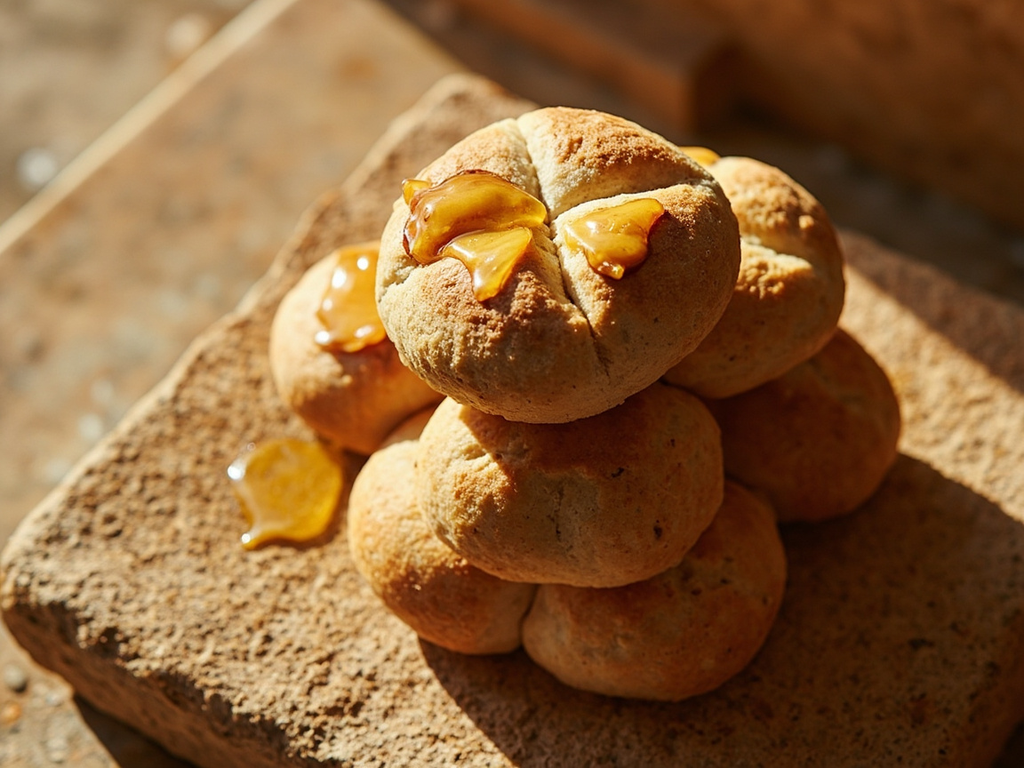
flipConical Emmer Offering Bread with Honey
Conical Emmer Offering Bread with Honey
Why this dish? The conical loaf is the basic offering deposited by the thousands on the altars of Isis's temples, at Philae as at Dendera. Frescoes show these pointed loaves piled before the goddess; placing them was to symbolically nourish the divine power of Isis.
A dense, slightly sweet small loaf, shaped into a cone like those on temple reliefs, made from emmer flour (the pharaohs' wheat), naturally leavened and perfumed with honey. The humblest and most sacred bread of Egypt.
Approach, mortal, and look upon these loaves that are set before me since the dawn of the Two Lands. The emmer grain is ground on stone until the flour is soft as river silt, kneaded with the sourdough that sleeps from one day to the next, and the dough is shaped into a peak toward the sky, where my father Ra watches. A tear of honey, and the bread becomes worthy of my altar. Place it before me with a pure heart: what you offer me, you will share afterward, for such is the justice of my house.
- •Emmer flour ground on a quern — a good measure (base)
- •Maintained natural sourdough — a little dough from the day before (leavening)
- •Honey — a few pressed combs (sacred sweetness)
- •River water — judged by hand (hydration)
- •Salt — a pinch (seasoning)
Conical Emmer Offering Bread with Honey
A dense, slightly sweet small loaf, shaped into a cone like those on temple reliefs, made from emmer flour (the pharaohs' wheat), naturally leavened and perfumed with honey. The humblest and most sacred bread of Egypt.
Why this dish? The conical loaf is the basic offering deposited by the thousands on the altars of Isis's temples, at Philae as at Dendera. Frescoes show these pointed loaves piled before the goddess; placing them was to symbolically nourish the divine power of Isis.
Approach, mortal, and look upon these loaves that are set before me since the dawn of the Two Lands. The emmer grain is ground on stone until the flour is soft as river silt, kneaded with the sourdough that sleeps from one day to the next, and the dough is shaped into a peak toward the sky, where my father Ra watches. A tear of honey, and the bread becomes worthy of my altar. Place it before me with a pure heart: what you offer me, you will share afterward, for such is the justice of my house.
Ingredients (period version)
- Emmer flour ground on a quern — a good measure (base)
- Maintained natural sourdough — a little dough from the day before (leavening)
- Honey — a few pressed combs (sacred sweetness)
- River water — judged by hand (hydration)
- Salt — a pinch (seasoning)
Ingredients
- Spelt or einkorn flour (if emmer unavailable) — 400 g (base)
- Active sourdough starter — 100 g (leavening)
- Honey — 2 tbsp (sweetness)
- Warm water — about 230 ml (hydration)
- Salt — 6 g (seasoning)
Method
- Dissolve the sourdough in warm water with the honey.
- Add the flour and salt, knead for 10 minutes until a supple dough forms.
- Let rise covered for 3 to 4 hours, until doubled.
- Divide into balls, then shape each into a cone by squeezing the base and tapering the top.
- Let rest for 1 hour, then bake at 220 °C for about 25 minutes, until golden and hollow-sounding.
How it was made : Egyptians baked emmer in preheated terracotta molds or directly on hot slabs. Leavening was achieved with a wild sourdough maintained from batch to batch, sometimes with leftover beer dough. Bread was the basic unit of the economy: workers were paid in loaves and beer jars.
The contemporary twist : Serve warm, split and drizzled with honey and a sprinkle of fleur de sel: a "temple bread" that makes an impression on a charcuterie board.
Sources : Delwen Samuel, "Bread Making and Social Interactions at the Amarna Workmen's Village" (World Archaeology, 1999) · Pierre Tallet, "La cuisine des pharaons" (Actes Sud)
Isis · Charactorium