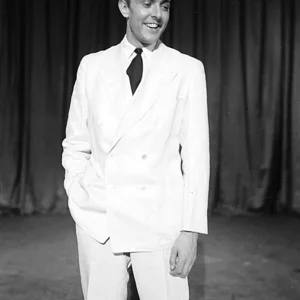

Jacques Tati (1907-1982) was a French director, actor, and screenwriter. Creator of the character Monsieur Hulot, he developed a poetic comedic cinema founded on visual slapstick and sound rather than dialogue.
Jacques Tati(1907 — 1982)
Jacques Tati
France
6 min read
Frequently asked questions
Key Facts
- 1949: directs his first feature film, Jour de fête (The Big Day)
- 1953: Les Vacances de Monsieur Hulot (Monsieur Hulot's Holiday), which establishes his famous character Mr. Hulot
- 1958: Mon oncle (My Uncle) wins the Academy Award for Best Foreign Language Film and humorously critiques modernity
- 1967: Playtime, an ambitious and costly film about the dehumanization of the modern city
- 1907-1982: a career marked by a sparse but influential body of work (six feature films)
Works & Achievements
A short film in which Tati plays a postman in a hurry; it served as the blueprint for the future Jour de fête.
Tati's first feature film: a village postman wants to modernize his round “the American way.” The film reveals his visual comedy.
The on-screen birth of Monsieur Hulot, in a seaside hotel. An almost silent film, hailed with the Prix Louis-Delluc.
A satire of the ultramodern house and its gadgets; the film won the Oscar for Best Foreign Film in 1959.
Tati's most ambitious work, shot in 70 mm on the giant set of “Tativille”; a peak of staging that remained misunderstood for a long time.
Monsieur Hulot's last great adventure, revolving around a camper van and traffic jams, extending the critique of the automobile society.
Tati's final film, shot on video, which reconnects with the spirit of the circus and music hall of his early days.
Anecdotes
Before going into cinema, Jacques Tati was a music-hall performer famous for his “sporting impressions”: with no props at all, he mimed a tennis player, a boxer or a horseman using nothing but his body. These acts, performed in the Parisian cabarets of the 1930s, are the origin of his comedy built on gesture rather than words.
His real name was Jacques Tatischeff: his paternal grandfather was a Russian aristocrat who had settled in France. The stage name “Tati” is simply a shortened form of this surname of Russian origin.
For his film Playtime (1967), Tati had an entire city built as a set near Paris, nicknamed “Tativille”: glass buildings, roads and even a fake airport. The shoot, oversized and very long, cost so much that it ruined the director, who ended up losing the rights to his own films.
His film Mon Oncle won the Oscar for Best Foreign Film in Hollywood in 1959. In it, Tati humorously contrasts the Arpels' ultramodern, gadget-filled house with the old working-class neighbourhood where Monsieur Hulot lives.
His first feature film, Jour de fête (1949), had been shot in colour thanks to an experimental French process, Thomsoncolor, which was impossible to develop at the time; the film was therefore released in black and white. It was only in 1995, through the work of his daughter Sophie Tatischeff, that the original colour version could finally be reconstructed.
The character of Monsieur Hulot is recognisable by his unique silhouette: raincoat, trousers that are too short, hat, pipe and umbrella, his body leaning forward. Tati turned him into an almost silent figure who bumps into things, hesitates and unintentionally disrupts the modern world around him.
Primary Sources
An almost dialogue-free comedy where the humor arises from sounds, gestures, and situations in a seaside hotel; the film recounts the clumsy holiday of Monsieur Hulot.
The film contrasts the Arpels' ultramodern, automated villa with Monsieur Hulot's old, warm neighborhood, satirizing consumer society and modernity.
Shot in 70 mm on a giant set of a modern city made of glass and steel, the film shows characters lost in a cold, standardized architecture, where the smallest object seems to complicate life.
In it, Tati explains that his ambition is for viewers, on leaving the theater, to look at the people around them and realize that they too are funny in everyday life.
Key Places
A town in the Yvelines department, in the Paris region, where Jacques Tati was born in 1907.
A village in the Berry region where Tati shot Jour de fête; there he set up the backdrop of the village fair and the postman François.
A seaside resort near Saint-Nazaire where Monsieur Hulot's Holiday was filmed; a statue of Hulot there still recalls the film.
A vast modern-city set built for Playtime, with glass buildings and entire streets. Its outsized cost ruined Tati.
The capital where Tati built his career in music hall and then cinema, and where he died in 1982.
Typical Objects

Always wedged in the corner of his mouth, the pipe is part of Hulot's inseparable silhouette. It heightens his dreamy, slightly off-beat air.

A light raincoat, a hat and trousers that are too short make up Monsieur Hulot's instantly recognisable costume. This minimalist getup is enough to identify the character in every film.

Held like a walking stick, Hulot's umbrella serves less to shelter him from the rain than to punctuate his clumsy gestures. It is a comic extension of his body.

In Jour de fête, the postman François wants to deliver the mail “American-style,” at top speed on his bicycle and then his machine. The contraption becomes the engine of the film's gags.

An automated kitchen, a fish-shaped fountain, an electric gate: the film's modern house piles up objects meant to make life easier but which turn against their owners.

For Playtime, Tati shot on wide 70 mm film in order to capture highly detailed wide shots in which several gags unfold at the same time. The format lets him fill the frame with a host of small actions.
School Curriculum
Vocabulary & Tags
Key Vocabulary
Daily Life
Morning
A perfectionist director, Tati often began his shooting days with long preparations: he adjusted the position of the actors, sets, and sounds down to the millimetre. Nothing was left to chance, because every gag relied on precise timing.
Afternoon
Afternoons were spent filming, sometimes for weeks, a single scene deemed too imperfect. Tati would redo a take dozens of times to achieve the exact movement or sound he had in mind.
Evening
In the evening, he would meet up with his crew to watch the footage they had shot and dream up new comic details. He thought of his cinema as the patient observation of the behaviour of ordinary people.
Food
Tati lived the life of a twentieth-century Parisian, splitting his time between meals taken on set and bistro tables. The scenes in his films, like the chaotic restaurant in *Playtime*, show that he carefully observed the table manners of his era.
Clothing
In everyday life, Tati wore the classic suit of the mid-twentieth-century man. On screen, by contrast, he donned the recognisable uniform of Hulot: a raincoat, a hat, trousers that were too short, and an umbrella.
Housing
Tati lived and worked mainly in the Paris region. Paradoxically, the man who poked fun at ultramodern houses in *Mon Oncle* had an entire artificial city of concrete and glass built for *Playtime*.
Historical Timeline
Period Vocabulary
Liens externes & ressources
Références
Œuvres
L'École des facteurs (court-métrage)
1947
Playtime
1967