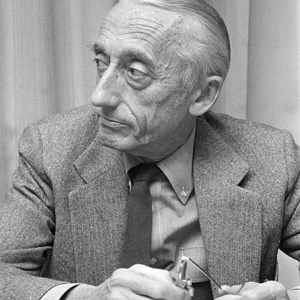

A French naval officer, oceanographer, and filmmaker, Jacques-Yves Cousteau was a pioneer of scuba diving and ocean exploration. Co-inventor of the self-contained underwater breathing apparatus, he popularized knowledge of the marine world through his films and his ship, the Calypso.
Jacques-Yves Cousteau(1910 — 1997)
Jacques-Yves Cousteau
France
6 min read
Frequently asked questions
Famous Quotes
« We must go and see for ourselves.»
Key Facts
- Born on 11 June 1910 in Saint-André-de-Cubzac (Gironde)
- Co-invented the self-contained underwater breathing apparatus (the Aqua-Lung) with Émile Gagnan in 1943
- Directed “The Silent World,” which won the Palme d'Or at Cannes in 1956 and an Academy Award in 1957
- Led his expeditions aboard the Calypso from 1950 onward
- Died on 25 June 1997 in Paris
Works & Achievements
A major co-invention with Émile Gagnan that revolutionized diving and opened the oceans to direct exploration by humans.
A best-selling account of his underwater explorations, translated into many languages.
A documentary co-directed with Louis Malle, winner of the Palme d'Or at Cannes and an Academy Award: it revealed to the world the colors of the ocean depths.
An underwater exploration craft designed to reach great depths and observe marine life.
A series of underwater habitats where divers lived for several days, testing human life beneath the sea.
A documentary about life in an underwater village, awarded an Academy Award.
A worldwide television series that made millions of viewers aware of the beauty and fragility of the oceans.
An ocean conservation organization, the activist extension of his life's work as an explorer.
Anecdotes
In 1936, the young Cousteau was set on becoming a naval aviator, but a serious car accident broke both of his arms. To rehabilitate himself, he started swimming in the Mediterranean and, by slipping on a simple pair of diving goggles, he discovered the underwater world: this accident changed the course of his entire life.
In 1943, in the midst of the Occupation, Cousteau developed the aqualung together with engineer Émile Gagnan. The brilliant idea was a “regulator” that delivered compressed air on demand, in rhythm with the diver's breathing: for the first time, a person could swim freely underwater with no hose tethering them to the surface.
His film “The Silent World” (1956), co-directed with the young Louis Malle, won the Palme d'Or at the Cannes Film Festival and then an Oscar — an extremely rare feat for a documentary. Millions of viewers discovered the colors and creatures of the ocean depths for the very first time.
Cousteau always wore a red beanie, which became his trademark. This wardrobe detail, borrowed from the headgear of divers, made him instantly recognizable on television all over the world.
In 1988, “the Commander” was elected to the Académie française. He who had spent his life exploring the silence of the oceans thus joined the guardians of the French language, a sign of the immense popularity he had gained with the general public.
Primary Sources
The sea, once it casts its spell, holds one in its net of wonder forever.
People protect what they love, but they can only love what they know.
Water and air, the two essential fluids on which all life depends, have become global garbage cans.
In it, Cousteau reflects on his calling as an explorer of the seas and the duty to pass on a living ocean to future generations.
Key Places
Small town in Gironde where Jacques-Yves Cousteau was born in 1910.
It was in the bay of Bandol, in the Mediterranean, that the first trials of the self-contained diving suit (the Aqua-Lung) took place in 1943.
Cousteau was its director from 1957 onward, making this place a leading center of marine science.
Reef where the Conshelf II experiment took place in 1963: men lived for a month beneath the sea.
City where Cousteau was admitted to the Académie française and where he died in 1997.
Typical Objects

Co-invented by Cousteau and Émile Gagnan in 1943, this device allows a diver to breathe underwater independently. It is the invention that made his entire career as an explorer of the ocean depths possible.

A key part of the diving apparatus, it delivers compressed air from the tank in time with the diver's breathing. Perfecting it was the decisive contribution of Cousteau and Gagnan.

A headpiece that became the emblem of the Commander and his crew. It made Cousteau instantly recognizable on screens all over the world.

A former minesweeper converted into a research vessel, it was the floating headquarters of Cousteau's expeditions across the oceans.

A small saucer-shaped exploration submarine, able to descend to 350 metres with two people on board. Cousteau used it to observe depths beyond the reach of divers.

Housed in a watertight casing, it allowed Cousteau to film the marine world in colour and to share his discoveries with the general public.

Worn on the feet, they give the diver the power needed to move through the water. They are part of the diving gear popularized by Cousteau.
School Curriculum
Vocabulary & Tags
Key Vocabulary
Daily Life
Morning
Aboard the Calypso, the day begins early. After sharing a coffee with the crew, the diving gear and cameras are made ready, the air tanks are checked, and the weather and currents are studied before the first dive.
Afternoon
The afternoon is devoted to exploration and filming dives, sometimes dozens of meters deep. On returning, observations are recorded, the film reels are developed or stored away, and equipment that is constantly attacked by salt is kept in good repair.
Evening
In the evening, the crew gathers for the meal and talks over the day's discoveries. Cousteau plans the expeditions to come, writes up his accounts, or works on the editing of his films.
Food
The food is that of a ship at sea: canned provisions, bread, cheese, wine, rounded out with fish and seafood caught on the spot. Port stops are a chance to stock up on fresh produce once again.
Clothing
When diving, Cousteau wears a wetsuit, mask, fins, and the aqualung strapped to his back. On deck, he sports a plain sailor's outfit and his famous red cap.
Housing
His true home was the Calypso, a laboratory ship where he lived and worked for months at a time. Cramped cabins, the engine room, and a deck cluttered with equipment made up his everyday world.
Historical Timeline
Period Vocabulary
Liens externes & ressources
Références
Œuvres
Le scaphandre autonome (Aqua-Lung)
1943
Le Monde du silence (livre)
1953
Le Monde du silence (film)
1956
Soucoupe plongeante SP-350 « Denise »
1959
Expériences Précontinent (Conshelf)
1962-1965
Le Monde sans soleil (film)
1964
L'Odyssée sous-marine de l'équipe Cousteau
1968-1976