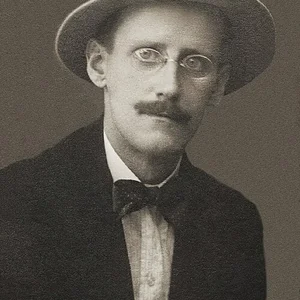

James Joyce (1882-1941) was an Irish writer, one of the major figures of literary modernism. His novel *Ulysses* (1922), which transposes Homer's *Odyssey* into a single day in Dublin, revolutionized narrative through its stream-of-consciousness technique.
James Joyce(1882 — 1941)
James Joyce
Irlande, France, Royaume-Uni
6 min read
Frequently asked questions
Key Facts
- Born on 2 February 1882 in Dublin, Ireland
- Publishes the short-story collection *Dubliners* in 1914
- Brings out the autobiographical novel *A Portrait of the Artist as a Young Man* in 1916
- Publishes *Ulysses* in 1922 in Paris, long banned for obscenity in English-speaking countries
- Dies on 13 January 1941 in Zurich, Switzerland
Works & Achievements
Joyce's first collection of poems, highly musical, revealing his singer's ear.
A collection of fifteen short stories depicting the everyday life of Dubliners; it closes with the masterpiece “The Dead.”
A partly autobiographical coming-of-age novel that follows Stephen Dedalus's awakening to his calling as an artist.
Joyce's only play, exploring the themes of love, jealousy, and freedom.
His masterpiece: a single day in Dublin (16 June 1904) that re-enacts Homer's Odyssey and revolutionizes the novel through interior monologue.
An experimental novel written over seventeen years, made of a dreamlike language blending dozens of tongues and countless puns.
Anecdotes
On 16 June 1904, Joyce went out for the first time with Nora Barnacle, who would become his lifelong partner. He chose this date as the single day on which all the action of *Ulysses* takes place. Today, every 16 June, admirers from all over the world celebrate “Bloomsday” by rereading the novel in the streets of Dublin.
Deemed obscene, *Ulysses* was banned for years in the United States and the United Kingdom. The book first appeared in Paris in 1922, published by the American bookseller **Sylvia Beach**. In 1933, an American judge finally lifted the ban, ruling that it was not a work of pornography but a genuine work of art.
Joyce suffered all his life from severe eye diseases and underwent many operations, coming close to blindness. He often wore a patch over one eye and wrote with thick coloured pencils on large sheets of paper. He sometimes put on a white jacket so that the light would reflect better onto his page.
At the age of 22, Joyce left Ireland and would almost never return, living in turn in **Trieste**, **Zurich** and **Paris**. Yet he never wrote about anything but Dublin, declaring that he wanted to give such a complete picture of it that, from his books, one could rebuild the entire city if it ever disappeared.
His final book, *Finnegans Wake*, took him seventeen years of work. In it Joyce invents thousands of words by blending dozens of different languages, creating a text so strange and difficult that it remains one of the most mysterious works in all of literature.
Primary Sources
Stately, plump Buck Mulligan came from the stairhead, bearing a bowl of lather on which a mirror and a razor lay crossed.
and then he asked me would I yes to say yes my mountain flower and first I put my arms around him yes and drew him down to me and yes I said yes I will Yes.
Welcome, O life! I go to encounter for the millionth time the reality of experience and to forge in the smithy of my soul the uncreated conscience of my race.
His soul swooned slowly as he heard the snow falling faintly through the universe and faintly falling, like the descent of their last end, upon all the living and the dead.
Key Places
Joyce's birthplace and the unique setting for all his work, from Dubliners to Ulysses. He made it the literary capital of his imagination even while living abroad.
Joyce lived here for about a decade, earning a living as an English teacher at the Berlitz school. It was here that he wrote much of his early work.
The hub of the 1920s avant-garde, Paris saw the publication of Ulysses by Sylvia Beach and of Finnegans Wake. Joyce spent nearly twenty years there.
A refuge for Joyce during both World Wars, Zurich was also the city where he died in 1941. He is buried there in Fluntern Cemetery.
This watchtower, where Joyce stayed for a few days in 1904, opens the novel Ulysses. Now the James Joyce Museum, it is today a major site for Bloomsday celebrations.
Typical Objects

Joyce, whose eyesight was constantly failing, often wore a black patch over his eye after his many operations. It became one of the most recognizable features of his portraits.

Joyce liked to walk leaning on an ashplant, an object he also lends to his hero Stephen Dedalus. It accompanied him on his long urban strolls.

Because of his poor eyesight, Joyce wrote with thick coloured crayons on large sheets of paper, in big letters. He piled up mountains of notes to build his novels.

The manuscript of *Ulysses*, covered with crossings-out and additions, bears witness to a slow and obsessive writing process. Joyce was still correcting the text on the printer's proofs, multiplying the details about Dublin.

Joyce wore strong glasses with very thick lenses to make up for his failing sight. Along with the eye patch, they are part of his highly distinctive silhouette.

An excellent singer, Joyce won a medal at an Irish singing competition in 1904 and nearly became a professional tenor. He gladly accompanied himself on the guitar or piano at evening gatherings.
School Curriculum
Vocabulary & Tags
Key Vocabulary
Tags
Daily Life
Morning
A night owl and a late riser, Joyce often began his day well past the morning hours, sometimes working in bed. Because of his fragile eyes, he wrote slowly, in large letters, on big sheets of paper propped against his knees.
Afternoon
In the afternoon, he gave English lessons (mainly in Trieste) or wandered the city at length, observing the streets, the shop signs and the passers-by. These walks fed the meticulous detail of his books.
Evening
In the evening, Joyce loved the opera, the theatre and dinners with friends, where he would happily sing in his fine tenor voice. He often stretched the night out at a café or restaurant, a glass of white wine in hand.
Food
Joyce ate little and took scant interest in food, but adored white wine, especially a Swiss vintage whose golden colour charmed him. He far preferred drinking and talking to lingering over long meals.
Clothing
Mindful of his appearance despite his frequent debts, Joyce dressed with care and wore rings. He was recognisable by his thick glasses, his eye patch and sometimes a light-coloured jacket meant to reflect light onto his page.
Housing
His life was a succession of moves across Europe: numerous lodgings in Trieste, Zurich and Paris, often modest and chosen according to his means at the time. This instability, tied to his money troubles, lasted almost his whole life.
Historical Timeline
Period Vocabulary
Liens externes & ressources
Références
Œuvres
Musique de chambre
1907
Gens de Dublin
1914
Portrait de l'artiste en jeune homme
1916
Finnegans Wake
1939