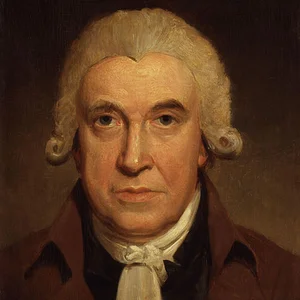

Scottish engineer and inventor (1736–1819), James Watt greatly improved Newcomen's steam engine in 1769, making it efficient and economical. His invention revolutionized industry and transportation, earning him a place as one of the fathers of the Industrial Revolution.
James Watt(1736 — 1819)
James Watt
Écosse
8 min read
Frequently asked questions
Key Facts
- 1736: born in Greenock, Scotland
- 1769: patents his improvement to the steam engine (separate condenser)
- 1775: partnership with Matthew Boulton for the manufacture and commercialization of steam engines
- 1782: invention of the double-acting rotary motion, making the engine usable for industry
- 1819: dies in Handsworth, England; the unit of power, the 'watt', is later named in his honor
Works & Achievements
A fundamental invention that radically improved the thermal efficiency of Newcomen's steam engine by keeping the cylinder hot while condensing steam in a separate vessel. This marks the birth of the modern steam engine.
A patent allowing steam to act alternately on both sides of the piston, doubling the engine's power and making it usable across all industries, not just in mines.
Watt patented a system for converting the back-and-forth motion of the piston into continuous rotary motion, making the steam engine applicable to mills, textile factories, and all machine tools.
The first automatic speed control system for a machine, and the forerunner of all modern governors. Two metal balls connected to the rotating shaft fly outward by centrifugal force to regulate the admission of steam.
A commercial invention by Watt that allowed documents to be duplicated instantly by pressing them against damp paper. Successfully sold across Britain and abroad, it was his only commercial success independent of his partnership with Boulton.
Watt established a unit of power comparable to the strength of a horse, enabling industrialists to assess the economic value of his engines. Still in use today, this unit greatly aided the widespread adoption of his inventions.
Anecdotes
Often sickly as a child, James Watt spent much of his early years at home, where he entertained himself by taking apart and reassembling scientific instruments. Legend has it that he once watched steam lifting the lid of a kettle and drew from it the inspiration for his future inventions — but this story is most likely apocryphal. What is certain is that his early mechanical curiosity was remarkable.
In 1764, Watt was given a scale model of Newcomen's steam engine, belonging to the University of Glasgow, to repair. Rather than simply fixing it, he analyzed its fundamental inefficiencies and realized that the problem lay in the cylinder's alternating cooling and heating. This insight led him to invent the separate condenser — the single most decisive improvement in the history of the steam engine.
In 1775, Watt entered into partnership with manufacturer Matthew Boulton, forming the firm Boulton & Watt. Boulton reportedly declared enthusiastically to a visitor: 'I sell here, Sir, what all the world desires to have — Power.' This partnership proved essential, as Watt was a brilliant engineer but poor at business, while Boulton excelled at bringing products to market.
It was James Watt who coined the term 'horsepower' to help industrialists understand the output of his engines by comparing it to that of the horses they replaced. He calculated that a horse could lift roughly 33,000 foot-pounds per minute. The SI unit of power, the watt, was named in his honor in 1882 — more than sixty years after his death.
Watt suffered from migraines and depression throughout his life, which he referred to as his 'nerves.' Despite these hardships, he continued to invent well into old age. In retirement, he set up a workshop in the attic of his home at Heathfield and pursued his experiments with great enthusiasm, including work on mechanical sculpture. He died at the age of 83 in 1819, universally recognized as one of the greatest minds of his era.
Primary Sources
I was walking on a Sunday afternoon on Glasgow Green… The idea came to me that, steam being an elastic body, it would rush into a vacuum, and if that vessel were kept cold, it would condense without cooling the cylinder.
My invention consists in keeping the space or cylinder in which the piston is moved always as hot as the steam that enters it, and in condensing the steam in a vessel separate from the cylinder.
I now have a method of making the engine turn with a continuous rotary motion, which will render it fit for all manner of purposes in mills and manufactures.
The sciences and the mechanical arts are so intimately connected that it is impossible to advance one without the other. Every improvement in machinery is the result of careful observation of natural principles.
Key Places
A port town in Scotland where James Watt was born in 1736. The son of a merchant and craftsman, he received an early technical education in his family's workshop.
It was here that Watt worked as an instrument maker and met scholars such as Joseph Black. He repaired the model of Newcomen's engine here — an encounter that would transform his life.
A large manufactory founded by Matthew Boulton in Birmingham, where the firm of Boulton & Watt produced and marketed steam engines from 1775. It was the most advanced industrial centre in Europe.
A country house acquired by Watt in 1790, where he spent his retirement. His private workshop in the attic, preserved intact after his death, is today on display at the Science Museum in London.
The tin and copper mines of Cornwall were among the first to widely adopt Boulton & Watt engines for pumping water. They formed the primary market and proving ground for Watt's inventions.
Typical Objects

Watt's major invention, this engine separates the steam condensation phase from the main cylinder, dramatically reducing coal consumption. It became the driving force of the Industrial Revolution in mines, textile mills, and foundries.

An ingenious device patented by Watt in 1784 that maintains a constant rotational speed in the engine. It is one of the earliest automatic control systems in the history of technology.

Watt began his career as a maker and repairer of scientific instruments at the University of Glasgow. These precision tools embody his rigorously scientific approach to engineering.

The central components of the steam engine, whose fit Watt greatly improved to prevent steam leaks. The precision of their manufacture was essential to the efficiency of his machines.

In 1780, Watt invented a machine capable of instantly reproducing handwritten documents by pressing them onto dampened paper. Successfully commercialized, this device was used in offices for nearly a century.

Watt was a meticulous technical draughtsman who recorded each of his inventions in notebooks filled with detailed diagrams. These instruments are a symbol of the intellectual work of the Enlightenment engineer.
School Curriculum
Vocabulary & Tags
Key Vocabulary
Daily Life
Morning
Watt rises early, often plagued by chronic migraines. He begins his day with a tour of his workshop, where sketchbooks and measuring instruments cover every surface. He spends the first hours recording his overnight observations and correcting his technical drawings.
Afternoon
The afternoon is devoted to experiments and visits to the Soho Manufactory workshop, where he oversees the production of machines. He corresponds extensively with scientists, industrialists, and business associates, replying to dozens of letters about technical problems encountered by customers.
Evening
Watt regularly attends meetings of the Lunar Society of Birmingham, a circle of scientists and industrialists who gathered on nights of the full moon. These exchanges with Erasmus Darwin, Joseph Priestley, and Josiah Wedgwood enrich his scientific and technical thinking.
Food
Like the British middle class of his era, Watt eats roasted meats, puddings, boiled vegetables, and strong ale. His frequent migraines encourage him to drink alcohol in moderation. Tea, the emblematic beverage of Georgian England, accompanies his long working sessions.
Clothing
Watt wears the typical dress of the English industrial gentleman: a dark woolen frock coat, embroidered waistcoat, knee breeches, and silk stockings for formal occasions, and plainer attire in the workshop. The powdered wig characteristic of the 18th century was still worn in his youth, gradually abandoned as 1800 approached.
Housing
Watt first lives in modest lodgings in Glasgow, then in a comfortable middle-class house in Birmingham reflecting his commercial success. From 1790, he settles at Heathfield Hall, an elegant country house with grounds, a symbol of his rise in society. His personal attic workshop, cluttered with tools and mechanical models, is his favourite retreat.
Historical Timeline
Period Vocabulary
Visual Style
Style portrait anglais des Lumières industrielles : huile sur toile dans les tons ambrés et bruns, éclairage dramatique à la manière de Joseph Wright of Derby, atelier encombré d'instruments de précision et de plans mécaniques.
Sound Ambience
Ambiance sonore d'une manufacture industrielle britannique du XVIIIe siècle : halètement des machines à vapeur, marteaux des forges, sifflement de la vapeur sous pression et brouhaha des ouvriers au travail.
Liens externes & ressources
Références
Œuvres
Brevet du condenseur séparé (brevet n°913)
1769
Machine à vapeur à double effet
1782
Mécanisme bielle-manivelle et mouvement rotatif
1781
Régulateur centrifuge à boules
1784
Machine à copier les lettres (Copying Machine)
1780
Définition du 'cheval-vapeur' (horsepower)
vers 1782