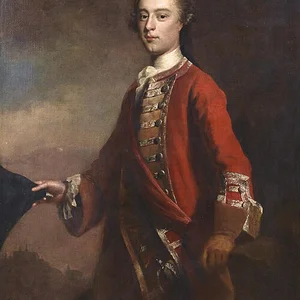

British general (1727–1759), James Wolfe is renowned for his decisive victory over the French at the Battle of the Plains of Abraham in Quebec in 1759. He died in combat on the very day of his victory, becoming a British national hero.
James Wolfe(1727 — 1759)
James Wolfe
royaume de Grande-Bretagne
9 min read
Frequently asked questions
Key Facts
- 1727: Born in Westerham, England
- 1759: Commands the siege of Quebec during the Seven Years' War
- September 13, 1759: Decisive British victory at the Battle of the Plains of Abraham
- September 13, 1759: Dies in combat during that same battle
- His victory leads to the fall of Quebec and marks the beginning of the end of New France
Works & Achievements
Wolfe commanded one of the assault columns during the siege of Louisbourg, France's main Atlantic naval stronghold. His bravery and effectiveness caught the attention of William Pitt and opened the door to his command of the Quebec expedition.
A tactical masterpiece: after three months of fruitless siege, Wolfe led his troops in a night ascent of a cliff considered unscalable, caught Montcalm off guard, and won in under an hour the battle that decided the fate of French North America.
Wolfe drew up detailed instructions on discipline, combat formations, and musketry training, reflecting his drive to modernize British infantry methods well before the Canadian campaign.
Wolfe's letters to his parents, his superiors (notably Pitt), and his friends are a primary historical source on British campaigns of the mid-eighteenth century and on the psychology of a commander driven by an overwhelming sense of duty.
Anecdotes
The night before the Battle of the Plains of Abraham, Wolfe crossed the St. Lawrence River by rowboat with his officers to reach the cliffs below Quebec. According to several contemporary witnesses, he quietly recited verses from Thomas Gray's Elegy Written in a Country Churchyard (1751) and reportedly declared that he would rather have been the author of those lines than take Quebec the following day. This anecdote reveals an uncommon artistic sensibility in a career soldier.
James Wolfe suffered from tuberculosis and serious health problems throughout his life. In a letter to his mother written in the summer of 1759, he wrote that he expected to die soon and that his health prevented him from fully carrying out his duties. Despite these frailties, William Pitt the Elder entrusted him with command of the expedition against Quebec at only 32, convinced of his exceptional tactical talent.
At the Battle of Culloden in April 1746, the Duke of Cumberland reportedly ordered Wolfe to shoot a wounded Scottish Jacobite soldier lying on the ground. According to several contemporary accounts, Wolfe refused, declaring that he would sooner resign his commission than execute a defenceless man. This episode, debated by historians but widely reported, helped forge his reputation as an officer who was both resolute and principled.
On 13 September 1759, Wolfe was struck by three bullets during the battle: in the wrist, the groin, and the chest. Mortally wounded, he still had the strength to hear an aide-de-camp announce the French rout. He is said to have given his final orders to cut off the enemy's retreat before dying on the battlefield. His body was repatriated to England and interred at Greenwich with full military honours.
King George II, upon learning of Wolfe's appointment to command the Quebec expedition, is said to have exclaimed: “Mad, is he? Then I hope he will bite some of my other generals!” This quip, reported by several contemporaries, reflects the initial scepticism surrounding the career of such a young and physically frail officer — and stands in stark contrast to the decisive victory that would transform the fate of North America.
Primary Sources
The army's situation is most precarious: the sick multiply, provisions are running low, and the enemy's position, entrenched behind natural ramparts and formidable defences, makes any direct assault extremely hazardous. I humbly submit to your judgement the state of our campaign.
My health is so poor that I greatly doubt I can fulfil my duties as well as I ought. Nevertheless, I shall do my best to serve the king and my country, even if it should cost me my life.
His Majesty's troops have, after a brief engagement on the heights above Quebec, defeated the French forces commanded by the Marquis de Montcalm. Quebec capitulated on 18 September. General Wolfe fell on the field of honour on the very day of victory.
We scaled the cliff in perfect silence, the French sentries having been surprised before they could raise the alarm. At daybreak, our army had formed in line of battle on the Plains of Abraham, within cannon range of the walls of Quebec.
Key Places
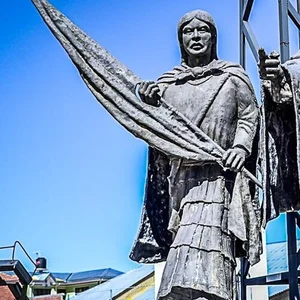
Birthplace of James Wolfe, where he was born on 2 January 1727. A bronze statue depicting him in military uniform stands in the village square, facing one of Winston Churchill.
A plateau west of the walls of Québec City where the decisive battle of 13 September 1759 took place: in less than an hour of fighting, Wolfe defeated Montcalm here — and lost his life. The site is now a Canadian national historic park.
A powerful French fortress captured by the British in 1758 during a campaign in which Wolfe distinguished himself. This victory led Pitt to choose him to command the expedition against Québec.
A narrow path at the foot of a steep cliff below the walls of Québec City, where Wolfe secretly landed his troops during the night of 12–13 September 1759, completely catching the French garrison off guard.
The burial place of James Wolfe, where his remains were interred after being brought back from America. The church houses a commemorative plaque in his honour.
Typical Objects

Wolfe wore the regulation uniform of British officers — a scarlet coat with lapels, gold epaulettes, white waistcoat and breeches. It was in this striking uniform that he was struck by three bullets during the Battle of the Plains of Abraham.

The standard weapon of British infantry, the Brown Bess fired a lead ball with a short effective range. Wolfe relied on the discipline of his soldiers' coordinated volleys to maximize firepower against the French troops.

An indispensable tool for any 18th-century commander, the spyglass allowed Wolfe to observe the French defenses from the banks of the St. Lawrence and to identify the weak point in the cliff that would become L'Anse-au-Foulon.

Wolfe relied on detailed cartographic surveys of the river and its surroundings to plan the night ascent to L'Anse-au-Foulon; these maps, drawn up by British military engineers, were essential to the success of the operation.

A mark of an officer's rank in the 18th century, Wolfe's sword was worn at all times on duty. According to family tradition, it was kept as a relic after his death and passed down to his relatives.

Though painted after his death, this monumental work by the American painter Benjamin West became the defining image of Wolfe dying on the battlefield. Reproduced as an engraving in thousands of copies, it lastingly built the myth of the hero sacrificed for the Empire.
School Curriculum
Vocabulary & Tags
Key Vocabulary
Tags
Daily Life
Morning
On campaign, Wolfe rose before dawn to inspect the guard posts and check on his troops. Despite his fragile health — tuberculosis, chronic rheumatism — he made a point of being among the first up, spending his mornings reading his officers' reports and studying maps and plans of the enemy terrain.
Afternoon
Campaign afternoons were devoted to intensive drilling and troop discipline, two demands on which Wolfe was unyielding. He personally supervised target-shooting exercises and line maneuvers, convinced that the precision of musket volleys was the decisive advantage of British infantry over its adversaries.
Evening
In the evenings, Wolfe gathered his senior officers to plan the next day's operations with a clarity and precision remarked upon by all. In his rare moments of leisure, he read poetry — particularly Thomas Gray — and kept up a regular and affectionate correspondence with his mother and friends back in England.
Food
British officers on campaign enjoyed a diet markedly superior to that of common soldiers: fresh or salted meat, ship's biscuit, seasonal vegetables, and modest quantities of wine and beer. Wolfe's illness, however, forced him to exercise some caution; his letters frequently mention digestive troubles, persistent fatigue, and the medicines he was taking.
Clothing
On duty, Wolfe wore the regulation red coat of a British infantry officer: a scarlet jacket with facings, white breeches and stockings, and a powdered wig or hair tied back in a queue. In the Canadian field, climate and forest conditions led some officers to adapt their dress (high boots, campaign coat), but Wolfe insisted on the official uniform as a mark of authority.
Housing
In English garrisons, Wolfe was billeted in town houses or with local notables, following the customs of the time. On campaign in Canada, he occupied a spacious command tent or requisitioned a Canadian house as his headquarters. During the siege of Quebec in the summer of 1759, his staff was established on the south bank of the St. Lawrence, facing the fortified city he sought to reduce.
Historical Timeline
Period Vocabulary
Liens externes & ressources
Références
Œuvres
Participation décisive à la prise de Louisbourg
1758
Campagne de Québec et bataille des Plaines d'Abraham
1759
Instructions tactiques aux officiers de son régiment
1755
Correspondance militaire et personnelle (1741-1759)
1741-1759