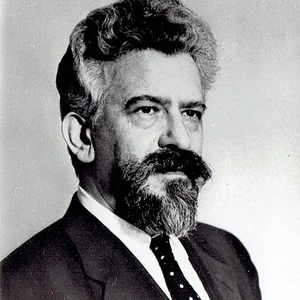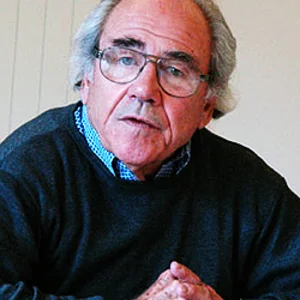

Jean Baudrillard (1929-2007) was a French philosopher and sociologist, a major figure of postmodern thought. He is famous for his analyses of consumer society, the media, and the virtual, developing the concepts of the simulacrum and hyperreality.
Jean Baudrillard(1929 — 2007)
Jean Baudrillard
France
6 min read
Frequently asked questions
Famous Quotes
« The simulacrum is never that which conceals the truth—it is the truth which conceals that there is none.»
« The Gulf War did not take place.»
Key Facts
- Born on July 27, 1929, in Reims and died on March 6, 2007, in Paris.
- Published 'The System of Objects' in 1968, a semiological analysis of consumption.
- Published 'The Consumer Society' in 1970, a major critique of consumerism.
- Developed the theory of the simulacrum and hyperreality in 'Simulacra and Simulation' (1981).
- Sparked controversy with 'The Gulf War Did Not Take Place' (1991) on the role of the media.
Works & Achievements
Baudrillard's first major work, which analyzes consumer objects as signs that carry social meaning.
A major essay describing how material abundance and advertising transform social relationships and desires.
A central theoretical work in which Baudrillard develops his radical critique of value and the sign.
Baudrillard's most famous book, which introduces the concepts of the simulacrum and hyperreality; it inspired the film “The Matrix.”
A philosophical travelogue in which Baudrillard sees the United States as the laboratory of modernity and hyperreality.
A collection of provocative articles on the role of the media in the spectacular perception of war.
An analysis of the September 11, 2001 attacks as a symbolic event of the globalized era.
Anecdotes
In 1991, while the Gulf War was raging on television, Baudrillard published a series of provocative articles titled “The Gulf War Did Not Take Place.” He was not denying the deaths or the fighting, but wanted to show that for Western viewers this conflict had above all become a media spectacle filtered through screens, almost a video game, rather than a lived reality.
Baudrillard began his career as a German teacher in French high schools and as a translator of German authors such as Bertolt Brecht and Karl Marx. It was only later, in the 1960s, that he turned to sociology and philosophy.
A passionate photographer, Baudrillard travelled across the American deserts, which he describes in his book “America” (1986). For him, cities like Las Vegas or Disneyland were the best examples of “hyperreality”: settings so perfect that they seem more real than reality itself.
Baudrillard's concept of the “simulacrum” inspired the directors of the film “The Matrix” (1999). In one scene, you can even glimpse his book “Simulacra and Simulation” being used as a hiding place, and the Wachowski siblings cited him as a major influence — even though Baudrillard himself felt the film had misunderstood his ideas.
In his very first major book, “The System of Objects” (1968), Baudrillard analyzes the furniture, cars and gadgets of the modern home. He shows that we do not buy objects only for their usefulness, but above all for what they say about us, as signs of social status.
Primary Sources
All around us today there exists a kind of fantastic conspicuousness of consumption and abundance, made up of the proliferation of objects, services, and material goods.
The simulacrum is never that which conceals the truth — it is the truth which conceals that there is none. The simulacrum is true.
We are all hostages of media intoxication, convinced without knowing it that the war took place, when all we have seen of it is the image.
California is everywhere, in the idea that the future is a ready-made dimension, already here, within sight.
Key Places
City in the Champagne region where Jean Baudrillard was born in 1929, into a family of modest civil servants with peasant roots.
University where Baudrillard taught sociology from 1966 onward and which was one of the hotbeds of the May 1968 protests.
French capital where Baudrillard lived, wrote most of his work, and where he died in 2007.
Region that Baudrillard traveled through and photographed, the inspiration for his book “America” and his reflection on hyperreality.
Typical Objects

For Baudrillard, the television screen is the central object of modern society, turning the world's events into images and spectacle. It embodies the reign of the mass media.

Baudrillard was a passionate amateur photographer, especially during his travels through the American deserts. The camera allowed him to capture the silence and strangeness of the landscapes.

In *The System of Objects*, Baudrillard analyzes the car as an object of prestige as much as of transport. It is a sign of social status and a symbol of mass consumption.

A working tool of the twentieth-century intellectual and writer, on which Baudrillard composed his essays before the age of the computer.

A symbol of the consumer society analyzed by Baudrillard, the advertising poster sells signs and desires more than products. It shapes the modern urban space.

An emblematic object of modern consumption, allowing purchases without handling cash. For Baudrillard, it illustrates the dematerialization of exchanges and the abstraction of value.
School Curriculum
Vocabulary & Tags
Key Vocabulary
Daily Life
Morning
An academic and writer, Baudrillard often devoted his mornings to reading and writing his essays, in the quiet of his Parisian apartment. Coffee and the day's newspaper accompanied his reflections on current events and the media.
Afternoon
His afternoons might be paced by his lectures and seminars at the University of Nanterre, where he taught sociology. He also discussed the great transformations of modern society with colleagues and students.
Evening
In the evening, Baudrillard happily frequented Parisian intellectual and artistic circles. A lover of discussion, he also enjoyed observing the flow of televised images, the raw material of his analyses.
Food
Like many Parisians of his time, he enjoyed bistro cuisine and meals shared among intellectuals at restaurants or cafés. His diet was that of a well-off French city dweller of the late twentieth century.
Clothing
Baudrillard wore the understated, casual attire of the French intellectual: a jacket, a shirt, and sometimes glasses, with no striving for ostentatious elegance. His style remained simple and urban.
Housing
He lived in an apartment in Paris, surrounded by books, objects, and his own photographs. His living environment reflected the modern urban setting he analyzed in his works.
Historical Timeline
Period Vocabulary
Liens externes & ressources
Références
Œuvres
Le Système des objets
1968
La Société de consommation
1970
L'Échange symbolique et la mort
1976
Amérique
1986
La Guerre du Golfe n'a pas eu lieu
1991
L'Esprit du terrorisme
2002