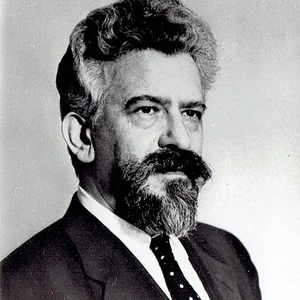

Bernard Stiegler (1952-2020) was a French philosopher and a major figure in the philosophy of technology. He analyzed how digital techniques and technologies shape the human mind, memory, and contemporary societies.
Bernard Stiegler(1952 — 2020)
Bernard Stiegler
France
6 min read
Frequently asked questions
Key Facts
- Born in 1952 in Villebon-sur-Yvette and died in 2020.
- Published his major trilogy *Technics and Time* starting in 1994.
- Founded the philosophical and political think tank Ars Industrialis in 2005.
- Directed the Institute for Research and Innovation (IRI) at the Centre Pompidou from 2006.
- A student of the philosopher **Jacques Derrida**, whose reflections on technology and memory he extended.
Works & Achievements
Stiegler's major work, which rethinks the relationship between humans and technology. In it he argues that humankind constitutes itself through the tools it makes.
An essay denouncing the power that television and the media hold over citizens' attention. He analyzes the threats this poses to democratic life.
A reflection on the education and attention of young people in the face of screens. In it Stiegler proposes an “ecology of the mind.”
An international association advocating an industrial policy for the technologies of the mind. It puts Stiegler's thought concretely into practice.
A place for passing on philosophy, open to all and outside the university framework. It illustrates Stiegler's desire to share thought widely.
An essay on technological acceleration that outpaces societies' capacity to reflect on it. It has become a key reference for thinking about the contemporary digital world.
Anecdotes
Before becoming a philosopher, Bernard Stiegler had a most unusual life: convicted of armed bank robberies, he spent five years in prison from 1978 to 1983. It was behind bars that he began to read intensively and study philosophy, turning that confinement into a genuine intellectual rebirth.
In prison, he started a correspondence and a body of reflective work that would catch the attention of the philosopher Gérard Granel, and then of Jacques Derrida, who became his thesis advisor. Stiegler liked to say that it was the experience of being cut off from the outside world that made him understand how deeply our thinking depends on objects, books, and techniques.
Stiegler directed major French cultural institutions, including IRCAM (a center for musical research) and the cultural development department of the Centre Pompidou. In doing so, he showed that a philosopher could also act concretely on the culture and technologies of his time.
In 2005, he founded the association Ars Industrialis and, in 2010, the School of Philosophy of Épineuil-le-Fleuriel, in a village in the Cher region. He wanted to create places where people from all walks of life could think together about the challenges of the digital age, far from university lecture halls alone.
Stiegler drew on the Greek myth of Prometheus and his brother Epimetheus to explain his philosophy: humans, forgotten when qualities were handed out to the animals, must make up for this lack through technology. For him, we are beings defined “by default,” shaped by the very tools we make.
Primary Sources
What is proper to humankind is to have nothing of its own: it is constituted by technics, which within it is a prosthesis, a supplement to an original lack.
The capture of attention by the program industries destroys the time of consciousness and threatens the life of the mind.
A society that no longer takes care of the attention of its youth is a society sawing off the very branch it sits on.
Disruption moves faster than societies, which no longer have the time to think about what is happening to them: it short-circuits reason.
Key Places
Commune in the Essonne department where Bernard Stiegler was born in 1952.
Institution where Stiegler taught and directed a research institute on innovation and technology.
Major Parisian cultural institution where Stiegler directed the cultural development department and the IRI (Institute for Research and Innovation).
Village in the Cher department where Stiegler founded his School of Philosophy in 2010, open to a broad audience.
Research center for music and sound, which Stiegler directed, demonstrating his concrete commitment to cultural technologies.
Typical Objects

A central tool in Stiegler's self-taught education while in prison, the book is for him a medium of memory and thought. It embodies what he calls the “technologies of the spirit.”

A symbol of the digital revolution that Stiegler analyzes throughout his work. He sees in it both a tool of emancipation and an instrument for capturing attention.

An emblematic object of the digital “disruption” criticized by Stiegler. It represents the attention-capturing industry that transforms our everyday behaviors.

Writing instruments that Stiegler considered prostheses of memory, extending the human mind. For him, writing is the very model of the technique that shapes thought.

Stiegler evoked the earliest writing media as the origin of the “exteriorization” of human memory. This object symbolizes his thesis that human beings have constituted themselves through technique from the very beginning.
School Curriculum
Vocabulary & Tags
Key Vocabulary
Daily Life
Morning
In the morning, Stiegler often wrote very early, taking advantage of the quiet to compose his dense and demanding books. He saw writing as a daily, disciplined task, almost like a craftsman at his workbench.
Afternoon
The afternoon was devoted to teaching, research meetings, and the running of cultural institutions such as the Centre Pompidou. He enjoyed debating digital technologies with students, researchers, and engineers.
Evening
In the evening, he sometimes led seminars or public lectures, notably at his School of Philosophy. He also kept up his reading, convinced that thinking requires time and attention.
Food
Like a French academic of his time, Stiegler shared convivial meals where intellectual discussion accompanied the table. He cherished these moments of exchange as a form of collective life of the mind.
Clothing
Stiegler wore plain, casual outfits, jackets and shirts, in the manner of a contemporary intellectual. He paid no attention to appearance, preferring to focus on ideas.
Housing
He lived in France, dividing his time between Paris, where his institutions were based, and the countryside of the Cher region around Épineuil-le-Fleuriel. This rural village was home to his school of philosophy.
Historical Timeline
Period Vocabulary
Liens externes & ressources
Références
Œuvres
La technique et le temps (3 tomes)
1994-2001
La télécratie contre la démocratie
2006
Prendre soin, de la jeunesse et des générations
2008
Fondation d'Ars Industrialis
2005
Fondation de l'École de philosophie d'Épineuil-le-Fleuriel
2010
Dans la disruption : comment ne pas devenir fou ?
2016