 flip
flipCapon and Fine Herb Potage
Capon and Fine Herb Potage
Why this dish? La Bruyère, "a sober man little given to excess," ate at regular hours and more simply than the great lords he observed. Amid the feasts of Chantilly, a good clear potage poured over stale bread was exactly the kind of measured dish that suited this discreet moralist.
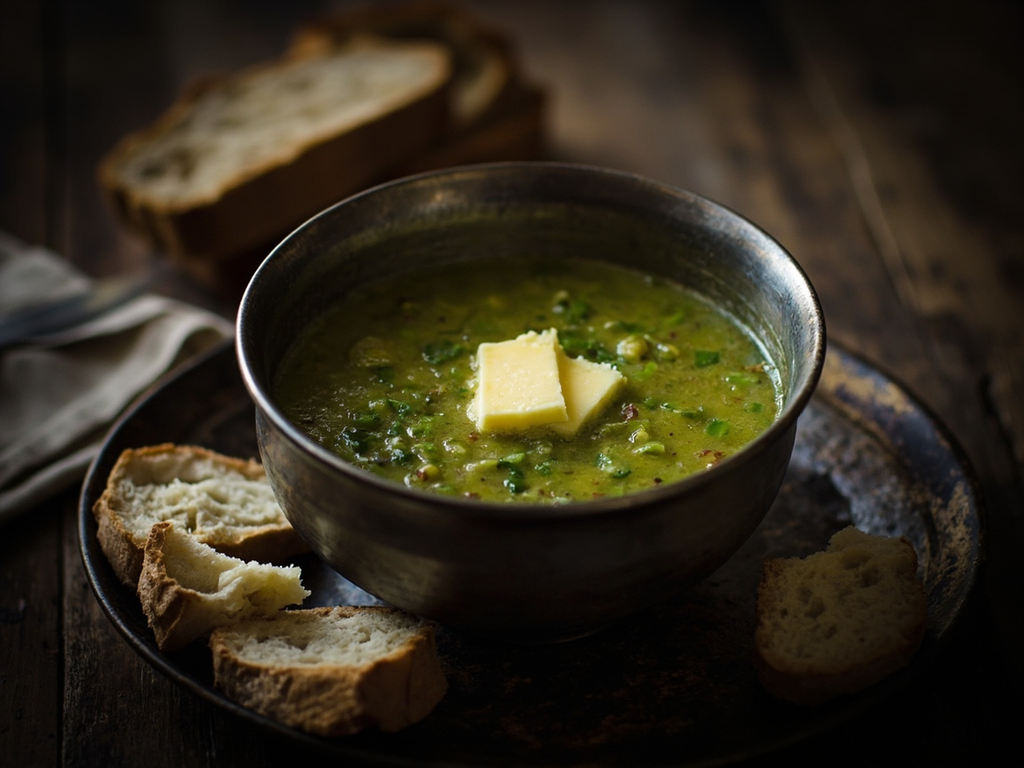
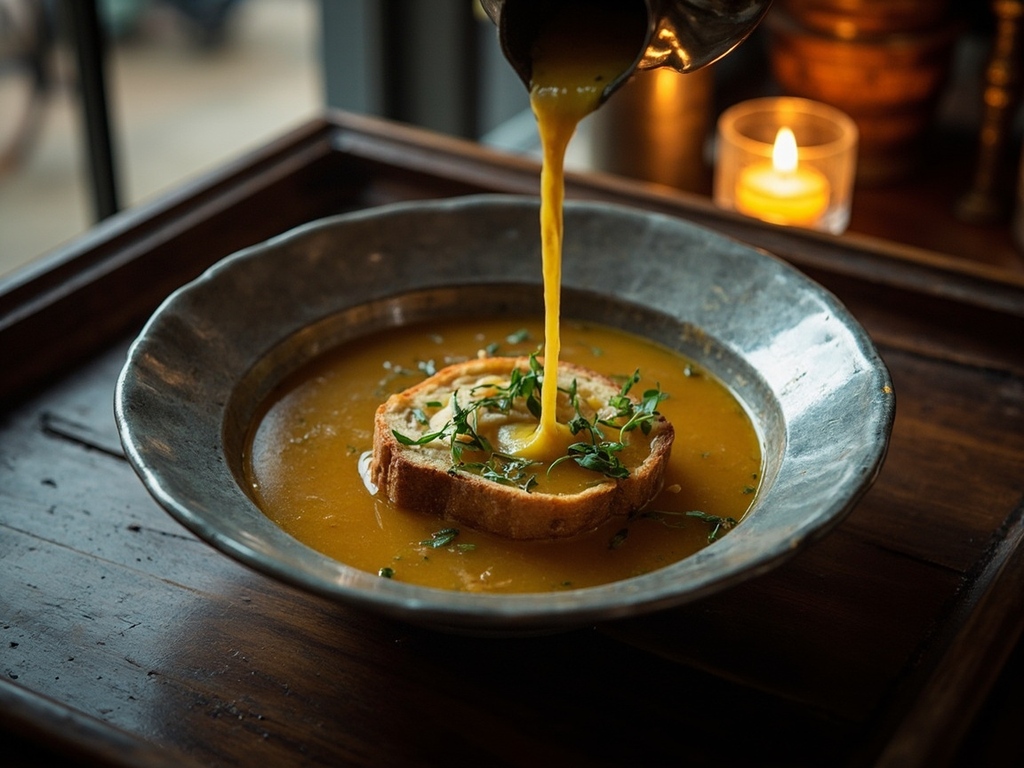
A golden capon broth perfumed with fresh herbs, poured over slices of bread. It is the foundation of any classic meal: nourishing, sober, and comforting.
Behold the princes' table: twenty dishes crowd upon it, yet the wise man desires but one. For myself, I hold this clear potage to be the most honest of meats. One lets a capon simmer gently with a few roots, tosses in a handful of chervil, and pours the whole over sops of stale bread. Drink it hot, with my wine cut with water beside me: he who eats thus at regular hours fares better than he who ruins his health with entremets.
- •Capon (or fat hen) — one, with its giblets (meat and broth base)
- •Root vegetables (turnip, parsnip, onion studded with clove) — a handful (broth flavoring)
- •Chervil and parsley — a bunch (fresh herbs)
- •Stale bread — several slices (support, thickens the potage)
- •Fresh butter — a knob (richness)
- •Salt, pepper — to taste (seasoning)
Capon and Fine Herb Potage
A golden capon broth perfumed with fresh herbs, poured over slices of bread. It is the foundation of any classic meal: nourishing, sober, and comforting.
Why this dish? La Bruyère, "a sober man little given to excess," ate at regular hours and more simply than the great lords he observed. Amid the feasts of Chantilly, a good clear potage poured over stale bread was exactly the kind of measured dish that suited this discreet moralist.
Behold the princes' table: twenty dishes crowd upon it, yet the wise man desires but one. For myself, I hold this clear potage to be the most honest of meats. One lets a capon simmer gently with a few roots, tosses in a handful of chervil, and pours the whole over sops of stale bread. Drink it hot, with my wine cut with water beside me: he who eats thus at regular hours fares better than he who ruins his health with entremets.
Ingredients (period version)
- Capon (or fat hen) — one, with its giblets (meat and broth base)
- Root vegetables (turnip, parsnip, onion studded with clove) — a handful (broth flavoring)
- Chervil and parsley — a bunch (fresh herbs)
- Stale bread — several slices (support, thickens the potage)
- Fresh butter — a knob (richness)
- Salt, pepper — to taste (seasoning)
Ingredients
- Free-range chicken thighs and carcass — 800 g (broth base)
- Leek, turnip, onion — 1 each (broth vegetables)
- Clove — 1, stuck into the onion (flavor)
- Fresh chervil (or parsley) — 1 small bunch (herbal finish)
- Rustic stale bread — 4 slices (to line the bottom of bowls)
- Butter — 20 g (richness)
- Salt, pepper — to taste (seasoning)
Method
- Place the poultry in a large pot, cover with cold water, bring to a simmer, and skim carefully.
- Add leek, turnip, and onion studded with the clove. Simmer gently for 1 hour 30 minutes, without boiling hard (otherwise the broth will become cloudy).
- Strain the broth, adjust salt and pepper, and finish with a knob of butter.
- Place a slice of stale bread in the bottom of each deep bowl.
- Pour the boiling broth over the bread, sprinkle with chopped chervil. Serve immediately with a few shreds of poultry meat.
How it was made : In the 17th century, potage was the pillar of the meal: one said "to put the potage on the table" to announce that it was time to sit down. The bread placed at the bottom of the dish was not a whim but the very origin of the word "soupe" (the "soupe" referred to the soaked bread slice). Broths were clarified with great care, a sign of refinement in La Varenne's cooking.
The contemporary twist : Serve it in a cup as an aperitif, "signature broth" style: a clear chicken consommé with chervil, elegant and light, before a winter dinner.
Sources : La Varenne, Le Cuisinier françois, 1651
Jean de La Bruyère · Charactorium