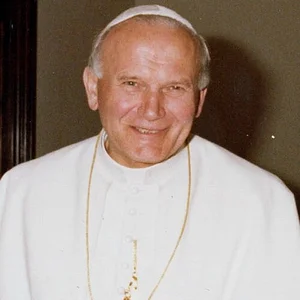

Polish pope from 1978 to 2005, the first non-Italian pope in more than four centuries. A major figure of the 20th century, he played a role in the fall of communism in Eastern Europe and left his mark on the Catholic Church through his very numerous travels.
John Paul II(1920 — 2005)
John Paul II
Pologne
6 min read
Frequently asked questions
Famous Quotes
« Be not afraid!»
Key Facts
- Elected pope on 16 October 1978, the first Polish pope and the first non-Italian pope since 1523
- Supported the Solidarność trade union in Poland, contributing to the weakening of the communist bloc in the 1980s
- Survived an assassination attempt in St. Peter's Square on 13 May 1981
- Undertook a great many apostolic journeys around the world during his pontificate (1978-2005)
- Died on 2 April 2005; canonized on 27 April 2014
Works & Achievements
The first encyclical of his pontificate, placing the dignity of man and Christ at the heart of his thought.
A series of catecheses on human love and the body, which became a major reference point in modern Catholic thought.
Large international gatherings of young Catholics that have since brought together millions of participants.
A social encyclical analyzing the fall of communism and the limits of unregulated capitalism.
The reference exposition of Catholic doctrine, whose first modern edition he promulgated.
A book of interviews in which he answers major questions about faith, sold in millions of copies.
An exceptional holy year marked by requests for forgiveness for the Church's past faults and a journey to the Holy Land.
More than 100 journeys to 129 countries made him the most-traveled pope in history.
Anecdotes
On 13 May 1981, in St. Peter's Square, John Paul II was gravely wounded by several bullets fired by the Turkish gunman Mehmet Ali Ağca. He survived after several hours of surgery, then visited his attacker in prison in 1983 to forgive him publicly.
Before becoming a priest, the young Karol Wojtyła was passionate about the theater: he acted in plays and wrote them himself. Under the Nazi occupation, he took part in an underground theater where texts were recited in secret to defend forbidden Polish culture.
Elected pope in 1978, he became the first non-Italian pope since the Dutchman Adrian VI, who died in 1523 — more than four and a half centuries earlier. A Pole, he caught everyone off guard on the evening of his election.
Nicknamed “the athletic pope,” he loved skiing, mountain hiking, and kayaking. He is said to have had a swimming pool installed at the Castel Gandolfo residence, joking that it cost less than a new conclave should the pope fall ill.
During the Second World War, to escape deportation, he worked in a stone quarry and then in a chemical factory, all while secretly studying theology at an underground seminary organized by the Archbishop of Kraków.
Primary Sources
Do not be afraid! Open, open wide the doors to Christ! To his saving power open the boundaries of States.
The Redeemer of man, Jesus Christ, is the centre of the universe and of history.
Let your Spirit descend! And renew the face of the earth. The face of this land!
The collapse of communism in several countries reveals the inefficiency of a system that claimed to organize the whole of society while denying the dignity and freedom of the person.
“Be not afraid!” is an exhortation addressed to all people that they may overcome fear in the present situation of the world.
Key Places
Birthplace of Karol Wojtyła, near Kraków. His childhood home is now a museum.
City where he studied, was ordained a priest, and later became archbishop. It was here that he forged his commitment in the face of the communist regime.
Seat of the Catholic Church where he carried out his pontificate for nearly twenty-seven years and where he died in 2005.
Site of the assassination attempt on 13 May 1981 and of the great gatherings of the faithful that he presided over there.
The popes' summer residence in the hills south of Rome, where John Paul II came to rest and work.
A major Marian pilgrimage site in Poland, home to the Black Madonna, which he visited on several occasions and which shaped his spirituality.
Liens externes & ressources
Références
Œuvres
Redemptor Hominis
1979
Théologie du corps (catéchèses)
1979-1984
Création des Journées Mondiales de la Jeunesse
1985
Centesimus Annus
1991
Catéchisme de l'Église catholique
1992
Franchir le seuil de l'espérance
1994
Grand Jubilé de l'an 2000
2000