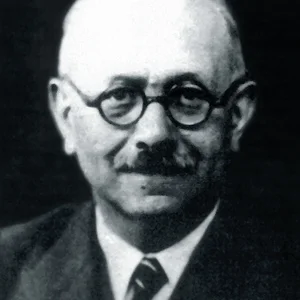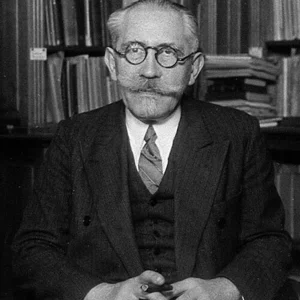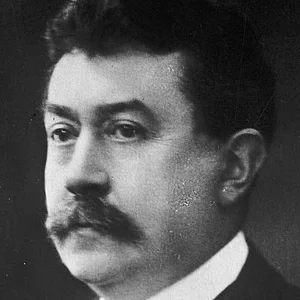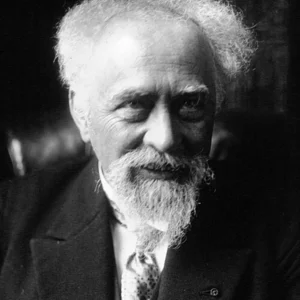

French physicist (1870–1942), he experimentally demonstrated the existence of atoms through the study of Brownian motion. Winner of the 1926 Nobel Prize in Physics, he founded the CNRS in 1939.
Jean Perrin(1870 — 1942)
Jean Perrin
France
8 min read
Frequently asked questions
Famous Quotes
« Science is a collective endeavor that requires organization.»
« To see the invisible — that is the goal of science.»
Key Facts
- 1895: doctoral thesis on cathode rays, measurement of the electron's charge
- 1908: experiments on Brownian motion confirming Einstein's atomic theory
- 1913: publication of *Atoms*, the landmark work on the reality of atoms
- 1926: Nobel Prize in Physics for his work on the discontinuous structure of matter
- 1939: co-founder of the CNRS (Centre national de la recherche scientifique)
Works & Achievements
By precisely measuring the displacements of microscopic particles in suspension, Perrin confirmed Einstein's theory and measured Avogadro's number, definitively proving the physical reality of atoms.
A synthesis and popular science work explaining atomic theory and the experimental evidence for the existence of atoms. Translated into several languages, it had a considerable influence on the international scientific community.
Award granted by the Royal Swedish Academy of Sciences for his work on the discontinuous structure of matter and the discovery of sedimentation equilibrium in colloids.
A fundamental research institute created with the support of patron Edmond de Rothschild, dedicated to the interfaces between physics, chemistry, and biology, foreshadowing modern interdisciplinary research policies.
An interactive science museum inaugurated at the Paris World's Fair, designed to democratize access to science and now an iconic landmark of scientific culture in France.
The culmination of Perrin's political commitment to public research, the Centre National de la Recherche Scientifique has become one of the world's leading fundamental research organizations.
Anecdotes
To prove the existence of atoms, Perrin spent weeks observing grains of gamboge resin suspended in water under a microscope. He patiently counted thousands of particles at different heights, demonstrating that their distribution followed exactly the laws predicted by atomic theory. This experimental patience allowed him to measure Avogadro's number with unmatched precision for the time.
Before his work on atoms, Perrin had made his mark in 1895 by proving that cathode rays were negatively charged particles. He devised an ingenious experiment to deflect these rays and collect their charge, confirming Crookes's hypothesis and paving the way for J.J. Thomson's discovery of the electron two years later.
At the Nobel Prize ceremony in Stockholm in 1926, Perrin stressed in his speech that science should remain accessible to everyone. Back in France, he campaigned passionately for public scientific education, persuading the Popular Front government to create the Palais de la Découverte in 1937 — an interactive museum where the public could witness real scientific experiments.
In 1936, appointed Under-Secretary of State for Research in Léon Blum's government, Perrin secured the creation of the Centre National de la Recherche Scientifique in 1939, giving France a public institution dedicated to fundamental research. He was fond of saying that "research is a luxury that pays off more than armies.
When Germany invaded France in 1940, Perrin — then 70 years old and a staunch republican — categorically refused to live under the Occupation and the Vichy regime. He sailed for the United States from Marseille and continued his scientific work in New York until his death in 1942. His ashes were returned to the Panthéon in 1948, a posthumous tribute to the man who had definitively "given substance to atoms.
Primary Sources
Can we see molecules? Yes, if we define "seeing" as directly perceiving the individual effects of singular objects. Brownian motion offers us precisely this spectacle: each visible grain is ceaselessly agitated by the incessant impacts of the invisible molecules surrounding it.
The reality of molecules is today difficult to contest. The agreement between values of Avogadro's number obtained by entirely different methods constitutes striking confirmation of the atomic theory of matter.
My measurements of the mean displacements of gamboge grains agree remarkably well with Einstein's formula. The Avogadro number I deduce from them, close to 6.8 × 10²³, is consistent with values obtained by entirely independent means.
France must establish a national body capable of coordinating and funding fundamental research, independently of immediate industrial imperatives, if it is to maintain its standing in international scientific competition.
Key Places
Birthplace of Jean Perrin, born on September 30, 1870. The capital of the industrial Nord department, it shaped his childhood before he moved to Paris to study at the École Normale Supérieure.
Perrin was a professor here from 1910 to 1940, first as a lecturer and then as a full professor of physical chemistry. It was in these laboratories that he conducted his landmark experiments on Brownian motion.
A popular science museum founded by Perrin and inaugurated at the 1937 World's Fair. Here he fulfilled his dream of making science vivid and accessible to everyone, with experiments demonstrated live to the public.
The place of Jean Perrin's exile and death. Having taken refuge in the United States after the fall of France in 1940, he died there on April 17, 1942, never having seen a free France again. His ashes were repatriated to the Panthéon in 1948.
The republican temple where Jean Perrin's ashes were transferred in 1948 during an official ceremony. He rests there alongside other great scientists, cementing his place in the pantheon of French science.
Typical Objects

The central instrument in Perrin's experiments to observe the Brownian motion of gamboge grains in suspension. He spent long hours counting and measuring the displacement of particles visible at high magnification.

A vacuum glass tube in which Perrin studied cathode rays as early as 1895, proving their negative charge. This foundational experiment placed him in the chain of discoveries leading to the identification of the electron.

A yellow pigment extracted from a tree native to Southeast Asia, ground into microscopic grains and suspended in water by Perrin for his experiments. Its uniform size and chemical stability made it an ideal experimental material.

A device used by Perrin to produce suspensions of uniformly sized particles — an essential condition for the precision of his measurements on the vertical distribution of grains and Brownian motion.

The notebook in which Perrin meticulously recorded his particle counts, measurements, and calculations. The rigour of his notes allowed the international scientific community to verify and reproduce his results.

The award presented to Jean Perrin in Stockholm in December 1926 for his work on the discontinuous nature of matter. It symbolised the international recognition of the physical reality of atoms, which had long been disputed by a portion of the scientific community.
School Curriculum
Vocabulary & Tags
Key Vocabulary
Daily Life
Morning
Jean Perrin arrived early at his laboratory at the Sorbonne, around eight o'clock, after a short walk through the Latin Quarter. He began his day by reading international scientific correspondence and checking on the experiments his assistants had left running the night before.
Afternoon
Afternoons were devoted to delicate experimental work: careful adjustment of the microscope, counting gamboge particles, recording measurements, and performing calculations in his notebooks. He also received students and researchers, fostering the tradition of open exchange that defined his laboratory.
Evening
Perrin's evenings were often spent at gatherings in Parisian cafés and salons where the scientific and political intelligentsia met. He moved in republican and secular circles, debating the role of science in society and drafting his articles and lectures.
Food
Like many Sorbonne professors, Perrin took his meals at brasseries in the Latin Quarter. His table was simple — meat, seasonal vegetables, bread — without pretension, though his connections to intellectual circles occasionally brought him to more lavish dinners hosted by patrons or colleagues.
Clothing
Perrin wore the classic attire of a republican professor of the *Belle Époque*: a dark wool suit, waistcoat, knotted tie, and often a pince-nez. His dress was neat without being showy, reflecting the dignity of a scientist engaged in public life.
Housing
Perrin lived in a bourgeois apartment on the Left Bank in Paris, close to the Sorbonne. His home combined a well-stocked library, working instruments, and natural curiosities he had collected on scientific travels across Europe.
Historical Timeline
Period Vocabulary
Liens externes & ressources
Références
Œuvres
Démonstration expérimentale de l'existence des atomes par l'étude du mouvement brownien
1908-1913
Prix Nobel de physique
1926
Fondation de l'Institut de Biologie Physico-Chimique
1927
Création du Palais de la Découverte
1937
Fondation du CNRS
1939