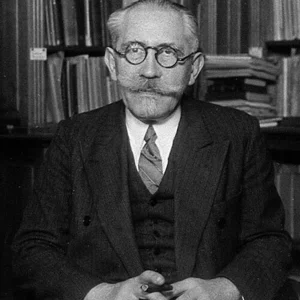

French physicist (1872–1946), student of Pierre Curie and friend of Einstein, pioneer of the theory of magnetism and ultrasonics. A committed philosopher of science, he was a passionate anti-fascist activist and defender of secular public education.
Paul Langevin(1872 — 1946)
Paul Langevin
France
8 min read
Frequently asked questions
Famous Quotes
« Thought can only progress if it stays in contact with reality.»
« Science is the collective work of humanity.»
Key Facts
- 1872: Born in Paris, trained at the École de physique et de chimie industrielles
- 1905: Publishes his foundational work on diamagnetism and paramagnetism
- 1908: Formulates the twin paradox arising from Einstein's special theory of relativity
- 1940: Arrested by the Gestapo after the occupation, placed under house arrest, then goes into exile in Switzerland
- 1946: Dies in Paris; given a state funeral, with the Communist Party paying tribute to his lifelong commitment
Works & Achievements
A foundational work on the behavior of ions in ionized gases, which established Langevin as an expert in radiation physics and earned him immediate international recognition.
A coherent theoretical explanation of the behavior of magnetic materials based on the atomic structure of matter; the Langevin law derived from this work is still taught in physics courses today.
A paper published in the *Comptes rendus de l'Académie des sciences*, proposing a stochastic equation to describe the random motion of suspended particles — one of the founding texts of modern statistical physics.
Development, in collaboration with Constantin Chilowsky, of the first ultrasonic underwater detection device — the direct ancestor of modern sonar systems and medical ultrasound imaging.
A remarkable work of popular science presenting the revolutions of modern physics (relativity, quantum theory, radioactivity) for a broad educated audience.
A report co-written with psychologist Henri Wallon, proposing a radical and democratic reform of French education: compulsory schooling to age 18, progressive guidance, and equal opportunity. Never fully implemented, it remains a landmark reference in the history of pedagogy.
Anecdotes
In 1911, as Marie Curie was about to receive her second Nobel Prize in Chemistry, the French press revealed her romantic relationship with Paul Langevin. The scandal was enormous: nationalist journalists hurled xenophobic insults at the Polish scientist, and Langevin even had to accept a duel challenge to defend his honor. Einstein, outraged, publicly expressed his support and wrote to Marie Curie urging her to ignore "the rabble.
During the First World War, Langevin put his science to work for France by inventing the first functional sonar: a piezoelectric crystal device capable of detecting German submarines using ultrasound. Tested at sea as early as 1917, this apparatus saved countless lives and laid the groundwork for the medical ultrasound imaging still used in hospitals around the world today.
In 1911, Langevin popularized Einstein's relativity by formulating what is still known as the "Langevin twin paradox
: if one of two twins set off in a rocket traveling close to the speed of light and then returned to Earth
he would be younger than his brother who had stayed behind. This striking thought experiment illustrated time dilation and caused a sensation at the Congress of Bologna.
In October 1940, the Gestapo arrested Langevin in Paris and placed him under house arrest. Scientists from around the world protested. In 1944, he managed to escape to Switzerland, from where he supported the French Resistance. At the Liberation, he returned triumphantly to Paris, was appointed director of the School of Physics and Chemistry, and joined the French Communist Party.
After the Liberation, Langevin co-authored with psychologist Henri Wallon an ambitious plan for reforming the French national education system, advocating compulsory schooling up to age 18, progressive career guidance, and equal opportunity. The "Langevin-Wallon Plan
published posthumously in 1947, was never fully implemented but remains an essential reference in the history of French pedagogy.
Primary Sources
The viscous resistance experienced by a particle moving through a liquid is exactly offset, on average, by the irregular collisions imparted to it by the molecules of the surrounding fluid.
The advances made in our understanding of physical phenomena over the past twenty years have been so considerable and so profound that they have revolutionized our conception of matter and energy.
Science and democracy are inseparably linked: both rest on the freedom to seek and express truth, without submitting to any dogmatic authority.
Einstein taught us that space and time are not absolute frameworks, independent of the phenomena that unfold within them, but are on the contrary intimately bound up with matter and energy.
Key Places
The institution where Langevin spent his entire career, first as a student under Pierre Curie and later as a professor and director. It was here that he developed his research on magnetism and ultrasound, and trained generations of physicists.
The institution where Langevin held the chair of general and experimental physics from 1909. His public lectures drew large audiences far beyond science students alone.
The legendary laboratory where Langevin studied under J. J. Thomson, the discoverer of the electron, in 1897–1898. This stay exposed him to the very best of international physics and decisively steered his career toward experimental physics.
The working-class neighbourhood where Paul Langevin was born on **23 January 1872**, into a modest family. His rise through academic excellence came to symbolise the republican meritocracy he would champion throughout his life.
The city where Langevin took refuge in **1944** after escaping the house arrest imposed by the German occupiers. There he maintained contact with the French Resistance until the Liberation of Paris.
Typical Objects

Cut quartz pieces used by Langevin to emit and receive ultrasound waves in water, enabling the detection of submarines. These crystals convert an electrical pulse into mechanical vibration and vice versa.

An instrument for measuring weak electrical currents, indispensable in physics laboratories of the era. Langevin used it in his experiments on magnetism and the ionization of gases.

The everyday tool of the theoretical lecturer, on which Langevin developed his mathematical demonstrations during his courses at the Collège de France and the EPCI. It was at a blackboard that he introduced Einstein's theory of relativity to his Parisian students.

A device producing high-voltage electrical discharges, used in experiments on gas ionization. Langevin relied on it in his doctoral research on ions.

Handwritten records in which Langevin set down his hypotheses, experimental results, and exchanges with Einstein and Bohr. They bear witness to his rigorous way of thinking and the intensity of his international correspondence.

Printed documents that Langevin signed and circulated in Parisian intellectual circles to defend the Spanish Republic and sound the alarm against the rise of Nazism. These texts were distributed through universities and republican lodges.
School Curriculum
Vocabulary & Tags
Key Vocabulary
Daily Life
Morning
Langevin began his days early, reading foreign scientific journals (*Nature*, *Annalen der Physik*) and replying to his voluminous correspondence with Einstein, Bohr, or Rutherford. His mornings at the EPCI laboratory were devoted to supervising his students' experimental work and to scientific discussions with his collaborators.
Afternoon
In the afternoons, he taught at the Collège de France or at the EPCI, lectures renowned for their clarity and infectious enthusiasm. He then dedicated time to his own theoretical research, often armed with chalk and a blackboard, developing elegant mathematical demonstrations that his students eagerly copied down.
Evening
Langevin's evenings were frequently taken up by his public commitments: meetings of the Ligue des droits de l'homme, popular lectures to spread scientific culture, or dinners with engaged intellectuals such as Romain Rolland or Henri Barbusse. He read widely in philosophy and politics.
Food
Coming from a modest background, Langevin kept simple tastes throughout his life. He took his meals with family or colleagues in the brasseries of the Latin Quarter, enjoying traditional French cuisine. Coffee was ever-present during the long working sessions in the laboratory.
Clothing
As a professor at the Collège de France, Langevin wore the sober dress of the republican intellectual of his era: dark suit, waistcoat, and tie, typical of the bourgeois scholar of the early twentieth century. In the laboratory, he donned the white coat of the experimental physicist.
Housing
Langevin lived for many years in apartments in the 5th arrondissement of Paris, close to the EPCI and the Collège de France. His home reflected that of a committed intellectual: bookshelves overflowing with volumes on physics and philosophy, papers in disarray, scientific instruments jostling with political pamphlets.
Historical Timeline
Period Vocabulary
Liens externes & ressources
Références
Œuvres
Thèse sur l'ionisation des gaz
1902
Théorie du magnétisme (para- et diamagnétisme)
1905
Équation de Langevin (mouvement brownien)
1908
Invention du sonar à ultrasons
1915-1918
La physique depuis vingt ans
1923
Plan Langevin-Wallon
1947