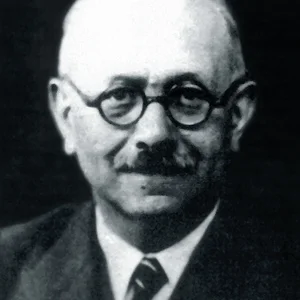

French historian and co-founder of the Annales School with Lucien Febvre, Marc Bloch revolutionized historical method by prioritizing social and economic structures over event-driven history. A resistance fighter from the very start, he was arrested by the Gestapo and shot in 1944.
Marc Bloch(1886 — 1944)
Marc Bloch
France
7 min read
Frequently asked questions
Famous Quotes
« Good history is written with written documents, when they exist. But it can be written, it must be written, without written documents, if none exist.»
« The misunderstanding of the present is the inevitable consequence of ignorance of the past.»
Key Facts
- 1886: Born in Lyon into an Alsatian Jewish intellectual family
- 1929: Co-founded with Lucien Febvre the journal Annales d'histoire économique et sociale
- 1939–1940: Mobilized as an officer, witness to the French defeat (Strange Defeat)
- 1943: Joined the Resistance (Franc-Tireur network) under the pseudonym Narbonne
- 1944: Arrested by the Gestapo, tortured and shot on June 16 near Lyon
Works & Achievements
A pioneering study of the healing power attributed to the kings of France and England: by analyzing a collective medieval belief, Bloch invented a history of mentalities that would shape the entire twentieth century.
The first major synthesis of the history of the French countryside, combining archival research, geography, and aerial photography to reconstruct agrarian landscapes from the Middle Ages to the early modern period.
Bloch's masterpiece on the structures of medieval society: he analyzes the bonds of dependence, loyalty, and lordship that organized Europe between the ninth and thirteenth centuries.
A testimony and analysis written in the immediate aftermath of the June 1940 collapse: Bloch searches for the deep causes of France's military and moral breakdown with a lucidity that left a lasting mark.
An unfinished work written in hiding, reflecting on what the historian's work actually entails — the criticism of sources and the meaning of historical inquiry — that has become a classic of epistemological thought.
Anecdotes
Marc Bloch served as an infantry officer during the First World War, where he was wounded and decorated four times, including with the Légion d'honneur. His experience of the fire and mud of the trenches deeply shaped his thinking about how people make history without always understanding it.
In 1929, Bloch and his friend Lucien Febvre founded a journal with a deliberately provocative title: *Annales d'histoire économique et sociale*. Rather than recounting battles and coronations, they wanted to study the daily lives of peasants, wheat prices, and epidemics — a revolution that would influence generations of historians around the world.
Bloch was one of the first historians to use aerial photographs as historical sources. Armed with topographic maps and images taken from aircraft, he would walk the French countryside to read in the landscape the traces of ancient fields and vanished villages, effectively inventing a true archaeology of the soil.
In the summer of 1940, as France collapsed before Nazi Germany, Bloch wrote in just a few weeks *Strange Defeat*, a lucid and courageous analysis of the reasons for the disaster. Although Jewish under Vichy law, he refused to flee abroad and joined the Resistance under the pseudonym "Narbonne.
Arrested by the Gestapo in Lyon in March 1944, Marc Bloch was tortured for weeks but refused to give up a single name. Shot on June 16, 1944 at Saint-Didier-de-Formans along with twenty-eight other resistance fighters, he is said to have cried "Vive la France!" before being killed — just a few weeks before the Liberation.
Primary Sources
History is the science of men in time. […] A good historian resembles the ogre of the legend: wherever he scents human flesh, there he knows his quarry lies.
We suffered a military defeat. But why? […] Our leaders, or those who acted in their name, proved incapable of imagining what a modern war could be.
The royal miracle, far from being a crude superstition, is a revealing social fact: it tells us everything a people expect from their king, and what a king must be to be believed.
The bonds of dependence from man to man formed the true fabric of feudal society: to understand vassalic loyalty is to understand an entire world.
Key Places
Marc Bloch's birthplace (6 July 1886) and the city where he was arrested by the Gestapo in March 1944. Lyon was also the hub of his activities within the Franc-Tireur resistance network.
It was in Strasbourg — a city symbolizing Franco-German reconciliation — that Bloch taught from 1919 to 1936 and co-founded with Lucien Febvre the *Annales* journal, which revolutionized historiography worldwide.
Bloch held the chair of economic history there from 1936, until Vichy's antisemitic laws abruptly stripped him of his position in 1940.
The site of Marc Bloch's martyrdom: he was shot on **16 June 1944** in a field in this commune in the Ain département, alongside twenty-eight other resistance fighters. A memorial there keeps his memory alive.
After the exodus of June 1940, Bloch attempted to continue teaching at the University of Montpellier before being expelled by Vichy's laws; his family also took refuge there for a time.
Liens externes & ressources
Références
Œuvres
Les Rois thaumaturges
1924
Les Caractères originaux de l'histoire rurale française
1931
La Société féodale
1939-1940 (2 volumes)
L'Étrange Défaite
rédigé 1940, publié posthume 1946
Apologie pour l'histoire ou Métier d'historien
rédigé 1943, publié posthume 1949