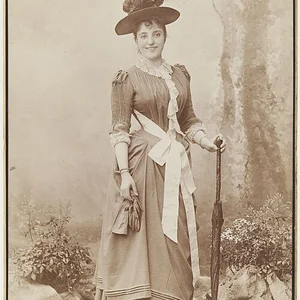

Jeanne Charcot, née Hugo (1869–1941), was the granddaughter of Victor Hugo and first wife of polar explorer Jean-Baptiste Charcot. She moved in the literary and social circles of Parisian Belle Époque society, though she was not an explorer herself.
Jeanne Charcot(1865 — 1940)
Jeanne Charcot
France
8 min read
Frequently asked questions
Key Facts
- 1869: birth of Jeanne Hugo, granddaughter of Victor Hugo
- 1896: marriage to Jean-Baptiste Charcot, future commander of the Pourquoi-Pas?
- 1903–1904: Jean-Baptiste Charcot led his first Antarctic expedition during their marriage
- 1904: divorce from Jean-Baptiste Charcot
- Her name remains associated with French polar expeditions of the early 20th century
Works & Achievements
Jeanne Hugo attended and animated the literary circles of Belle Époque Paris, keeping Victor Hugo's legacy alive through direct human connection. Her presence in these salons made her a precious living link between nineteenth-century Romanticism and the emerging modern age.
Like many women of the Parisian upper bourgeoisie, Jeanne threw herself into charitable activities to support wounded soldiers and families in need, carrying on the humanist commitment that was a hallmark of the Hugo family.
Jeanne maintained a rich correspondence with the literary and social figures of her day. These letters are a precious source for understanding the social and intellectual networks of Belle Époque Paris as seen from within a women's salon.
Anecdotes
Victor Hugo's cherished granddaughter, Jeanne grew up surrounded by the literary glory of the author of *Les Misérables*. Her grandfather dedicated tender poems to her in the collection *L'Art d'être grand-père* (1877), when she was only 8 years old. This childhood steeped in poetry and celebrity left a lasting mark on her taste for Parisian intellectual circles.
In 1896, Jeanne Hugo married Jean-Baptiste Charcot, son of the famous neurologist Jean-Martin Charcot. The union seemed promising, joining two illustrious legacies, but their characters proved radically opposed: Jeanne was drawn to Parisian salons and high society, while her husband dreamed only of polar ice and distant expeditions.
When Victor Hugo died in May 1885, Jeanne was around 16 years old. She experienced the state funeral as both a family and a historical event: more than a million Parisians filed past the coffin laid in state beneath the Arc de Triomphe before the burial at the Panthéon. Being Hugo's granddaughter became an identity she had to carry — opening doors to the finest salons but also imposing considerable expectations.
During Jean-Baptiste Charcot's first Antarctic expedition (1903–1905), Jeanne remained in Paris and frequented literary and social circles with great regularity. Their correspondence bears witness to the couple's gradual estrangement, symbolizing the divide between two worlds: that of scientific adventure and that of the social conventions of the Belle Époque.
During the First World War, like many women of the Parisian upper bourgeoisie, Jeanne Charcot threw herself into charitable work and support for the wounded. In doing so, she carried on the humanist commitment that had defined the Hugo family, whose patriarch had championed the poor and the oppressed throughout his life.
Primary Sources
Jeanne was on dry bread in the dark closet, / For some misdeed, and, failing in my duty, / I went to see the outcast in utter darkness.
Marriage celebrated at the town hall of the 6th arrondissement of Paris between Jean-Baptiste Étienne Auguste Charcot, physician, and Jeanne Marguerite Hugo, both residing in Paris.
We left Brest on a misty morning; a few loved ones waved their handkerchiefs from the quay, and I thought of those I was leaving behind, in the Paris I was about to flee for months.
The letters exchanged among members of the Hugo family after 1885 bear witness to Jeanne's role in preserving the memory of her grandfather and in maintaining the bonds among the heirs.
Key Places
Victor Hugo's Parisian home from 1832 to 1848, now a municipal museum. Jeanne would visit her grandfather here and was steeped in the unique literary and artistic atmosphere of the place, surrounded by the most celebrated figures of the age.
Victor Hugo's residence during his years of exile (1856–1870), where he wrote, among other works, *Les Misérables*. Jeanne may have stayed here as a child, discovering this house decorated entirely by Hugo himself — a reflection of his creative genius.
The main living environment of Jeanne Charcot, née Hugo, in the fashionable districts of the Left Bank and western Paris. She moved through literary salons, elegant boutiques, and social circles that formed the heart of Belle Époque society.
The republican monument where Victor Hugo has rested since his state funeral in 1885. For Jeanne, the Panthéon embodied her grandfather's eternal glory and served as a place of intimate family memory amid the wider public mourning.
Typical Objects

The central piece of furniture in a bourgeois Belle Époque household, where Jeanne wrote her daily correspondence. Society women maintained intense epistolary exchanges — one of the few spaces for personal expression that society fully recognized.

A treasured keepsake preserving portraits of Victor Hugo and other family members, bearing witness to Jeanne's illustrious lineage. Photography, still a relatively new technique during the Belle Époque, made it possible for the first time to permanently capture the faces of loved ones.

A small rectangle of fine cardstock bearing one's name and titles, essential to Parisian social life. Leaving one's card at an acquaintance's home was a highly codified social ritual that Jeanne observed like all women of her standing.

Leather-bound volumes adorning family bookshelves, passed down as a precious inheritance. For Jeanne, these books were not merely literary works but tangible traces of her beloved grandfather, who had died when she was sixteen.

An indispensable accessory for society women at the receptions and dinner parties of the Belle Époque. The fan served both as a cooling tool and as a coded language, allowing feelings and intentions to be expressed discreetly without words.

A hallmark of Belle Époque women's fashion, these extravagant hats were worn by elegant women like Jeanne on outings to the city, to the races, or for strolls through the Bois de Boulogne.
School Curriculum
Vocabulary & Tags
Key Vocabulary
Daily Life
Morning
Jeanne rose around eight o'clock and began her day with a careful toilette, assisted by her chambermaid. She then devoted the morning to reading the Parisian press — Le Figaro above all — and to writing her voluminous correspondence, responding to invitations and maintaining her network of social connections.
Afternoon
Afternoons were devoted to courtesy calls on acquaintances or to receiving visitors in her drawing room. She would sometimes take a carriage ride through the Bois de Boulogne in the fashion of the day. Cultural outings — exhibitions, matinées at the Comédie-Française, gallery visits — regularly punctuated her weeks.
Evening
Evenings were the heart of social life: dinners in town at the homes of prominent bourgeois families, receptions in literary or artistic salons, sometimes the Opéra Garnier or a concert. As the heiress to the Hugo name, Jeanne was a sought-after guest whose presence lent prestige to any gathering.
Food
The bourgeois table of the Belle Époque was abundant and highly codified: soup, meat in sauce, seasonal vegetables, aged cheese, and dessert. Breakfast consisted of café au lait, buttered bread, and pastries. Jeanne also discovered the first great gastronomic restaurants that were establishing themselves in Paris as venues for refined socialising.
Clothing
Jeanne wore the characteristic dress of the elegant Belle Époque woman: a boned corset that sculpted the figure into an S-shape, a long trailing skirt, a high collar and puffed sleeves by day; a low-cut silk gown and white gloves by evening. Extravagant hats and family jewels completed her outfits for going out.
Housing
Jeanne lived in a spacious Haussmann-style apartment, typical of the Parisian upper bourgeoisie: high moulded ceilings, Hungarian-point parquet flooring, and a marble fireplace in each main room. The walls were adorned with family portraits — including one of Victor Hugo — and the library carefully preserved the original editions of her grandfather's works.
Historical Timeline
Period Vocabulary
Liens externes & ressources
Références
Œuvres
Animation des salons littéraires parisiens
1890-1914
Œuvres de bienfaisance pendant la Première Guerre mondiale
1914-1918
Correspondance littéraire et mondaine
1890-1941