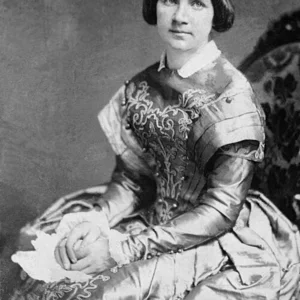

Nineteenth-century Swedish singer, a coloratura soprano of international fame nicknamed “the Swedish Nightingale.” She enjoyed immense success in Europe and then in the United States during a tour organized by the impresario P. T. Barnum.
Jenny Lind(1820 — 1887)
Jenny Lind
Suède
6 min read
Frequently asked questions
Key Facts
- Born in Stockholm in 1820, she made her debut at the Royal Swedish Opera while still a teenager.
- She triumphed on the great European stages (Berlin, Vienna, London) during the 1840s.
- In 1850-1852, P. T. Barnum organized her tour of the United States, which became a popular phenomenon (“Lind mania”).
- She retired from the operatic stage while still young and devoted herself to concerts and to charitable works.
- Having died in England in 1887, she remains an icon of Romantic singing.
Works & Achievements
The role of her notable debut in Stockholm, which revealed her talent to the Swedish public.
One of her signature bel canto roles, perfectly suited to her agile coloratura voice.
A great dramatic role from the bel canto repertoire that she performed successfully across Europe.
Verdi's opera, premiered in London with her in the role of Amalia, written with her voice in mind.
A series of triumphant concerts across the United States, organized by P. T. Barnum, which made her a worldwide star.
She became an iconic interpreter of this oratorio by her friend Mendelssohn.
The London institution's first professor of singing, passing on her art to a new generation.
Anecdotes
Nicknamed "the Swedish Nightingale," Jenny Lind is said to have inspired the storyteller Hans Christian Andersen's famous tale "The Nightingale" (1843): the Danish writer, deeply in love with her, was rejected but remained a fervent admirer of her voice all his life.
In 1850, the American impresario P. T. Barnum organized a triumphant tour of the United States even though he had never heard Jenny Lind sing: he gambled solely on her reputation. The "Lind mania" was such that tickets for the first concert were sold at auction, and objects bearing her likeness (hats, gloves, pianos) flooded the market.
At the height of her fame, Jenny Lind abandoned the opera stage for good in 1849, before the age of thirty, out of religious scruple and distaste for the world of theater, preferring from then on to sing only in concerts and oratorios.
The composer Felix Mendelssohn was a very close friend and a great admirer of the singer; his sudden death in 1847 deeply distressed her. It is said that she waited nearly a year before daring to sing again some of the works he loved.
Jenny Lind redistributed a large portion of the colossal sums earned during her American tour to charitable causes, notably to found schools and support young musicians in Sweden.
Primary Sources
I resolved to engage Jenny Lind for a concert tour of the United States, although I had never heard her sing and barely knew her reputation other than by hearsay.
Through Jenny Lind I understood for the first time the holiness there can be in art. No book, no person has exercised over me a more ennobling influence than that of Jenny Lind.
An immense crowd thronged Castle Garden to hear the Swedish Nightingale; from the very first notes, the audience was carried away with enthusiasm.
Key Places
Jenny Lind's birthplace, where she began her training and her career at the Royal Swedish Opera.
Here she studied under the singing teacher Manuel García to heal her voice and perfect her technique.
The site of her English operatic triumphs and later her long-term home; she taught here at the Royal College of Music.
The hall where, on 11 September 1850, Jenny Lind gave her first American concert, sparking the “Lind mania.”
The city where she married the pianist Otto Goldschmidt in 1852, near the end of her American tour.
A home in the Malvern Hills, England, where Jenny Lind spent her final years and died in 1887.
Typical Objects

The scores of Bellini, Donizetti and Meyerbeer made up the favourite repertoire of the coloratura soprano, demanding virtuosity and vocal agility.

For her recitals, Jenny Lind wore long, light-coloured crinoline gowns, plain yet elegant, reflecting her image of purity.

During the American tour, printed posters announced the arrival of the “Swedish Nightingale” with a great deal of publicity.

In New York, the craze was such that the first tickets to her concerts were sold at auction for record prices.

A small metal instrument that gives a reference note, used to tune up and work on vocal pitch.

Medallions, engravings and trinkets bearing the singer's image were sold to admirers, an early sign of a true celebrity culture.
School Curriculum
Vocabulary & Tags
Key Vocabulary
Daily Life
Morning
Like every professional singer, Jenny Lind protected her voice from the moment she woke up, avoiding the cold and any vocal strain. Mornings were often devoted to careful vocal exercises and studying new scores at the piano.
Afternoon
Afternoons were used for rehearsals with the orchestra or her accompanying pianist, as well as for the abundant correspondence of an international celebrity. During tours, long journeys by train or boat took up much of the time.
Evening
Evenings were the time for concerts and performances, given before packed houses. After the show, shunning social life, she often preferred quiet to the bustle of receptions.
Food
Mindful of her voice, she watched her diet and the temperature of her drinks, avoiding anything that might irritate her throat. Her table remained the rather modest one of the nineteenth-century middle class.
Clothing
In private, she wore the plain, buttoned-up dresses of the respectable Victorian woman; on stage, long, light-colored crinoline gowns, elegant but never excessive, in keeping with her image of purity.
Housing
At the height of her career, she stayed in fine hotels and grand residences; once settled in England, she lived in comfortable houses, including her home in the Malvern Hills, where she died.