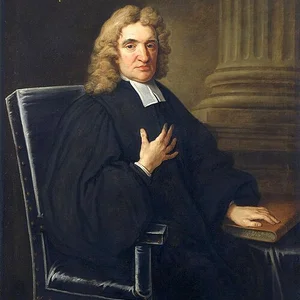

John Flamsteed was an English astronomer, the first Astronomer Royal of England, appointed by Charles II in 1675. He led the founding of the Greenwich Observatory and compiled a star catalogue of unprecedented precision, recording nearly 3,000 stars.
John Flamsteed(1646 — 1720)
John Flamsteed
6 min read
Frequently asked questions
Key Facts
- Appointed the first Astronomer Royal of England by Charles II in 1675
- Oversees the founding of the Royal Observatory at Greenwich in 1675-1676
- Makes the first recorded observation of the planet Uranus in 1690, mistaking it for a star (34 Tauri)
- His star catalogue 'Historia Coelestis Britannica', recording nearly 3,000 stars, is published posthumously in 1725
- Comes into conflict with Isaac Newton and Edmond Halley over the unauthorized publication of his observations in 1712
Works & Achievements
A catalogue of nearly 3,000 stars of unmatched precision, the fruit of more than forty years of observation. It founded modern positional astronomy.
An atlas of celestial charts based on his observations, which remained the standard map of the sky throughout the eighteenth century.
A system assigning a number to each star within its constellation (the “Flamsteed numbers”), still in use today.
Flamsteed observed and catalogued Uranus under the name 34 Tauri, without recognising it as a planet, nearly a century before its official discovery.
His precise measurements confirmed the regularity of the Earth's rotation, the basis of astronomical timekeeping.
Systematic recordings of the Moon's position intended to perfect the method of lunar distances for calculating longitude at sea.
Anecdotes
In 1675, Charles II appointed John Flamsteed as the first Astronomer Royal — but gave him neither instruments nor an assistant! Flamsteed had to pay out of his own pocket for most of his telescopes and microscopes, and supplement his meagre salary by giving private lessons.
Flamsteed and Isaac Newton clashed bitterly. Newton, impatient to obtain Greenwich's stellar data for his own work, forced through the publication in 1712 of an unauthorised version of Flamsteed's catalogue. Furious, Flamsteed bought back 300 of the 400 printed copies and burned them publicly.
Flamsteed is credited with the first recorded observation of the planet Uranus, in 1690 — nearly a century before its official discovery by William Herschel. But Flamsteed took it for an ordinary star and catalogued it under the name “34 Tauri”, never suspecting that it was a new planet.
Flamsteed introduced a system of numbering stars by constellation, ordered according to their right ascension. These “Flamsteed numbers” (such as 61 Cygni) are still used by astronomers today, more than three centuries later.
In frail health since childhood — rheumatism had forced him to leave school — Flamsteed was a stubborn perfectionist. His great catalogue, the *Historia Coelestis Britannica*, did not appear in its complete form until 1725, five years after his death, thanks to the work of his widow Margaret.
Primary Sources
Catalogue of nearly 3,000 stars observed from Greenwich, with their positions determined to an unprecedented accuracy thanks to the systematic use of the telescope and the pendulum clock.
A collection of celestial maps depicting the constellations based on the Greenwich observations, the reference work for charting the northern sky throughout the eighteenth century.
An exchange of letters concerning the lunar observations that Newton demanded in order to validate his theory of gravitation, revealing the growing tension between the two men.
Astronomy notes and lessons reflecting his teaching and his method of rigorous observation in the service of navigation and celestial cartography.
Key Places
Village in central England where Flamsteed was born in 1646 into a family of merchants.
Observatory founded in 1675 that Flamsteed directed for forty-five years, compiling his great star catalogue. He lived and died there.
College of the University of Cambridge where Flamsteed was admitted and studied astronomy, later earning a degree.
Town near his birthplace where the young Flamsteed, having had to leave school for health reasons, taught himself astronomy.
Parish of which Flamsteed became rector in 1684: ordained a priest, he served his ministry there while continuing his observations at Greenwich.
Capital where the Royal Society met, of which Flamsteed was a member, at the heart of the scientific debates of his time.
Typical Objects

Large instrument fixed to the wall of the observatory used to measure the angles between stars with great precision. Flamsteed used it to build his first observations at Greenwich.

Astronomical telescope fitted with a crosshair reticle used to point precisely at a star. It was the systematic use of the telescope that gave Flamsteed's catalogue its unprecedented accuracy.

High-precision clock essential for measuring the time at which stars cross the meridian. Flamsteed used the pendulum clocks built by Thomas Tompion for his timings.

Instrument graduated over a 90-degree arc used to measure the height of celestial bodies above the horizon. A fundamental tool of positional astronomy in the 17th century.

Registers in which Flamsteed recorded the position, magnitude and coordinates of every star he observed. Thousands of pages of notes patiently accumulated over more than forty years.

A drawn representation of the constellations and the positions of the stars, both a scientific tool and a work of art. Flamsteed's *Atlas Coelestis* remained the standard reference throughout the 18th century.
School Curriculum
Vocabulary & Tags
Key Vocabulary
Tags
Lieu
Daily Life
Morning
Flamsteed often began his days with his religious duties, for he was an Anglican priest. The morning was devoted to fine-tuning and checking his instruments, as well as writing his scientific correspondence.
Afternoon
In the afternoon, he calculated and made fair copies of the previous night's observations, reducing the raw data into usable stellar positions. He sometimes received visitors, students or colleagues from the Royal Society.
Evening
It was at night that the bulk of his work took place: stationed at his telescopes, he watched for the stars crossing the meridian, noting the exact moment by the sound of the pendulum. Exhausting vigils, often in the cold, repeated over decades.
Food
The diet of a well-off English clergyman of the time relied on bread, mutton or beef, vegetables from the kitchen garden, and beer, a safer drink than water. Tea and coffee, still expensive, were beginning to spread in London.
Clothing
Flamsteed wore the sober attire of the Anglican clergy: a dark frock coat, a white-collared linen shirt, and a wig, as was customary among gentlemen of the late 17th century. For his nighttime vigils, he bundled up against the cold of the observatory.
Housing
He lived in the apartments of the Royal Observatory at Greenwich, a building designed by Christopher Wren and perched on a hill overlooking the Thames. The observation rooms adjoined his living quarters, blending domestic life with scientific work.
Historical Timeline
Period Vocabulary
Liens externes & ressources
Références
Œuvres
Catalogue stellaire de Greenwich (Historia Coelestis Britannica)
1725 (posthume)
Atlas Coelestis
1729 (posthume)
Numérotation des étoiles par constellation
fin XVIIe siècle
Première observation enregistrée d'Uranus
1690
Détermination du taux de rotation de la Terre
années 1670-1680
Observations lunaires pour la longitude
1690-1715