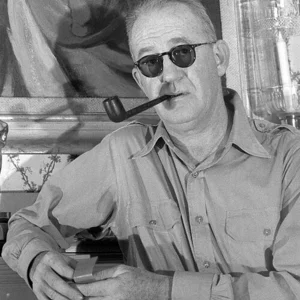

John Ford (1894-1973) was an American director and producer, considered one of the masters of Hollywood cinema. An iconic figure of the western, he profoundly shaped the history of the seventh art and holds the record of four Academy Awards for Best Director.
John Ford(1894 — 1973)
John Ford
États-Unis
7 min read
Frequently asked questions
Famous Quotes
« My name is John Ford. I make Westerns.»
Key Facts
- Born in 1894 in Cape Elizabeth (Maine) into a family of Irish immigrants
- Directed *Stagecoach* in 1939, which launched John Wayne and redefined the western
- Won four Academy Awards for Best Director (1936, 1941, 1942, 1953), an absolute record
- Shot *The Searchers* in 1956, often cited among the greatest films ever made
- Died in 1973 in California, after more than 140 films over a half-century career
Works & Achievements
A vast silent epic on the building of the first transcontinental railroad, which established Ford as a great director of American epics.
A drama about the Irish struggle for independence; it earned Ford his first Oscar for Best Director.
A Western that restored the genre's prestige, launched John Wayne, and inaugurated filming in Monument Valley.
An adaptation of Steinbeck's novel about farmers ruined by the Great Depression; his second Oscar for Best Director.
A chronicle of a family of Welsh miners; the film won the Oscar for Best Picture, beating “Citizen Kane.”
A romantic comedy shot in Ireland, a tribute to his roots; his fourth Oscar for Best Director, a record.
A dark Western with John Wayne, often cited among the greatest films of all time for its depth and visual beauty.
A twilight Western that questions the myth of the West, famous for the line “When the legend becomes fact, print the legend.”
Anecdotes
On his film sets, John Ford wielded a legendary authority: he often wore an eye patch and dark glasses, and would nervously chew on a handkerchief or the corner of his hat. Reputed to be tyrannical yet respected, he shot very few takes and essentially edited the film “in the camera” to prevent producers from re-cutting his work as they pleased.
In 1942, while heading the U.S. Navy's film unit, Ford personally filmed the Battle of Midway from a rooftop. Wounded in the arm by shrapnel, he kept on shooting. His documentary “The Battle of Midway” won an Oscar and showed American families real footage of the war in the Pacific.
Ford turned Monument Valley, on the Arizona–Utah border, into the mythic backdrop of the Western. With its immense red sandstone buttes, the landscape became so closely tied to his films that it was nicknamed “John Ford country.” He shot about a dozen feature films there, often with the actor John Wayne.
In 1950, at the height of the anti-communist witch hunts, a proposal sought to force directors to sign a loyalty oath. During a stormy meeting of the Directors Guild, Ford stood up and declared: “My name is John Ford. I make Westerns.” He then defended his colleague Joseph Mankiewicz and caused the maneuver to fail.
John Ford still holds the record of four Oscars for Best Director. Curiously, he never won them for a Western, the genre that made him famous, but for dramas such as “The Grapes of Wrath” (1940) and “How Green Was My Valley” (1941), which beat “Citizen Kane” for the prize.
Primary Sources
My name is John Ford. I make Westerns. […] But I don't like you, C. B., I don't like what you stand for, and I don't like what you've been saying here tonight.
When the legend becomes fact, print the legend.
Combat film shot by Ford and his U.S. Navy unit during the battle, edited with narration aimed at the American public.
My name is John Ford and I make pictures to pay the rent; the rest is for the critics to talk about.
Key Places
Small coastal town where John Feeney was born in 1894, into an Irish Catholic family. His Irish roots would later feed several of his films.
City where he grew up and attended high school before leaving for California. It was here that he coined the family nickname before becoming “John Ford.”
Capital of American cinema, where Ford arrived in 1914 and built his entire career within the major studios. It was there that he directed the majority of his films.
Desert valley of red sandstone buttes that he turned into an iconic Western backdrop. It is known as “John Ford Country.”
Site of the decisive 1942 naval battle that Ford filmed under fire, where he was wounded. His documentary brought footage of it back to the American public.
Town in the California desert where the filmmaker died of cancer in 1973, shortly after receiving the first honorary award from the American Film Institute.
Typical Objects

Heavy studio camera mounted on a tripod or dolly, the central tool of every director of Hollywood's golden age. Ford used it sparingly, shooting few takes to keep control over the editing.

Conical megaphone used to give orders to the entire crew and the extras across vast outdoor sets. A symbol of the director's authority on set.

Accessories that became Ford's trademark; he had eye trouble and cultivated a gruff image. They reinforced his silhouette as an intimidating boss on shoots.

A famous tic of the filmmaker: he would gnaw on a white handkerchief or the corner of his hat during takes. This nervous habit was part of his legend on set.

Award from the Academy of Motion Picture Arts and Sciences. Ford won four as best director, a record never equaled.

Military attire he wore while heading the Navy's photographic unit during the Second World War. Ford earned the rank of rear admiral in the reserve.
School Curriculum
Vocabulary & Tags
Key Vocabulary
Tags
Daily Life
Morning
During filming, Ford got up early and arrived on set or out in the desert before his crew. He prepared his shots over a cup of coffee and discussed scenes with his loyal actors, whom he gathered film after film like a theatrical troupe.
Afternoon
His afternoons were spent directing takes with an iron hand, shooting few versions of each scene to keep control over the editing. He demanded silence and discipline, and did not hesitate to humiliate an actor to draw out the emotion he wanted.
Evening
In the evening, after work, Ford liked to relax among close friends, playing cards and drinking. Between films, he treated himself to long sea voyages aboard his sailboat, the Araner, far from the studios.
Food
Ford led a simple life at the table, blending American cooking with Irish-inspired dishes. Known for his fondness for alcohol between shoots, he nonetheless imposed strict abstinence on himself while filming.
Clothing
On set, he cultivated a scruffy, instantly recognizable look: a worn cap or hat, an old jacket, a pipe in his mouth, an eyepatch and dark glasses. In his naval uniform, by contrast, he adopted the strict attire of an officer.
Housing
He lived in California, near Hollywood, in a comfortable but unostentatious house. His true refuge was his sailboat, where he escaped the pressure of the studios and welcomed his friends from the film world.
Historical Timeline
Period Vocabulary
Liens externes & ressources
Références
Œuvres
Le Mouchard (The Informer)
1935
La Chevauchée fantastique (Stagecoach)
1939
Les Raisins de la colère (The Grapes of Wrath)
1940
L'Homme tranquille (The Quiet Man)
1952