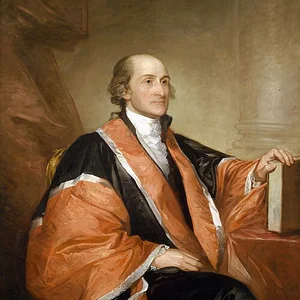

John Jay (1745-1829) was an American statesman, diplomat, and jurist, one of the Founding Fathers of the United States. A co-author of the Federalist Papers, he was the first Chief Justice of the United States Supreme Court.
John Jay(1745 — 1829)
John Jay
États-Unis
5 min read
Frequently asked questions
Key Facts
- Takes part in negotiating the Treaty of Paris (1783), which recognized the independence of the United States
- Co-writes the Federalist Papers (1787-1788) with Alexander Hamilton and James Madison to defend the ratification of the Constitution
- Becomes the first Chief Justice of the United States Supreme Court in 1789
- Negotiates the Treaty of London, known as the “Jay Treaty” (1794), with Great Britain
- Elected Governor of New York State in 1795, where he had a law passed for the gradual abolition of slavery (1799)
Works & Achievements
Jay was one of the principal drafters of this first state constitution, a model for others.
As a negotiator, he helped secure Great Britain's official recognition of American independence.
His essays argued for the ratification of the Constitution, notably on national unity and foreign policy.
As the first Chief Justice, he laid the institutional foundations of the nation's highest court.
A controversial diplomatic agreement with Great Britain that averted a war and stabilized trade.
Signed while he was governor, it set the state on the path toward emancipation.
An antislavery society that he presided over, campaigning for the emancipation and education of free Black people.
Anecdotes
John Jay wrote five of the eighty-five Federalist Papers in 1787-1788, but a severe bout of rheumatism forced him to halt his contribution, leaving Alexander Hamilton and James Madison to write the vast majority of the essays.
In 1794, Jay negotiated a treaty with Great Britain intended to avert another war. The “Jay Treaty” was so unpopular that he declared he could have traveled from Boston to Philadelphia by the light of his own effigies, which crowds burned along his route.
Having become the first Chief Justice of the Supreme Court in 1789, Jay found the office so unprestigious at first that he took on diplomatic missions alongside it, then resigned in 1795 to become Governor of New York State.
Deeply opposed to slavery, Jay founded the New York Manumission Society in 1785, even though he himself owned slaves: he explained that he freed them gradually once he felt he had recouped the value of their purchase through their labor.
In 1799, as Governor of New York, he signed a law for the gradual abolition of slavery, a major reform he regarded as one of his greatest accomplishments.
Primary Sources
Providence has been pleased to give this one connected country to one united people — a people descended from the same ancestors, speaking the same language, professing the same religion.
It will be in the interest of the Senate to take care that treaties are made only by able and trustworthy men.
There shall be a firm, inviolable, and universal peace, and a true and sincere friendship between His Britannic Majesty and the United States of America.
Until America comes to provide for the abolition of slavery, her prayers to Heaven for her own liberty will be marked by inconsistency.
Key Places
John Jay's birthplace and the center of his political career; he was born there in 1745 into a family of Huguenot merchants.
Seat of the Continental Congresses and the Convention of 1787, where Jay served and worked to found the republic.
Site of the peace negotiations with Great Britain that led to the Treaty of 1783, which recognized the independence of the United States.
New York institution where Jay studied law before being admitted to the bar in 1768.
Farming estate where Jay retired from public life in 1801 and where he died in 1829.
British capital with which Jay negotiated the Treaty of 1794, intended to ease commercial and border tensions.
Typical Objects

Writing instrument of 18th-century diplomats and jurists, used to draft treaties, essays, and rulings. Jay used it for his contributions to the Federalist Papers.

Collection of 85 essays defending the ratification of the Constitution, published in 1788. Jay wrote five of them, devoted in particular to foreign policy.

Official garment worn by the first Chief Justice of the United States. Jay wore a black robe with red and salmon facings during the Court's earliest sessions.

Wax seal used to authenticate treaties and official correspondence. Jay employed it during peace negotiations and the treaty of 1794.

Diplomatic act of 1794 settling the disputes between the United States and Great Britain. Highly controversial, it nonetheless averted a premature war.

Horse-drawn vehicle that allowed statesmen to cover the long distances between the towns of the young republic. Jay used it to reach Philadelphia or the ports of embarkation.
School Curriculum
Vocabulary & Tags
Key Vocabulary
Tags
Daily Life
Morning
An early riser and methodical man, Jay devoted his mornings to reading, prayer, and the study of legal or diplomatic files. His abundant correspondence took up a large part of his early hours.
Afternoon
The afternoon was given over to hearings, political meetings, or court sessions, depending on the period of his life. During his missions abroad, he would receive diplomats and negotiators there.
Evening
In the evening, as a pious and reserved man, he preferred the family circle to social gatherings. He read, wrote, or conversed with those close to him rather than frequenting the salons.
Food
Like the American elite of his time, he ate meats, game, bread, vegetables from the garden, and fruit, accompanied by wine and cider. His table remained plain, mirroring his measured temperament.
Clothing
He wore the attire of eighteenth-century gentlemen: a frock coat, waistcoat, breeches, stockings, and buckled shoes, along with a powdered wig for official occasions. At the Supreme Court, he donned a magistrate's robe.
Housing
Jay lived in middle-class New York residences and later on his vast farming estate at Bedford. His country house, which he had built after 1801, combined comfort and simplicity.
Historical Timeline
Period Vocabulary
Liens externes & ressources
Références
Œuvres
Constitution de l'État de New York
1777
Traité de Paris
1783
Federalist Papers (articles 2, 3, 4, 5 et 64)
1787-1788
Présidence de la Cour suprême des États-Unis
1789-1795
Traité de Jay
1794
Loi d'abolition graduelle de l'esclavage de New York
1799
Fondation de la New York Manumission Society
1785