 flip
flipAsado Criollo over Embers
Asado Criollo over Embers
Why this dish? The *asado* was the daily fare of San Martín's soldier as well as the pampa gaucho: simply grilled beef, without fuss. His profile recalls it — frugal grilled beef, eaten at camp. It is the dish that fed the Army of the Andes before the crossing of the Cordillera.
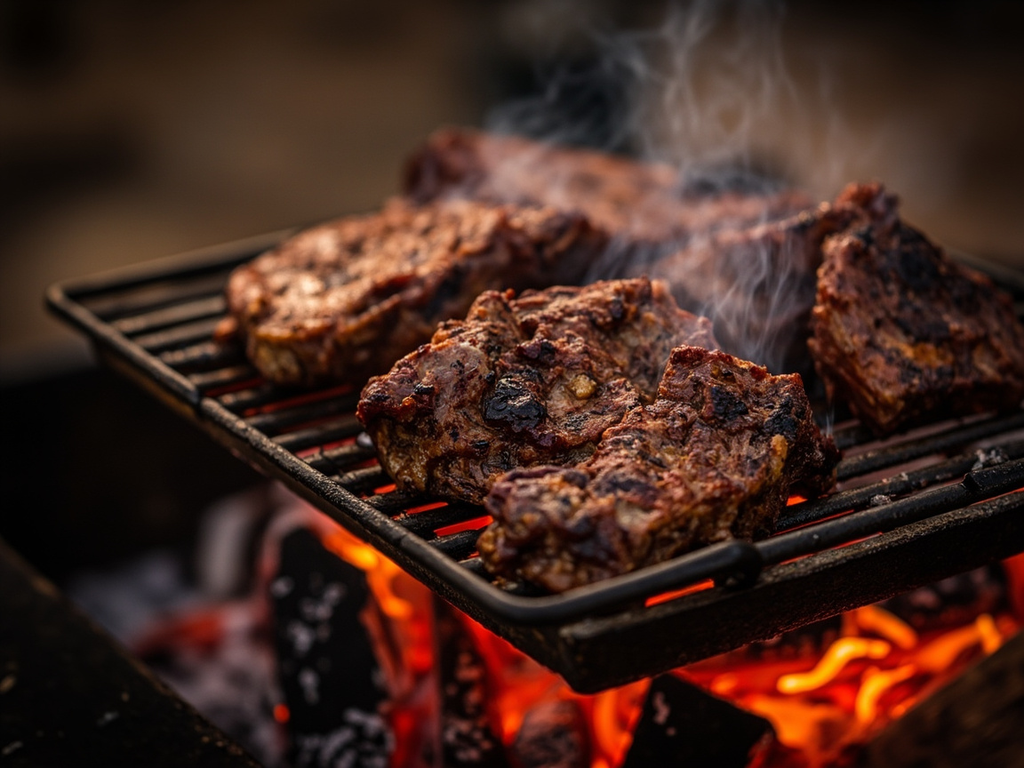
Salted beef pieces placed on the embers of a wood fire, cooked slowly until the crust turns golden and the meat remains juicy. Eaten by hand or with the tip of a knife, standing around the fire.
Soldier, seek no ceremony at my table: dry wood, salt, and a good cut of beef — that is all the pampa offers us and all a man needs. I let it sear slowly on the embers, never in the flame, for haste dries the meat as it loses armies. At the Mendoza camp, my Grenadiers turned the quarters with the point of their sabers, and we ate standing, knife in hand, before saddling up. A stomach like mine asks for little: a piece, salt, water — and the fatherland come morning.
- •Beef rib or flank (tira de asado) — a large piece with bone (main meat)
- •Coarse rock salt — by hand (seasoning)
- •Dry wood and embers — a good fire (cooking)
Asado Criollo over Embers
Salted beef pieces placed on the embers of a wood fire, cooked slowly until the crust turns golden and the meat remains juicy. Eaten by hand or with the tip of a knife, standing around the fire.
Why this dish? The *asado* was the daily fare of San Martín's soldier as well as the pampa gaucho: simply grilled beef, without fuss. His profile recalls it — frugal grilled beef, eaten at camp. It is the dish that fed the Army of the Andes before the crossing of the Cordillera.
Soldier, seek no ceremony at my table: dry wood, salt, and a good cut of beef — that is all the pampa offers us and all a man needs. I let it sear slowly on the embers, never in the flame, for haste dries the meat as it loses armies. At the Mendoza camp, my Grenadiers turned the quarters with the point of their sabers, and we ate standing, knife in hand, before saddling up. A stomach like mine asks for little: a piece, salt, water — and the fatherland come morning.
Ingredients (period version)
- Beef rib or flank (tira de asado) — a large piece with bone (main meat)
- Coarse rock salt — by hand (seasoning)
- Dry wood and embers — a good fire (cooking)
Ingredients
- Beef short ribs for grilling (tira de asado / plate cut) — 1.2 kg (main meat)
- Coarse salt — 2 tbsp (seasoning)
- Charcoal or wood — for a barbecue (cooking)
Method
- Light a fire and wait until the wood forms a bed of red embers covered with ash (no flames).
- Generously salt the meat with coarse salt on both sides just before placing it.
- Set the grill 15-20 cm above the embers and place the meat bone-side down.
- Cook slowly for 35-45 minutes, turning once, until a nice golden crust forms and the interior remains pink.
- Let rest for 5 minutes, then carve and serve with bread and mate on the side.
How it was made : Gauchos and soldiers often stuck the meat on a stake (*asado al asador*) tilted near the fire, or placed it on a makeshift grill. No marinade, no sauce: only salt and smoke. In San Martín's time, beef was so abundant on the pampa that it was wasted, sometimes keeping only the tongue and hide.
The contemporary twist : Serve with *chimichurri* (parsley, garlic, oregano, vinegar, oil, and a little chili) — a sauce now inseparable from Argentine *asado*, presented on a rustic wooden board.
José de San Martín · Charactorium