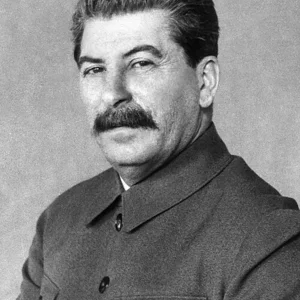

Soviet dictator from 1922 to 1953, Joseph Stalin established a totalitarian regime characterized by massive political repression and forced industrialization. His leadership transformed the USSR into a superpower, but at the cost of millions of lives.
Joseph Stalin(1878 — 1953)
Joseph Stalin
Union soviétique, Empire russe, Russie soviétique
7 min read
Frequently asked questions
Famous Quotes
« Death is the solution to all problems. No man, no problem.»
« A single death is a tragedy; a million deaths is a statistic.»
Key Facts
- 1922: Becomes General Secretary of the Soviet Communist Party, the starting point of his rise to power
- 1928–1933: Forced collectivization of land and the Great Famine (7–10 million deaths)
- 1936–1938: The Great Terror, a wave of mass repression targeting real or suspected opponents (approximately 750,000 executions)
- 1941–1945: Led the USSR during World War II against Nazi Germany
- 1922–1953: Development of the Gulag system, a network of forced labor camps and political repression
Works & Achievements
A major theoretical text written at Lenin's request, defining the Bolshevik conception of the nation. It established Stalin's intellectual reputation within the Bolshevik party.
A collection of texts in which Stalin develops and codifies Leninist doctrine according to his own interpretation. This work became the official ideological bible of Stalinist USSR.
A forced industrialization program that transformed the agrarian USSR into an industrial power within a decade. At the cost of immense popular suffering, it made the USSR a global economic player.
A policy of forced consolidation of peasant lands into kolkhozes (collective farms). It broke the independent peasantry but triggered devastating famines, particularly in Ukraine.
The official party history manual, written under Stalin's direct supervision, in which he rewrote history to his own advantage. Imposed in all Soviet schools, it was one of the most widely distributed books in the world.
Stalin's first public address after the Nazi invasion, fundamental in galvanizing Soviet resistance. His appeal to 'brothers and sisters' marked a rhetorical break from the usual ideological language.
Anecdotes
Stalin, son of a Georgian cobbler, was sent to the Orthodox seminary in Tiflis to become a priest. There he secretly discovered the writings of Marx and Lenin, and was ultimately expelled in 1899 for revolutionary activities. This missed destiny as a priest became one of the most striking paradoxes of 20th-century history.
At the Yalta Conference in February 1945, Stalin arrived with military punctuality to face Roosevelt and Churchill. He negotiated with cold mastery, securing major concessions over Eastern Europe while projecting an apparent allied goodwill. Western diplomats reported being unsettled by his unshakeable calm.
Stalin used a particular method for his purges: he personally signed execution lists known as 'Stalin's lists'. It is estimated that he approved more than 380 of them, thereby condemning approximately 40,000 people to death by his own hand between 1936 and 1938, sometimes annotating the margins with simple notes such as 'shoot'.
Contrary to the monolithic image he projected, Stalin had a passion for cinema. He regularly screened films in his private Kremlin theater, sometimes until dawn, in the company of his associates. He intervened directly in Soviet film production, censoring or approving works, making cinema a propaganda tool he personally controlled.
Primary Sources
A nation is a historically constituted, stable community of people, formed on the basis of a common language, territory, economic life, and psychological make-up manifested in a common culture.
Our Soviet State has passed through two main phases in its development. The first phase was the period from the October Revolution to the elimination of the exploiting classes... The second phase was the period from the elimination of capitalist elements to the complete victory of the socialist economic system.
Comrades, citizens, brothers and sisters, fighters of our army and navy! I am addressing you, my friends! The treacherous military attack by Hitlerite Germany on our homeland, begun on June 22, continues.
Writers are engineers of human souls. The production of souls is more important than the production of tanks. That is why I raise my glass to the writers.
Key Places
The residence and center of Stalinist power, the Kremlin was the heart of the Soviet state. Stalin held his late-night meetings with the Politburo there and signed his most decisive orders.
Stalin's birthplace, where he was born on December 18, 1878, in a modest house. A monumental museum was erected there in his honor during his lifetime, turning his birth into a founding myth.
This city on the Volga was the site of the most decisive battle on the Eastern Front (1942–1943). Its name, chosen in tribute to Stalin, made it a symbol of Soviet resistance to Nazism.
Stalin's preferred private residence outside the Kremlin, where he spent his nights and received his closest collaborators. It was in this dacha that he died on March 5, 1953.
It was in this religious institution that the young Stalin clandestinely discovered Marxism before being expelled in 1899. This place marks the decisive break from his religious vocation.
Typical Objects

Stalin was rarely photographed without his pipe, a carefully maintained symbol of a fatherly image of wisdom. It was part of the staging of his personal propaganda and official portraits.

Official documents bearing the names of those condemned to death, which Stalin personally signed with his red pen. These lists embody the cold bureaucratization of Stalinist repression.

From 1945 onwards, Stalin wore a white uniform of Generalissimo of the Soviet Union, a rank created specifically for him. This garment symbolized his absolute dominance over the victorious army.

Stalin governed the USSR largely by telephone, making late-night calls to his generals and commissars. This instrument embodied his centralized and nocturnal style of government.

Portraits of Stalin were displayed in all public places, offices, factories and schools across the USSR. Their mass reproduction was a pillar of the Stalinist personality cult.

The thick files of the Soviet secret police, containing denunciations, confessions obtained under torture and convictions, structured the machinery of Stalinist terror.
School Curriculum
Vocabulary & Tags
Key Vocabulary
Daily Life
Morning
Stalin rarely woke before noon, being in the habit of working very late into the night. He would begin his day by reading NKVD reports and military telegrams, often in his dressing gown at his Kuntsevo dacha.
Afternoon
His afternoons were devoted to Politburo meetings, audiences with People's Commissars, and reviewing files. He personally annotated documents, sometimes sarcastically, and regularly called his generals or regional officials.
Evening
Stalin's evenings and nights were his preferred moments of power: he would summon his associates to endless late dinners at his dacha, alternating between jokes and humiliations, and often screened films until three or four in the morning.
Food
Stalin enjoyed Georgian cuisine: khinkali (dumplings), shashlyk (skewers), and Georgian wines he had brought directly from the Caucasus. His dinners with the Politburo lasted for hours, and guests were compelled to drink for fear of offending him.
Clothing
In public, Stalin wore his khaki military uniform or, from 1945 onward, his white Generalissimo uniform. In private, he favored a simple grey military tunic (the gimnasterka), a modest garment that reinforced his image as a man of the people.
Housing
Stalin lived primarily at his Kuntsevo dacha on the outskirts of Moscow, a functional but isolated residence protected by several rings of NKVD guards. He owned several dachas across the USSR, but Kuntsevo remained his main residence and the place of his death.
Historical Timeline
Period Vocabulary
Visual Style
Le réalisme socialiste soviétique : images monumentales et héroïques, architecture imposante, palette de rouges soviétiques, de gris aciers et de dorés de propagande.
Sound Ambience
Un univers sonore mêlant la puissance industrielle de l'URSS en construction, la solennité des cérémonies officielles et la tension feutrée d'une société sous surveillance permanente.
Liens externes & ressources
Références
Œuvres
Le Marxisme et la question nationale
1913
Les Questions du léninisme
1926
Les Plans quinquennaux d'industrialisation (1er plan : 1928-1932)
1928
Collectivisation de l'agriculture soviétique
1929-1933
Histoire du Parti communiste de l'Union soviétique (bolcheviks) — Cours abrégé
1938
Discours du 3 juillet 1941 à la nation soviétique
1941