 flip
flipCornstarch Alfajores with Dulce de Leche
Cornstarch Alfajores with Dulce de Leche
Why this dish? The Buenos Aires merienda — mate or coffee and something sweet around five o'clock — is a daily ritual that Cortázar knew as a child in Banfield. These melt-in-the-mouth alfajores with dulce de leche are the quintessential Argentine madeleine, the taste of a Buenos Aires suburb childhood.
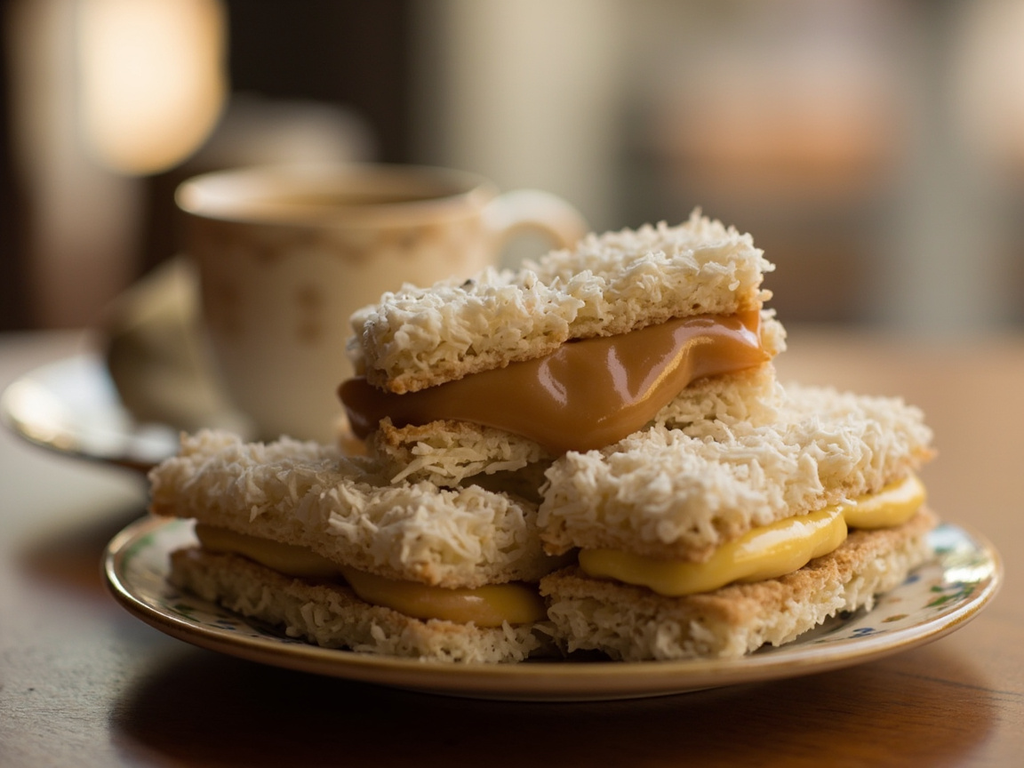
Two tiny shortbread biscuits made with cornstarch, so tender they melt, glued together by a generous layer of dulce de leche and rolled in shredded coconut. A bite that crumbles as soon as it reaches your mouth.
As a kid in Banfield, the merienda was sacred: at five o'clock the little cornstarch alfajores appeared, and you had to eat them carefully because they fell apart in your hand like an old page. The dulce de leche nice and generous in the middle, the shredded coconut all around the edge, and the mate beside it. Eat it slowly, che, because childhood happiness is chewed without hurry.
- •Cornstarch (maizena) — twice the weight of flour (tenderness of the biscuit)
- •Wheat flour — small portion (structure)
- •Butter — generous (shortbread)
- •Egg yolks and sugar — in measured parts (binder and sweetness)
- •Dulce de leche — as desired (filling)
- •Shredded coconut — for rolling (finish)
Cornstarch Alfajores with Dulce de Leche
Two tiny shortbread biscuits made with cornstarch, so tender they melt, glued together by a generous layer of dulce de leche and rolled in shredded coconut. A bite that crumbles as soon as it reaches your mouth.
Why this dish? The Buenos Aires merienda — mate or coffee and something sweet around five o'clock — is a daily ritual that Cortázar knew as a child in Banfield. These melt-in-the-mouth alfajores with dulce de leche are the quintessential Argentine madeleine, the taste of a Buenos Aires suburb childhood.
As a kid in Banfield, the merienda was sacred: at five o'clock the little cornstarch alfajores appeared, and you had to eat them carefully because they fell apart in your hand like an old page. The dulce de leche nice and generous in the middle, the shredded coconut all around the edge, and the mate beside it. Eat it slowly, che, because childhood happiness is chewed without hurry.
Ingredients (period version)
- Cornstarch (maizena) — twice the weight of flour (tenderness of the biscuit)
- Wheat flour — small portion (structure)
- Butter — generous (shortbread)
- Egg yolks and sugar — in measured parts (binder and sweetness)
- Dulce de leche — as desired (filling)
- Shredded coconut — for rolling (finish)
Ingredients
- Cornstarch — 200 g (tenderness)
- Wheat flour — 100 g (structure)
- Soft butter — 100 g (shortbread)
- Sugar — 75 g (sweetness)
- Egg yolks — 3 (binder)
- Baking powder — 1 tsp (lightness)
- Lemon zest — 1 (flavor)
- Dulce de leche — 300 g (filling)
- Shredded coconut — 60 g (finish)
Method
- Cream butter and sugar, add yolks and lemon zest.
- Fold in sifted cornstarch, flour, and baking powder until a soft dough forms; rest 30 minutes in the fridge.
- Roll out to 5 mm, cut 4 cm circles, bake 8–10 minutes at 170 °C without browning.
- Cool completely (biscuits are fragile), then generously fill with dulce de leche and sandwich in pairs.
- Roll the exposed dulce de leche edge in shredded coconut.
How it was made : The alfajor descends from Andalusian sweets brought with colonization, but its dulce de leche version became a Rio de la Plata institution in the 20th century. The merienda, inherited from Hispanic habits, structures the Argentine afternoon around a sweet, social break.
The contemporary twist : A pinch of fleur de sel on the dulce de leche before assembling: the contrast wakes up the sweetness without betraying the nostalgia.
Julio Cortázar · Charactorium