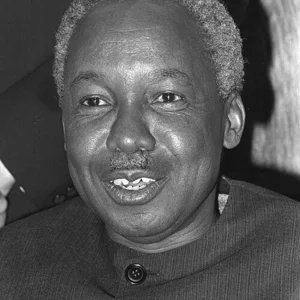

Tanzanian statesman, the first president of Tanzania from 1964 to 1985. A major figure of Pan-Africanism and decolonization, he sought to build an African socialism founded on village solidarity (ujamaa).
Julius Nyerere(1922 — 1999)
Julius Nyerere
Tanzanie
6 min read
Frequently asked questions
Key Facts
- 1961: leads Tanganyika to independence and becomes its Prime Minister
- 1964: architect of the union between Tanganyika and Zanzibar forming Tanzania, of which he becomes president
- 1967: proclaims the Arusha Declaration defining ujamaa, socialism, and self-reliance
- 1985: voluntarily steps down from power, a rare case in Africa at the time
- Nicknamed “Mwalimu” (the teacher, the master in Swahili) by his people
Works & Achievements
Creation of the party that peacefully led Tanganyika to independence, the foundation of the country's political unity.
Founding manifesto of ujamaa, defining African socialism and national self-reliance.
Successful merger of Tanganyika and Zanzibar, a rare example of a lasting union between two African states.
The choice of a common African language that united the country's many peoples and became a model for the continent.
Translation of “Julius Caesar” and “The Merchant of Venice” to demonstrate the literary richness of Swahili.
A collection of texts setting out his political philosophy of African communal socialism.
A vast educational effort that gave Tanzania one of the highest literacy rates in Africa of its time.
Anecdotes
Julius Nyerere was nicknamed “Mwalimu”, which means “the schoolteacher” in Swahili. Before entering politics, he had indeed been a teacher, and this affectionate nickname stayed with him all his life, right up to the highest office in the State.
To give Tanzania a common language and unite its dozens of peoples, Nyerere made Swahili the national language. He himself translated two of Shakespeare's plays into Swahili, including *Julius Caesar*, to prove that this African language could express anything.
In 1985, Nyerere did something rare among the African leaders of his time: he voluntarily stepped down from power after more than twenty years as president. He publicly acknowledged that his economic project, *ujamaa*, had failed — a humility that left a deep impression.
In 1979, Nyerere sent the Tanzanian army into Uganda to overthrow the dictator Idi Amin Dada, who had attacked Tanzania. It is one of the rare cases where an African country brought down a neighbour's tyrant by force of arms.
A devout Catholic, Nyerere led a life of great simplicity, refusing the luxury of presidential palaces. After his death, the Catholic Church even opened a beatification process, presenting him as a possible “Servant of God”.
Primary Sources
The policy of TANU is to build a socialist society. The principle of this society is that no man shall exploit another, and that all citizens have equal rights.
Ujamaa, or “familyhood,” describes our socialism. It is opposed to capitalism, which seeks to build a happy society on the exploitation of man by man.
We, the people of Tanganyika, would like to light a candle and place it on top of Mount Kilimanjaro, so that it may shine beyond our borders, bringing hope where there was despair.
African independence is meaningless unless it leads to the unity of the entire continent. No single African state is truly free until the whole of Africa is free.
Key Places
Nyerere's native village, near Lake Victoria, where he was born in 1922 and where he is buried. A museum there honors his memory.
Tanzania's main city and former capital, the center of power where Nyerere governed for more than two decades.
A city in northern Tanzania where the Arusha Declaration, the manifesto of ujamaa socialism, was proclaimed in 1967.
The Scottish university where Nyerere studied in the late 1940s, one of the first Tanganyikans to earn a degree there.
The British capital where Nyerere died of leukemia in October 1999, in a hospital where he was being treated.
A central city designated by Nyerere in 1974 as Tanzania's new capital, to bring power closer to the heart of the country.
Typical Objects

The basic farming tool of the Tanzanian peasant, which became a symbol of ujamaa and the collective working of the land. The hoe featured as an emblem of labor in Nyerere's ideology.

The plain, buttoned outfit that Nyerere often wore, marking his rejection of Western dress and his affinity with the non-aligned and socialist countries.

The founding document of 1967 setting out the principles of Tanzanian socialism and self-reliance (kujitegemea). A cornerstone of Nyerere's political writing.

The flag adopted in 1964 at the union of Tanganyika and Zanzibar, whose colors symbolize the people, the land, the sea, and the nation's wealth. An emblem of the nation forged by Nyerere.

A collection gathering Nyerere's speeches on freedom and unity. A tool for spreading his Pan-Africanist thought among the people and the world.

An essential communication tool for spreading Swahili and messages of national unity in a country with dozens of languages. Nyerere used it to unite the people.
School Curriculum
Vocabulary & Tags
Key Vocabulary
Daily Life
Morning
An early riser and deeply religious, Nyerere often began his day with Mass or a time of prayer. He would then move on to government meetings and reading through files, in a sober and methodical working style.
Afternoon
His afternoons were devoted to audiences, tours of the ujamaa villages, and discussions with farmers. He loved debating directly with citizens, true to his nickname of the “schoolmaster.”
Evening
In the evening, he read a great deal, wrote speeches and essays, and sometimes received African heads of state. He regularly returned to his family farm in Butiama to reconnect with a simple life.
Food
Nyerere ate simply, relying on local products such as ugali (a maize porridge), rice, plantains, beans, and fish from the lake. He embraced a frugality in keeping with his ideal of sharing.
Clothing
He often wore a plain, closed-collar suit in the Mao or Nehru style, refusing any ostentation. At ceremonies, he sometimes wore traditional attire, but always in a spirit of modesty.
Housing
Refusing presidential pomp, he kept a modest home and would return to his farm in Butiama. His way of life stood in sharp contrast to that of many leaders of his time.
Historical Timeline
Period Vocabulary
Liens externes & ressources
Références
Œuvres
Fondation de la TANU
1954
Déclaration d'Arusha
1967
Union de la Tanzanie
1964
Adoption du swahili comme langue nationale
années 1960
Traduction de Shakespeare en swahili
1963-1969
Ujamaa — Essays on Socialism
1968
Campagne d'alphabétisation
années 1970