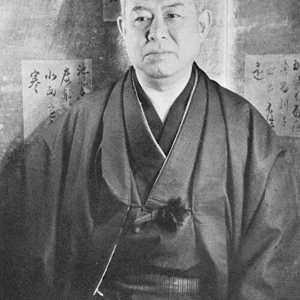

Jun'ichirō Tanizaki (1886-1965) is one of the greatest Japanese novelists of the twentieth century. His work explores desire, the Japanese aesthetic tradition, and the tension between Western modernity and ancestral culture.
Junichiro Tanizaki(1886 — 1965)
Jun'ichirō Tanizaki
Japon, empire du Japon
6 min read
Frequently asked questions
Key Facts
- Born in 1886 in Tokyo, in the Nihonbashi district
- Published In Praise of Shadows (In'ei raisan), an essay on Japanese aesthetics, in 1933
- Wrote The Makioka Sisters (Sasameyuki), a sweeping novel, between 1943 and 1948
- Produced a translation of The Tale of Genji into modern Japanese
- Died in 1965, regarded as a master of modern Japanese literature
Works & Achievements
Debut short story that reveals his talent and his taste for troubling beauty and desire.
Novel about a man fascinated by a young, “Westernized” woman, a mirror of the seductive pull of modernity.
A major essay on Japanese aesthetics, celebrating dimness, restraint, and aged materials.
A tale of a servant's absolute devotion to a blind and tyrannical musician.
A sweeping portrait of a bourgeois family from Osaka, regarded as his masterpiece in fiction.
An adaptation of the great classical novel, revised several times, that makes the work accessible to modern readers.
A daring novel about marital desire, built from the private diaries of a husband and wife.
A late, provocative work about the desire of a sick old man, blending irony and lucidity.
Anecdotes
In September 1923, the Great Kantō earthquake devastated Tokyo. Tanizaki, who was then on holiday near Hakone, decided not to rebuild his life in the modernized capital but to settle in the Kansai region, around Kyoto and Osaka. This move transformed his work: he immersed himself there in the traditions, dialects, and aesthetics of old Japan.
In 1930, Tanizaki caused an enormous scandal: together with his wife Chiyo and his friend the poet Satō Haruo, he published a joint letter announcing that he was “giving” his wife to his friend, who loved her. The press dubbed the affair “the wife-transfer incident,” and it fueled conversations across the entire country.
Fascinated by classical masterpieces, Tanizaki translated *The Tale of Genji* into modern Japanese, an 11th-century novel written by the court lady Murasaki Shikibu. He took up this colossal task several times over the course of his life in order to make it accessible to his contemporaries.
During the Second World War, the serialized publication of his novel *The Makioka Sisters* was halted by military censorship: the authorities judged this refined portrait of a bourgeois family too frivolous and harmful to the war effort. Tanizaki kept writing in secret and was only able to publish the complete work after 1945.
In his essay *In Praise of Shadows* (1933), Tanizaki defends a surprising idea: traditional Japanese beauty is born of dimness, of chiaroscuro and discreet reflections, and not of the bright electric lighting that came from the West. He even meditates there on the beauty of old lacquerware seen by candlelight.
Primary Sources
We find beauty not in the thing itself, but in the patterns of shadows, the light and the darkness, that one thing against another creates.
I shall try to relate the facts of our relationship as honestly and frankly as I can. It is, no doubt, a relationship without precedent.
“Koi-san, will you help me?” Seeing that Taeko had finally picked up her makeup brush, Sachiko called to her over her shoulder.
Key Places
A commercial district in central Tokyo where Tanizaki was born in 1886, into a family of merchants in decline.
A residential town between Osaka and Kobe where Tanizaki settled after 1923; it serves as the setting for *The Makioka Sisters*.
The former imperial capital whose traditions, temples, and gardens nourished Tanizaki's aesthetic from the 1920s onward.
A hot-spring resort town where Tanizaki spent his final years and died in 1965.
Typical Objects

Japanese grid paper where each square holds a single character, used by writers to draft novels and short stories by hand.

Traditional ink brush used for calligraphy and writing, a symbol of Tanizaki's connection to classical Japanese culture.

Bowls and boxes coated in dark lacquer, whose beauty Tanizaki praises when they catch the faint glow of a candle in “In Praise of Shadows.”

A panel of wood and translucent paper that filters light in Japanese homes, a central element of the aesthetic of shadow so dear to Tanizaki.

A traditional lamp wrapped in paper that gives off a soft, muted light, an emblem of the atmosphere of shadow the writer celebrated.

An eleventh-century classic novel that Tanizaki translated into modern Japanese, deepening his attachment to the Japanese literary tradition.
School Curriculum
Vocabulary & Tags
Key Vocabulary
Daily Life
Morning
A meticulous writer, Tanizaki often devoted his mornings to the work of writing, tracing his characters by hand on squared paper. In his Japanese-style house, the soft light filtered through the paper partitions accompanied his hours of composition.
Afternoon
The afternoon might be set aside for reading the classics, doing research for his translations, or corresponding with publishers and fellow writers. He also enjoyed strolling through the ancient cities of the Kansai region, observing customs and landscapes.
Evening
In the evening, he savored the dimness of traditional interiors, the glow of lanterns, and the theater—especially *bunraku* (puppet theater) and *kabuki*. These subdued atmospheres nourished his reflections on the beauty of shadow.
Food
He ate the refined Japanese cuisine of his era: rice, fish, seasonal vegetables, miso soup, and tea. Tanizaki paid aesthetic attention to the presentation of dishes and to the lacquered tableware that held them.
Clothing
Depending on the occasion, he alternated between the traditional kimono, which he favored in private, and the Western suit adopted by the men of letters of his time. This back-and-forth in dress reflects the tension between tradition and modernity at the heart of his work.
Housing
He lived in Japanese houses with tatami mats, sliding partitions, and gardens, especially after settling in the Kansai region. These dwellings, where the light remained soft and indirect, embodied the aesthetic ideal he describes in “In Praise of Shadows.”
Historical Timeline
Period Vocabulary
Liens externes & ressources
Références
Œuvres
Le Tatouage (Shisei)
1910
Un amour insensé (Chijin no ai)
1924-1925
Éloge de l'ombre (In'ei raisan)
1933
Histoire de Shunkin (Shunkinshō)
1933
Les Sœurs Makioka (Sasameyuki)
1943-1948
Traduction du Dit du Genji en japonais moderne
1939-1941
La Clef (Kagi)
1956