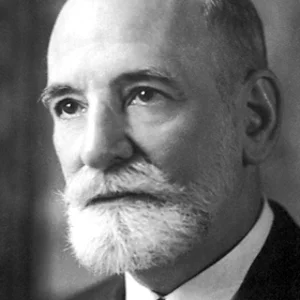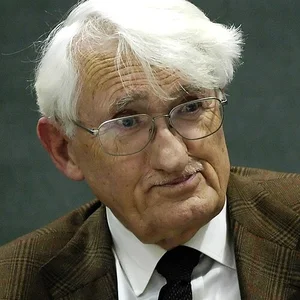

German philosopher and sociologist, a major figure of the second generation of the Frankfurt School. A theorist of communicative action and the public sphere, he is one of the most influential thinkers in contemporary political philosophy.
Jürgen Habermas(1929 — 2026)
Jürgen Habermas
Allemagne
7 min read
Frequently asked questions
Key Facts
- Born in 1929 in Düsseldorf, Germany.
- In 1962 he published 'The Structural Transformation of the Public Sphere', an analysis of the formation of bourgeois public opinion.
- In 1981 he released 'The Theory of Communicative Action', his major work.
- In 1986 he took part in the 'historians' quarrel' (Historikerstreit) over the memory of Nazism.
- He received the Peace Prize of the German Book Trade in 2001.
Works & Achievements
A historical study of the emergence, in the 18th century, of a public sphere where citizens debate matters of common concern. The book that made him famous.
Habermas shows that all knowledge is bound up with human “interests,” challenging the idea of a wholly neutral science.
Here he sets out his famous “discourse ethics”: a norm is just only if everyone it affects could accept it after a free discussion.
His major work: it contrasts action oriented toward mutual understanding (communication) with action oriented toward success and efficiency.
A wide-ranging critical dialogue with the thinkers of his time, in which he defends the promises of modern reason against those who reject it.
A synthesis on the rule of law: Habermas shows how law and democracy support each other in modern societies.
Anecdotes
Jürgen Habermas was born with a cleft palate (a *harelip*) and underwent several operations in his childhood, which long affected the way he spoke. He himself admitted that this experience of depending on others and struggling to make himself understood was probably not unrelated to his lifelong fascination with language and communication.
As a teenager, Habermas lived through the end of the Second World War and the fall of the Nazi regime. At fifteen or sixteen, the discovery of the images of the concentration camps and the **1945–1946** Nuremberg trials were for him a profound moral shock, one that fed his lifelong commitment to democracy and public debate.
A young assistant to the philosopher **Theodor W. Adorno** in Frankfurt in the 1950s, Habermas was deemed too radical by the Institute's director, **Max Horkheimer**. He therefore had to go elsewhere to prepare his habilitation thesis, to Marburg, under the jurist **Wolfgang Abendroth**: it was out of this work that his great book on the public sphere was born.
In **2004**, Habermas, a thinker of secular tradition, held a now-famous public dialogue with Cardinal **Joseph Ratzinger**, the future Pope Benedict XVI. The two men, who seemed to disagree on everything, debated with mutual respect the “moral foundations” of democratic societies and the place of religion within modern reason.
To explain his theory of the public sphere, Habermas draws on a very concrete image: the coffeehouses of London and the salons of Paris in the eighteenth century. There, private individuals armed with newspapers freely discussed common affairs — foreshadowing, in his view, the ideal of a democracy in which citizens decide through the force of the better argument.
Primary Sources
By the “public sphere” we mean first of all the domain of social life in which private individuals, gathered together as a public, can form an opinion on matters of general interest through free discussion.
Communicative action refers to the interaction through which subjects seek to reach an understanding about a situation in order to coordinate their actions, not through coercion but through the pursuit of agreement.
A norm can claim validity only if all those affected could approve of it as participants in a rational discussion.
Only those laws are legitimate on which all citizens could agree in a process of opinion- and will-formation that is itself founded on the law.
Key Places
Habermas's birthplace in 1929, in western Germany. He then grew up in the nearby small town of Gummersbach.
It was in Bonn that he defended his doctoral thesis on the philosopher Schelling in 1954. The city was also the capital of the young Federal Republic.
Birthplace of the “Frankfurt School”: Habermas worked at the Institute for Social Research and then taught there for decades. It is the heart of his intellectual life.
Habermas was a professor of philosophy here from 1961, at one of the oldest universities in Germany.
Near Munich, Habermas directed a Max Planck institute from 1971 to 1983 devoted to studying the living conditions of the modern scientific and technical world.
Typical Objects

The everyday working tool of 20th-century intellectuals, on which Habermas wrote books and articles before the computer age. A symbol of the thinker's craft, producing texts.

The book is the philosopher's primary instrument: a place to read, to write, and to debate at a distance with other thinkers. Habermas's great treatises are among the most discussed of his time.

For Habermas, the press is the heart of the modern "public sphere": it is through the newspaper that citizens inform themselves and form an opinion. He himself wrote regularly in the major daily papers.

The desk from which a professor teaches before students. Habermas shaped generations of students at Heidelberg and Frankfurt through his lectures.

In the cafés of the 18th century, private citizens freely discussed public affairs. Habermas made it the very symbol of the birth of democratic discussion.

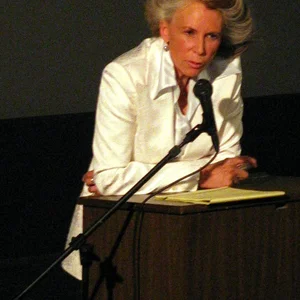
Habermas is a public intellectual, giving lectures and debates all over the world. The microphone embodies his conviction that democracy lives on the exchange of speech.
School Curriculum
Vocabulary & Tags
Key Vocabulary
Daily Life
Morning
The morning of a philosophy professor like Habermas is devoted to solitary work: reading, taking notes and writing, for a long time on a typewriter. Coffee accompanies these hours of concentration in which books and articles take shape.
Afternoon
The afternoon is paced by university life: lectures, seminars with students and discussions with colleagues. Habermas attaches great importance to the exchange of arguments, which lies at the very heart of his thought.
Evening
In the evening, he continues his reading and prepares his talks, but also stays attentive to current affairs. As a politically engaged intellectual, he sometimes writes opinion pieces for the major German newspapers in order to take part in the debates of the day.
Food
The diet of a post-war German academic is simple and without extravagance: bread, cheese, classic dishes of German cuisine. Coffee is the faithful companion of long hours of study.
Clothing
Habermas wears the sober attire of the twentieth-century academic: suit, shirt and tie for classes and lectures. His glasses are part of his familiar silhouette.
Housing
He lives in comfortable but unluxurious homes, typical of the German intellectual middle class, notably in the Starnberg area of Bavaria. The study, lined with books, is its essential room.
Historical Timeline
Period Vocabulary
Liens externes & ressources
Références
Œuvres
L'Espace public (Strukturwandel der Öffentlichkeit)
1962
Connaissance et intérêt (Erkenntnis und Interesse)
1968
De l'éthique de la discussion (Moralbewußtsein und kommunikatives Handeln)
1983
Théorie de l'agir communicationnel (Theorie des kommunikativen Handelns)
1981
Le Discours philosophique de la modernité
1985
Droit et démocratie (Faktizität und Geltung)
1992