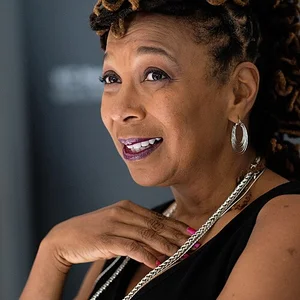

American legal scholar and theorist born in 1959, she coined the concept of intersectionality in 1989, showing how racial, gender, and class discrimination intersect and mutually reinforce one another. A professor at UCLA and Columbia, she is one of the founders of Critical Race Theory.
Kimberlé Crenshaw(1959 — ?)
Kimberlé Crenshaw
États-Unis
9 min read
Frequently asked questions
Key Facts
- Born in 1959 in Canton, Ohio
- Coined the term “intersectionality” in a landmark article published in 1989 in the Stanford Law Review
- Professor at UCLA School of Law and Columbia Law School
- Co-founder of the African American Policy Forum
- Direct influence on anti-discrimination policies in Europe and at United Nations bodies
Works & Achievements
Foundational article in which Crenshaw coined the term 'intersectionality'. She demonstrates that Black women fall into the blind spots of both anti-racist law and feminist law, neither of which protects against overlapping forms of discrimination.
Major article that extends the concept to gender-based violence, showing how women of color are doubly victimized and doubly rendered invisible by judicial and social institutions.
Foundational anthology that brings together the essential texts of Critical Race Theory and officially establishes it as a fully recognized academic discipline in the United States.
Activist initiative co-founded with the AAPF to raise the visibility of Black women victims of police violence, who are too often absent from a public debate focused on male victims.
Talk viewed by millions worldwide that makes the concept of intersectionality accessible to a non-academic audience, contributing to its widespread international reach.
A collection of her most important texts, offering a synthesis of thirty years of thinking on intersectionality, Critical Race Theory, and equality policies in the United States and around the world.
Anecdotes
In 1989, to explain her brand-new concept of intersectionality, Kimberlé Crenshaw invented a metaphor that has since become famous: imagine an intersection where cars coming from all directions represent racism, sexism, and class discrimination. A person standing at the center can be struck by vehicles coming from any side. This concrete image made a complex idea accessible to the general public and to policymakers alike.
In 2016, during her TED Talk on the urgency of intersectionality, Crenshaw asked the audience to stand if they knew the name of a Black man killed by police, then to remain standing if they also knew the name of a Black woman killed under the same circumstances. Most of those standing sat back down, strikingly revealing that Black female victims remain invisible when race and gender intersect.
As a student at Harvard in the early 1980s, Crenshaw was among the few Black women in her law classes. She observed that professors systematically overlooked cases of discrimination experienced by Black women — treated neither as cases of 'pure' racism nor as cases of 'pure' sexism. It was this personal, frustrating experience that drove her to develop the concept of intersectionality.
In 1991, during the U.S. Senate hearings to confirm Judge Clarence Thomas to the Supreme Court, Crenshaw publicly supported Anita Hill, a Black woman who accused Thomas of sexual harassment. She highlighted that Hill was doubly ignored because she was both Black and a woman — a perfect illustration of her theory, playing out in a high-stakes national news story.
In 2014, Crenshaw co-founded the 'Say Her Name' campaign to draw attention to Black women who are victims of police violence, often absent from media coverage unlike their male counterparts. Names such as Sandra Bland and Breonna Taylor were brought to the public's attention through this initiative, which transformed an activist tool into a powerful educational one.
Primary Sources
Because the intersectional experience is greater than the sum of racism and sexism, any analysis that does not take intersectionality into account cannot sufficiently address the particular manner in which Black women are subordinated.
The problem is not simply that both feminist and antiracist practices have discounted the intersectional identities of women of color, but that these practices often reconfigure racism and sexism in ways that both disempower women of color and undermine efforts to combat patriarchy and white supremacy.
Critical race theory questions the very foundations of the liberal order, including equality theory, legal reasoning, Enlightenment rationalism, and neutral principles of constitutional law.
Intersectionality is a lens through which you can see where power comes and collides, where it interlocks and intersects. It's not simply that there's a race problem here, a gender problem here, and a class or LGBTQ problem there.
Key Places
Kimberlé Crenshaw's hometown, located in the American Midwest. She grew up in an environment shaped by de facto segregation and racial inequality, experiences that forged her political awareness from childhood.
Crenshaw earned her Bachelor of Arts here in 1981. It was within this elite academic setting that she first began observing the intersecting dynamics of race and gender in legal education.
She earned her Juris Doctor here in 1984. As one of the few Black women in her classes, she experienced firsthand the forms of invisibility that her theory of intersectionality would seek to name and challenge.
Crenshaw has been a tenured professor here since the 1990s. She teaches constitutional law and critical race theory, shaping multiple generations of socially engaged legal scholars.
She also holds a professorial chair here, and co-founded the African American Policy Forum (AAPF), a think tank that extends her research into the political and social arena.
Crenshaw has testified before the U.S. Congress and contributed to numerous legislative debates on civil rights and gender-based violence, bringing intersectionality to the heart of federal policymaking.
Typical Objects

As a law professor at UCLA and Columbia, Crenshaw works daily with legislative texts and judicial decisions, analyzing them to expose the blind spots in anti-discrimination law.

Her work appears in and draws on specialized journals such as the University of Chicago Legal Forum and the Harvard Law Review, essential venues for American legal scholarship.

An international speaker, Crenshaw presents at universities, policy forums, and TED Talks, carrying her ideas far beyond academia to reach the general public.

The campaign she co-founded uses photographic portraits and names displayed in large format to make invisible victims visible, turning an activist tool into an educational instrument.

Her articles and books have been written and distributed digitally since the 1990s, a period when computing transformed the production and circulation of academic knowledge.

Crenshaw feeds her thinking with notes accumulated through her reading, her courses, and her encounters with communities affected by overlapping forms of discrimination.
School Curriculum
Vocabulary & Tags
Key Vocabulary
Tags
Daily Life
Morning
Crenshaw's day begins early, with a mix of legal press reading and close attention to American political news. As a professor at two major law schools (UCLA and Columbia), she prepares her courses by annotating court rulings and recent academic articles, always on the lookout for cases that illustrate intersecting forms of discrimination.
Afternoon
Her afternoons are divided between university teaching, leading research seminars, and mentoring doctoral students. She regularly takes part in conferences, symposia, and congressional hearings where she argues her positions on civil rights and systemic discrimination before policymakers.
Evening
In the evenings, Crenshaw engages with activist organizations such as the African American Policy Forum, which she co-founded. She prepares media appearances for television programs or social justice podcasts, and takes part in community forums in underserved neighborhoods across New York and Los Angeles.
Food
Like many American academics with packed schedules, her eating habits reflect the culinary diversity of New York and Los Angeles. Her demanding days often mean grabbing a quick lunch on campus or at a neighborhood restaurant between classes or meetings.
Clothing
In academic and professional settings, Crenshaw favors polished, formal attire — typically suits or coordinated ensembles that reflect her standing as a distinguished professor and legal scholar. At activist events, she sometimes incorporates accessories or colors associated with the civil rights movements she champions.
Housing
She divides her time between Los Angeles (UCLA) and New York (Columbia), moving back and forth between two of America's great metropolises in step with her teaching commitments. Like most faculty at these elite universities, she lives in an urban apartment, at the center of the intellectual and political energy she helps sustain.
Historical Timeline
Period Vocabulary
Liens externes & ressources
Références
Œuvres
Demarginalizing the Intersection of Race and Sex
1989
Mapping the Margins: Intersectionality, Identity Politics, and Violence Against Women of Color
1991
Critical Race Theory: The Key Writings That Formed the Movement (codirigé avec Gotanda, Peller et Thomas)
1995
Campagne 'Say Her Name'
2014
The Urgency of Intersectionality (TED Talk)
2016
On Intersectionality: Essential Writings
2019