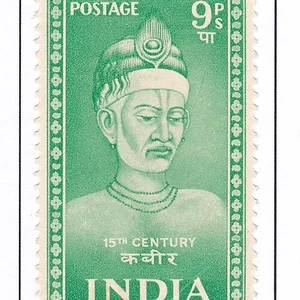

Kabir was a 15th-century Indian poet and mystic, a leading figure of the Bhakti devotional movement. A weaver by birth, he preached a single God beyond the divisions between Hinduism and Islam, denouncing rituals and caste hierarchies.
Kabir(1398 — 1518)
Kabir
6 min read
Frequently asked questions
Key Facts
- Born around 1440 in Benares (Varanasi), traditionally into a family of Muslim weavers
- A central figure of the Bhakti movement, preaching devotion to a single, formless God
- Rejected caste distinctions, idolatry, and the formal rituals of both Hinduism and Islam
- His poems (dohas and padas) were incorporated into the Guru Granth Sahib, the sacred book of Sikhism
- Died around 1518; his disciples founded the Kabir Panth movement
Works & Achievements
Short two-line poems, easy to memorize and popular, condensing a spiritual lesson or a social critique. They are still recited throughout Northern India.
Teaching couplets conveying the “truth seen” by the master. A cornerstone of instruction for the disciples of the Kabir Panth.
Longer poems setting out Kabir's spiritual doctrine on God, the soul, and the illusion of the world.
Devotional songs meant to be performed to music. Several were incorporated into the sacred book of the Sikhs.
The main collection of Kabir's sayings preserved by the Kabir Panth community, regarded as his “seed book.”
More than 500 verses attributed to Kabir were included in the Sikh sacred book, a sign of his influence beyond his own community.
Anecdotes
According to tradition, Kabir was abandoned as a baby on a pond near Benares and taken in by a Muslim couple of weavers, Niru and Nima. This uncertain origin explains why he always refused to belong fully to one religion rather than another.
It is said that Kabir, wishing to become the disciple of the great Hindu master Ramananda—who refused to teach a Muslim—lay down at night on the steps of the Ganges where the master came down to bathe. Stumbling over him in the dark, Ramananda cried out “Ram! Ram!”, and Kabir at once declared that he had received from him the divine name as initiation.
Kabir composed his poems orally, in the common tongue, while working at his loom. Probably unable to read or write, he said of himself: “I have never touched ink or paper, my hand has never held a pen.”
At his death, Hindus and Muslims are said to have quarreled over his body: some wanted to cremate it, others to bury it. Legend has it that when they lifted the shroud, they found only flowers, which they shared out to burn at Benares and bury at Maghar.
Kabir openly mocked pilgrimages and ritual ablutions: “If one could reach God by bathing in water, I would gladly be born a frog,” he scoffed, denouncing purely outward devotion.
Primary Sources
O servant, where do you seek me? See, I am right beside you. I am neither in the temple nor in the mosque, neither in the Kaaba nor on Mount Kailash.
If God dwelt in the mosque, to whom does the rest of the land belong? Why should the cow-killer perform the rites if he does not know the Lord within himself?
Slowly, slowly, O mind, everything comes in its own time: the gardener may pour a hundred buckets, but the fruit ripens only in its season.
Hindu and Muslim have the same Lord; only the names differ. Why do you quarrel?
Key Places
Hindu holy city on the Ganges where tradition places the birth and life of Kabir. A major pilgrimage center that he criticized even while living there as a weaver.
Small town near Gorakhpur where Kabir is said to have died. He reportedly chose to end his days there to challenge the belief that dying in Benares guarantees salvation.
Sacred river where, according to legend, Kabir received his initiation from Ramananda on the steps (ghats). A central place of the rites that the poet called into question.
Capital of the sultanate under the Sayyid and then Lodi dynasties during Kabir's lifetime. The center of Muslim power in northern India during this troubled era.
Memorial site where a Muslim tomb and a Hindu cenotaph stand side by side in memory of Kabir, a symbol of the unity he preached.
Typical Objects

The weaver's tool on which Kabīr worked every day. In his poetry, weaving became a metaphor for divine creation and the union of the soul with God.

A small piece of wood that carries the weft thread between the warp threads. A recurring image in Kabīr's work of time slipping by and life flowing away.

A string of beads used to repeat the name of God. Kabīr was wary of them, mocking those who turn the beads without transforming their hearts.

The weaver's raw material. In Kabīr's poems, thread symbolizes the breath of life and the invisible bond between the soul and the divine.

The “Nām,” the inner repetition of the name of God, lies at the heart of Kabīr's teaching. For him, this single name transcends the labels of “Allah” or “Rām.”

A vessel used for ritual ablutions near Benares. Kabīr used it to mock those who believe they can purify themselves with water rather than with sincerity of heart.
School Curriculum
Vocabulary & Tags
Key Vocabulary
Daily Life
Morning
Kabir rises before dawn to meditate and repeat the divine name in silence. He then sets up his loom in his modest house in Benares and begins his day's work.
Afternoon
The weaver spends long hours at his loom, running the shuttle between the threads. As he works, he composes and hums his poems, blending the craftsman's gesture with meditation.
Evening
In the evening, disciples and the curious, both Hindus and Muslims, gather around him to listen to his songs and his words. The exchanges can last late into the night, punctuated by devotional songs (bhajans).
Food
Kabir leads the frugal life of a humble artisan: wheat flatbreads (rotis), vegetables, lentils, and fruit. True to the Bhakti ideal, he advocates a simple, non-violent diet, far from ritual excess.
Clothing
He wears the plain cotton clothing of the weaver: a loincloth (dhoti), a long tunic, and sometimes a shawl. Without any ostentatious signs of religious affiliation, neither Hindu markings nor Sufi attire.
Housing
He lives in a humble weaver's house in a working-class district of Benares, where his loom holds a central place. A modest dwelling reflecting his rejection of wealth and hierarchies.
Historical Timeline
Period Vocabulary
Liens externes & ressources
Références
Œuvres
Dohas (distiques)
XVe siècle
Sâkhî (témoignages)
XVe siècle
Ramaini
XVe siècle
Shabad (hymnes chantés)
XVe siècle
Bîjak
compilé après 1518
Hymnes de l'Âdi Granth
intégrés en 1604