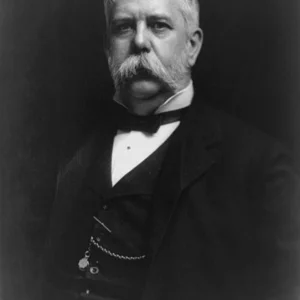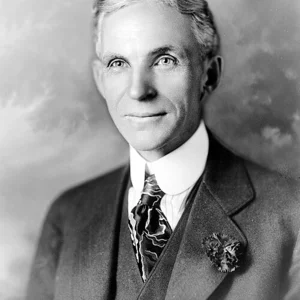

American industrialist (1863–1947), Henry Ford revolutionized automobile manufacturing by introducing the assembly line and the Model T. He is the founder of the Ford Motor Company and one of the founding fathers of modern industrial capitalism.
Henry Ford(1863 — 1947)
Henry Ford
États-Unis
10 min read
Frequently asked questions
Famous Quotes
« If I had asked people what they wanted, they would have said faster horses.»
« Whether you think you can, or you think you can't – you're right.»
Key Facts
- 1863: Born in Dearborn, Michigan
- 1903: Founded the Ford Motor Company
- 1908: Launch of the Model T, an affordable car for the general public
- 1913: Introduction of the moving assembly line at the Highland Park plant
- 1914: Introduction of the five-dollar workday, doubling the average worker's wage
Works & Achievements
The first automobile designed to be mass-produced and sold, the Model T revolutionized American society by making the car accessible to the middle class. With 15 million units built between 1908 and 1927, it remains the world's enduring symbol of the democratization of the automobile.
A landmark industrial innovation of the twentieth century, this moving assembly line cut the time to assemble a Model T from 12 hours to 93 minutes. It became the organizational blueprint for the entire global manufacturing industry and gave its name to 'Fordism.'
An unprecedented economic and social decision, this doubling of the minimum wage for Ford workers transformed the relationship between a company and its employees. By making workers financially capable of buying what they produced, Ford created an economic model in which producers and consumers were one and the same — anticipating Keynesian theory.
A fully integrated mega-factory that transformed raw iron ore into a finished automobile on a single site, River Rouge embodied the Fordist dream of a self-sufficient capitalism free from any outside dependency. For decades it remained the largest industrial production site in the world.
Co-written with journalist Samuel Crowther, this book laid out Ford's industrial and social philosophy for a general audience. Translated around the world, it influenced industrialists, politicians, and even dictators such as Benito Mussolini and Adolf Hitler.
Founded in Dearborn on the fiftieth anniversary of Edison's electric light bulb, this unique museum complex preserves historic buildings relocated from across the United States. Ford wanted to demonstrate that American industrial and craft history deserved to be celebrated on equal footing with political history.
Anecdotes
In January 1914, Henry Ford stunned the business world by announcing he would nearly double the minimum wage for his workers to five dollars a day. This masterstroke dramatically reduced turnover in his factories, where the annual staff turnover rate had reached 370% — so grueling were the working rhythms. By making his own employees able to afford a Ford, he invented, without naming it, the concept of the consumer society.
Ford drew inspiration from Chicago's industrial slaughterhouses to design his assembly line. In those plants, animal carcasses moved along on rolling hooks past specialized workers, each performing a single motion. Ford reversed the principle: it was the car that moved toward stationary workers. When the first assembly line started up at Highland Park in 1913, the time to build a Model T dropped from 12 hours to 93 minutes.
For years, the Model T was offered in just one color: black. Ford reportedly replied to a customer asking for a different shade: “You can have it in any color, so long as it is black.” This was no whim but an industrial decision: black lacquer dried faster than any other color, which sped up production.
Ford harbored a deep distrust of bankers and financial middlemen. In 1919, he bought out all minority shareholders in Ford Motor Company so as never to depend on outside investors. He went so far as to build his River Rouge complex as a self-sufficient empire with its own iron mines, forests, railways, and river port — so that he would owe his success to no one but himself.
A committed pacifist at the outset of the First World War, Ford chartered a ship in 1915 dubbed the “Peace Ship” to cross the Atlantic and attempt to negotiate an armistice in Europe. The initiative, ridiculed by the press, was a resounding failure. Ford disembarked ill in Denmark and returned to the United States empty-handed. As a twist of fate, his factories went on to produce vast quantities of military equipment during both world wars.
Primary Sources
The way to make automobiles is to make one automobile like another automobile, to make them all alike, to make them come through the factory just alike; just as one pin is like another pin when it comes from a pin factory.
There is no reason why a man who gives good work to this company should not be able to start a home, raise children, and live comfortably. We share the profits with the men who create them.
We have found in buying materials that it is not worthwhile to buy for other than immediate needs. We buy only enough to fit into the plan of production, taking into consideration the state of transportation at the time.
My mission is to employ as many men as possible, to pay them as well as possible, and to manufacture cars at the lowest possible price. Profits, if any remain, come last.
An idealist is a person who helps other people to be prosperous. The idealist says: if I can make things better for the men who work for me, I shall make more money. That is not theory — it is sound business.
Key Places
Henry Ford's birthplace in 1863, this modest farm in Wayne County has been reconstructed within Greenfield Village. It was here that Ford developed his ambivalent relationship with agricultural work — which he sought to mechanize in order to free farmers from physical hardship.
Opened in 1910 and designed by architect Albert Kahn, this factory was the laboratory of the Fordist revolution: it was here that the world's first moving assembly line was introduced in 1913. Now a historic landmark, it stands as the birthplace of modern mass production.
Built between 1917 and 1928, River Rouge is one of the largest industrial complexes ever constructed: 93 buildings spread across 4 km², integrating mines, forests, blast furnaces, a glass plant, and assembly lines. Ford made it the tangible proof of his vision for total industrial self-sufficiency.
Known as Ford World Headquarters, the historic home of Ford Motor Company has been located in Dearborn since 1956. The campus also houses the Henry Ford Museum and Greenfield Village, institutions founded by Ford himself to preserve American industrial history.
Henry Ford's personal home, built in 1915 on the banks of the Rouge River, Fair Lane was a 56-room mansion featuring its own power plant designed by his friend Thomas Edison. Ford entertained figures such as Harvey Firestone there and spent the final decades of his life on the estate.
Typical Objects

The iconic car launched in 1908 and produced in 15 million units, the Model T is the symbol of the democratization of the automobile. Its simple, standardized design allowed the selling price to drop from $850 to $260 over twenty years, thanks to the productivity gains of the assembly line.

The central element of the Fordist revolution, the motorized conveyor moves chassis from one workstation to the next at a constant speed, dictating the pace of production. Introduced at Highland Park in 1913, it is the cornerstone of Fordism and would be copied across all major industries of the 20th century.

The instrument of scientific management theorized by Frederick Winslow Taylor, whose ideas Ford drew upon to break every task down into elementary motions and calculate the optimal time for each. The stopwatch symbolizes the subordination of the worker's body to the rhythm of the machine in the Fordist factory.

Ford published practical guides written in plain language so that Model T owners could maintain their vehicles themselves. This unprecedented educational approach accompanied the spread of car culture across rural America, where professional mechanics were scarce.

The Ford worker's pay stub became a social symbol in 1910s America: it represented a promise of stability and access to consumer life. Ford tied this high wage to strict conditions, however — workers were expected to be sober, thrifty, and compliant with a code of conduct monitored by the company's Sociological Department.

The River Rouge industrial complex had its own internal rail network spanning several dozen kilometers. These locomotives hauled iron ore, coal, and raw materials directly from river barges to the smelting furnaces, embodying Ford's ambition to control his entire supply chain.
School Curriculum
Vocabulary & Tags
Key Vocabulary
Tags
Daily Life
Morning
Ford rose early, around 6 a.m., a habit inherited from his farm childhood. He ate a frugal breakfast and walked or drove to his factories, which he would tour at length inspecting the assembly lines. He placed great importance on direct observation of production and had little appetite for purely administrative work.
Afternoon
Ford's afternoons were often spent in meetings with his engineers and foremen on the shop floor rather than in offices. A passionate hands-on mechanic, he enjoyed getting his own hands into engines and suggesting technical improvements. He sometimes allowed himself walks through the woods surrounding Fair Lane, convinced that physical activity nurtured creativity.
Evening
Ford generally returned to Fair Lane to dine with his wife Clara, whom he had married in 1888 and remained close to throughout his life. He was a passionate dancer of traditional American folk dances and even funded the construction of a ballroom at Greenfield Village. He read little but appreciated folk music and evenings spent with his friends Harvey Firestone and Thomas Edison.
Food
Ford was a committed vegetarian from the 1920s onward, influenced by his reading on health and longevity. He mainly ate vegetables from his kitchen garden, soy milk, and whole grains, and extolled the virtues of medicinal plants. He was a lifelong teetotaler and had all drinking establishments closed on his industrial sites.
Clothing
Ford dressed simply for a man of his wealth: understated suits of classic cut, often grey or navy blue, white shirts, and felt hats. On the assembly lines, he frequently wore a grey work coat. He had no patience for sartorial ostentation and was wary of overly well-dressed businessmen.
Housing
Ford lived at Fair Lane, an imposing 56-room mansion built in 1915 in Dearborn on the banks of the Rouge River. The home, powered by its own hydroelectric plant designed by Thomas Edison, included an indoor swimming pool, an ice rink, an experimental farm, and greenhouses. Despite this luxury, Ford always kept a spartan office and maintained an austere personal lifestyle.
Historical Timeline
Period Vocabulary
Liens externes & ressources
Références
Œuvres
Modèle T
1908
Chaîne d'assemblage mobile de Highland Park
1913
Five-Dollar Day (salaire de 5 dollars par jour)
1914
Complexe industriel de River Rouge
1927
My Life and Work (autobiographie)
1922
Greenfield Village et Henry Ford Museum
1929