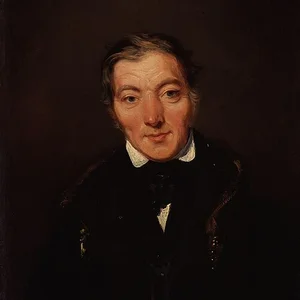

A Welsh industrialist and socialist theorist, Robert Owen transformed the New Lanark cotton mill into a model of social reform. A pioneer of utopian socialism and the cooperative movement, he championed better conditions for workers and education for all.
Robert Owen(1771 — 1858)
Robert Owen
pays de Galles, Royaume-Uni de Grande-Bretagne et d'Irlande
6 min read
Frequently asked questions
Key Facts
- Born in 1771 in Newtown (Wales), died in 1858
- From 1800, ran and reformed the New Lanark cotton mill in Scotland, improving housing, wages, and working conditions
- Founded one of the first infant schools at New Lanark around 1816
- Published 'A New View of Society' (1813-1816), setting out his ideas on how character is shaped by environment
- In 1825, founded the utopian community of New Harmony in Indiana (United States), which failed in 1828
- Inspired the British cooperative and trade union movement in the 1830s
Works & Achievements
Transformation of an ordinary factory into a social model: a shorter working day, healthy housing, free schooling and a store selling at cost price. A worldwide showcase of industrial reformism.
A series of essays setting out his central thesis: human character is shaped by environment, so education and good conditions can regenerate society.
A school and community centre in New Lanark welcoming the young children of the workers, regarded as one of the first infant schools in Europe.
A report proposing “villages of cooperation” founded on labour as the measure of value, the theoretical basis of Owenite socialism.
A practical attempt at a cooperative society in the United States. Its failure did not erase its influence on later communitarian movements.
A London institution where goods were exchanged for a currency measuring labour time, a pioneering experiment in alternative economics.
A systematic exposition of his doctrine of a “new moral world” founded on the science of character and on cooperation.
Anecdotes
At New Lanark in Scotland, Robert Owen refused to employ children under the age of ten in his cotton mill, while elsewhere youngsters of five or six were already working twelve hours a day. He opened a free school for them, which both shocked and fascinated visitors who came from all over Europe.
Owen invented a curious tool of discipline: the 'silent monitor', a small wooden block with four coloured faces hung beside each worker. Depending on which colour was turned toward the aisle, you could tell at a glance whether the worker had been excellent, good, average or poor the day before — without shouting or blows.
In 1825, Owen left Britain to found the ideal community of New Harmony in Indiana, in the United States. He sank a large part of his fortune into it, but the colony, undermined by quarrels, fell apart in barely two years.
Owen believed so firmly that human character is shaped by environment that he declared: a child raised in good conditions will turn out good, whatever his blood. This idea, commonplace today, was revolutionary at a time when the poor were judged responsible for their own misery.
Late in his life, the old rationalist industrialist converted to spiritualism and claimed to communicate with the spirits of the dead, including those of Benjamin Franklin and Thomas Jefferson, to the great astonishment of his former disciples.
Primary Sources
The character of man is, without a single exception, always formed for him; it might have been, and may yet be, formed for him by others.
Manual labour, properly directed, is the source of all wealth and of national prosperity.
Every society founded until now has been founded in ignorance of the true laws of human nature.
My great object has been to improve the character and condition of all, from the humblest birth to the highest.
Key Places
Small Welsh town where Robert Owen was born in 1771 and where he returned to die in 1858. There he had left school at the age of ten to become an apprentice.
Factory village on the banks of the Clyde where Owen carried out his great social experiment: decent housing, a school and a cooperative store. Today it is a UNESCO World Heritage Site.
Cotton capital where the young Owen made his fortune as the manager of a large spinning mill before buying New Lanark. The beating heart of the Industrial Revolution.
Site purchased in 1825 to found an ideal cooperative community, which collapsed within two years. Owen invested in it and lost a large part of his fortune.
Hub of his reform campaigns: the National Equitable Labour Exchange, trade union congresses and publications. There Owen spread his ideas among workers and Parliament.
Liens externes & ressources
Références
Œuvres
Réforme de la filature de New Lanark
1800-1825
A New View of Society
1813-1814
Institut pour la formation du caractère
1816
Bourse nationale d'échange équitable du travail
1832