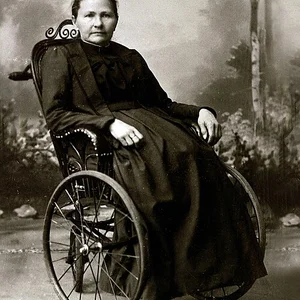

Margarete Steiff (1847-1909) was a German seamstress and entrepreneur, founder of the Steiff toy manufacturing company. Stricken with polio and using a wheelchair, she built a thriving business from her hand-sewn felt animals, which gave rise to the famous teddy bear.
Margarete Steiff(1847 — 1909)
Margarete Steiff
Royaume du Wurtemberg
6 min read
Frequently asked questions
Key Facts
- Stricken with polio at around 18 months of age, she remained paralyzed in her legs and retained only limited use of her right arm.
- She opened a felt sewing workshop in Giengen an der Brenz and founded her company in 1880.
- In 1880, she made a small felt elephant intended to serve as a pincushion, which became a success as a children's toy.
- In 1902-1903, the Steiff firm produced the jointed teddy bear designed by her nephew Richard Steiff, the future “teddy bear.”
- She died in 1909, leaving behind a manufacturing company that had become world-renowned and is still in operation today.
Works & Achievements
Margarete Steiff's first business, specializing in making felt clothing and goods. The economic foundation of her future factory.
Her first animal creation, at first a pincushion and then a hit toy. The birth certificate of the Steiff toy industry.
The officially registered company, employing many women workers from the region. It would become a worldwide benchmark for quality toys.
Designed with her nephew Richard Steiff, the first bear with movable limbs. It launched the worldwide teddy bear craze.
A distinctive mark registered to authenticate every Steiff animal. A pioneering commercial innovation against counterfeiting.
Anecdotes
At the age of 18 months, Margarete Steiff contracted polio, which left her legs paralyzed and limited the use of her right arm. She would spend her entire life in a wheelchair, but refused to let herself be defined by her disability, learning to sew in order to earn her independence.
When she bought the first sewing machine in the town of Giengen, Margarete discovered that she could not use it normally because of her right arm. So she decided to turn the machine around to operate it with her left hand, adapting the tool to her body rather than the other way around.
In 1880, Margarete sewed a small felt elephant originally designed as a pincushion for seamstresses. But children seized upon it as a toy: faced with this unexpected success, she launched into making stuffed animals and sold several thousand elephants within a few years.
In 1902, her nephew Richard Steiff designed a bear with movable joints. Presented at the Leipzig toy fair in 1903, the bear left Europeans indifferent, until an American buyer ordered 3,000 of them all at once, launching the worldwide craze for the teddy bear.
To protect its creations from imitations, the company registered the famous “button in ear” (Knopf im Ohr) trademark in 1904: a small metal button fixed to the ear of each animal. It is one of the earliest trademarks in the history of toys.
Primary Sources
For children, only the best is good enough. (Für Kinder ist nur das Beste gut genug.)
Every authentic animal from the manufactory bears a metal button fixed to its ear as a guarantee of origin and quality.
Carefully sewn felt and plush animals, sturdy toys made to withstand children's play.
Key Places
Town in Württemberg where Margarete Steiff was born, lived, and founded her manufacturing company. The Steiff company headquarters are still located there today.
A felt-making workshop opened in 1877, the birthplace of the first stuffed animals. It would grow into the world-famous manufacturing company.
A major Saxon city whose trade fair hosted the famous toy fair. It was there, in 1903, that the Steiff bear found its first American buyer.
A modern museum located in Giengen, tracing the history of Margarete Steiff and her toys. A place of remembrance for her entrepreneurial legacy.
Typical Objects

Mohair bear with jointed arms, legs and head that became the flagship product of the Steiff company. Its English name “teddy bear” is linked to American president Theodore Roosevelt.

Small elephant sewn from felt, first designed as a pincushion before being adopted as a toy. It is Margarete Steiff's very first animal creation.

The first sewing machine in the town of Giengen, which Margarete turned around so she could operate it with her left hand despite her disability. The founding tool of her work as a seamstress.

Small metal button attached to the ear of every Steiff animal, registered as a trademark. It guarantees the authenticity and quality of the product against imitations.

A sturdy non-woven fabric used for the first Steiff animals, before mohair was adopted. The basic material of Margarete's sewing work.

The chair in which Margarete Steiff lived her entire life after contracting polio. Far from holding her back, it accompanied her daily work as an entrepreneur and seamstress.
School Curriculum
Vocabulary & Tags
Key Vocabulary
Daily Life
Morning
Settled in early at her workshop in Giengen, Margarete supervises the workers and cuts the felt patterns herself. Despite the pain and fatigue, she insists on checking the quality of every piece first thing in the morning.
Afternoon
The afternoon is devoted to sewing, designing new animal models, and managing orders. She receives suppliers and customers, negotiates prices, and organizes the production of the family workshop.
Evening
In the evening, Margarete often continues her sewing work at home and keeps the company's accounts. Surrounded by her family, especially her nephews, she prepares the next day's projects and catalogs.
Food
Her diet is that of the late-19th-century Swabian middle class: rye bread, potatoes, soups, cured meats, and slow-cooked dishes like Spätzle. Meals are simple, nourishing, and eaten as a family.
Clothing
Margarete wears the long, buttoned dresses typical of women of her time, made from the wool and felt fabrics she masters perfectly. Her outfit is plain and practical, suited to her work as a seamstress in a wheelchair.
Housing
She lives in Giengen, a small town in Württemberg, in a house close to her workshop. Her home, adapted for getting around in a wheelchair, blends family living space and workplace.
Historical Timeline
Period Vocabulary
Liens externes & ressources
Références
Œuvres
Atelier de feutre de Giengen
1877
L'éléphant en feutre (Elefäntle)
1880
Manufacture de jouets Steiff
1893
L'ours en peluche articulé (modèle 55 PB)
1902-1903
La marque « bouton dans l'oreille »
1904