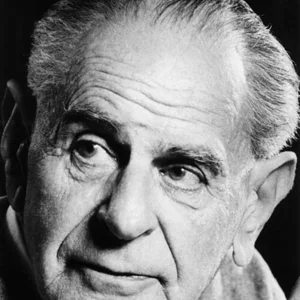

An Austrian-born British philosopher of science, Karl Popper is one of the major thinkers of the 20th century. He revolutionized epistemology with the criterion of falsifiability and defended liberal democracy in *The Open Society and Its Enemies*.
Karl Popper(1902 — 1994)
Karl Popper
Autriche, Royaume-Uni, Royaume-Uni de Grande-Bretagne et d'Irlande, Cisleithanie
7 min read
Frequently asked questions
Famous Quotes
« A theory which is not refutable by any conceivable event is non-scientific.»
Key Facts
- Born in Vienna in 1902 into a Jewish family converted to Protestantism
- Publishes *The Logic of Scientific Discovery* in 1934, setting out the criterion of falsifiability
- Emigrates to New Zealand in 1937 to flee Nazism, then settles in London
- Publishes *The Open Society and Its Enemies* in 1945, a critique of Plato, Hegel, and Marx
- Teaches at the London School of Economics and dies in London in 1994
Works & Achievements
A foundational work proposing falsifiability as the criterion for demarcating science. It transformed the epistemology of the 20th century.
A critique of doctrines that claim to predict the inevitable course of history. Popper exposes the foundations of totalitarian political prophecies.
A passionate defense of liberal democracy against Plato, Hegel, and Marx, whom he accuses of feeding totalitarianism. It became a classic of political philosophy.
A collection setting out his view of knowledge as a succession of bold hypotheses and refutations. In it he develops “critical rationalism.”
Popper presents his theory of the “three worlds” and his evolutionary view of knowledge as the product of selection through trial and error.
An account of his life and the genesis of his ideas, from Vienna to London. A valuable testimony to a century of intellectual upheaval.
A dialogue with the neurophysiologist John Eccles on the relationship between mind and brain. Popper defends an interactionist position.
Anecdotes
In 1919, the young Popper attended a lecture by Albert Einstein in Vienna. He was struck by the fact that Einstein himself pointed out which observations could refute his theory of relativity. This intellectual honesty, which he contrasted with the dogmatism of Marxism and psychoanalysis, became the starting point of his entire philosophy: a genuine scientific theory takes the risk of being proven wrong.
Before becoming a philosopher, Popper built furniture as a cabinetmaking apprentice and earned a teaching certificate. He also worked with disadvantaged children in Vienna, which fed his interest in education and learning through trial and error.
Worried about the rise of Nazism, Popper, who was of Jewish descent, left Austria in 1937 to teach in New Zealand, on the other side of the world. It was there, isolated during the Second World War, that he wrote *The Open Society and Its Enemies*, which he called his “war effort” against totalitarian regimes.
In 1946, during a meeting in Cambridge, Popper and the famous philosopher Ludwig Wittgenstein are said to have clashed violently. According to one version that has become legendary, Wittgenstein supposedly brandished a fireplace poker to drive home his point before storming out of the room. The episode, nicknamed “the poker affair,” has become a myth in the history of philosophy.
Popper liked to repeat that “we do not know, we can only guess.” For him, human knowledge is not like a structure resting on solid rock, but like piles driven into a swamp: we stop driving them deeper not because we have reached firm ground, but because we judge the piles strong enough for the time being.
Primary Sources
It is not the verifiability but the falsifiability of a system that is to be taken as a criterion of demarcation. [...] A system belonging to empirical science must be capable of being refuted by experience.
The open society is one in which individuals are confronted with personal decisions, as opposed to the closed, magical, tribal or collectivist society.
The criterion of the scientific status of a theory lies in the possibility of invalidating it, of refuting it, or indeed of testing it.
I still remember the lasting impression that Einstein's theory made on me: for the first time, I encountered a theory that itself indicated what could refute it.
Key Places
Popper's birthplace, a bustling intellectual hub of the early 20th century where he studied and forged his critical thinking.
Where he studied philosophy and psychology, earning his doctorate in 1928 and brushing shoulders, from a distance, with the Vienna Circle.
His place of exile from 1937 to 1945, where he taught at Canterbury University College and wrote *The Open Society and Its Enemies*.
The institution where Popper taught logic and scientific method from 1946 onward, at the heart of his career and his worldwide influence.
An area on the outskirts of London where Popper lived in his final decades, leading a studious and secluded life.
Typical Objects

Popper's key concept: a theory is only scientific if it can be refuted by experience. It is the intellectual tool that separates science from pseudo-science.

The typescript written in exile in New Zealand during the war. Popper regarded it as his personal contribution to the fight against totalitarianism.

The philosopher's everyday tool for writing his books and his abundant correspondence. Popper reworked his texts endlessly, producing many versions.

The medium for his courses in logic and scientific method at the London School of Economics. On it, Popper trained generations of students in critical thinking.

A vast collection of books on philosophy, science and music that surrounded his work. Popper read in several languages and constantly tested ideas against one another.

A passionate music lover, Popper had first considered a musical career and studied composition. Bach and Mozart nourished his thinking about objectivity and creation.
School Curriculum
Vocabulary & Tags
Key Vocabulary
Tags
Daily Life
Morning
An early riser and tireless worker, Popper often began his day by going back over the pages he had written the day before. He reworked his manuscripts endlessly, crossing out and rewriting until he reached perfect clarity. The morning was his time of intense concentration.
Afternoon
His afternoons were divided between reading, an abundant correspondence with other scholars, and preparing his lectures. When he taught at the LSE, he engaged in dialogue with his students, pushing them toward criticism. He defended his ideas with a passion that could at times be formidable.
Evening
In the evening, Popper liked to listen to or play classical music, Bach and Mozart in particular. Conversations with his wife Josefine, known as “Hennie,” his faithful collaborator, punctuated his evenings. He often carried on his thinking late into the night.
Food
Popper led a sober life with no extravagance at the table. Accustomed to the modest ways of life of Central Europe and later England, he attached little importance to fine dining. Intellectual work came before the pleasures of the table.
Clothing
He dressed with the sobriety of the twentieth-century university professor: suit, shirt, and tie. His attire reflected the seriousness and rigor he brought to his thinking. There was nothing ostentatious about his appearance.
Housing
After his exile in New Zealand, Popper settled in the residential suburbs south of London. His home, quiet and studious, overflowed with books and musical scores. There he led a secluded, almost ascetic existence, wholly devoted to study.
Historical Timeline
Period Vocabulary
Liens externes & ressources
Références
Œuvres
Logik der Forschung (La Logique de la découverte scientifique)
1934
Misère de l'historicisme
1944-1945
La Société ouverte et ses ennemis
1945
Conjectures et réfutations
1963
La Connaissance objective
1972
La Quête inachevée (autobiographie)
1974
Le Moi et son cerveau (avec John Eccles)
1977