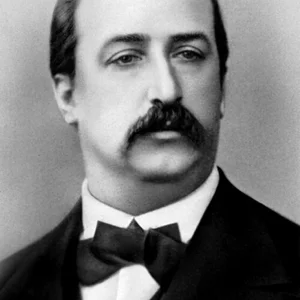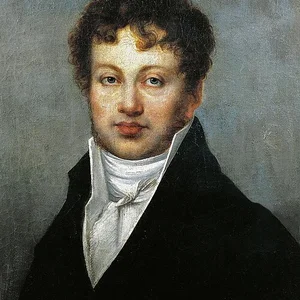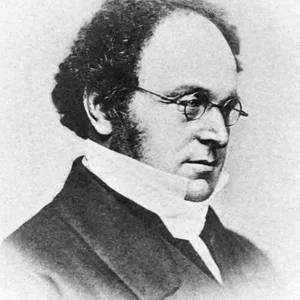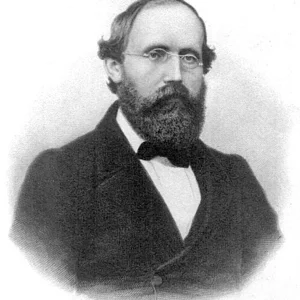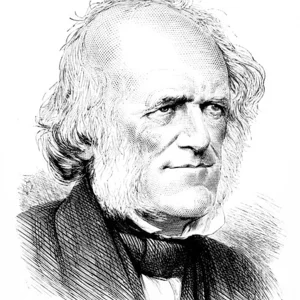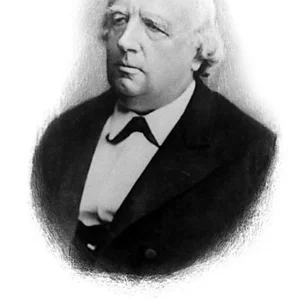

Karl Weierstrass was a German mathematician regarded as the “father of modern analysis.” He placed analysis on rigorous foundations by formalizing the notions of limit and continuity.
Karl Weierstrass(1815 — 1897)
Karl Weierstrass
royaume de Prusse
6 min read
Frequently asked questions
Key Facts
- Born in 1815 in Ostenfelde (Westphalia), died in 1897 in Berlin
- Long a secondary-school teacher before becoming famous through a paper on Abelian functions (1854)
- Appointed professor at the University of Berlin in 1856
- Formalized the rigorous definition of limit and continuity (the epsilon-delta method)
- In 1872 gave the example of a function that is continuous everywhere but differentiable nowhere (the Weierstrass function)
Works & Achievements
The work that revealed his genius and lifted him from secondary-school teacher to recognized mathematician.
A precise formulation of the notions of limit and continuity that grounds modern analysis on solid logical foundations.
A revolutionary example of a curve that is continuous yet has no tangent at any point, overturning geometric intuition.
A fundamental result stating that every bounded sequence has a convergent subsequence, a cornerstone of analysis.
A proof that any continuous function on an interval can be approximated as closely as desired by polynomials.
The construction of entire functions from their zeros, a major tool in the theory of complex functions.
Lessons of a new rigor, spread through his students' notes, that trained mathematicians across Europe.
Anecdotes
For fourteen years, Karl Weierstrass taught mathematics in provincial secondary schools (Gymnasien), to pupils who were sometimes very young, while carrying out his research in the evenings and at night. It is said that he also had to teach gymnastics and calligraphy, far from the image of a great scholar.
In 1854, a paper on Abelian functions published in a specialized journal struck like a thunderbolt: this obscure secondary-school teacher had just solved a major problem. The University of Königsberg immediately awarded him an honorary doctorate, and his academic career was launched.
Weierstrass astonished the mathematical world by constructing a function that is continuous at every point but differentiable at none. Many believed such a “monstrosity” to be impossible; some, like Charles Hermite, spoke with dread of this “deplorable plague of functions with no derivative.”
A brilliant student from Russia, Sofia Kovalevskaya could not officially enroll at the University of Berlin because she was a woman. Weierstrass agreed to give her private lessons for years and helped her become one of the first women to earn a doctorate in mathematics.
As a student at Bonn, the young Weierstrass spent more time fencing and in taverns than studying the law his father wanted to impose on him. He returned without a degree, to his family's great disappointment, before finally turning to mathematics.
Primary Sources
A memoir on the theory of abelian functions that revealed Weierstrass's talent and earned him the recognition of the mathematicians of his time.
A presentation to the Berlin Academy of a continuous function that has no derivative at any point of its domain.
Letters exchanged between Weierstrass and his student Sofia Kovalevskaya, bearing witness to their scientific collaboration and their lasting friendship.
An edition gathering Weierstrass's memoirs, lectures, and notes, which for a long time were circulated mainly through his students' transcriptions of his lessons.
Key Places
Village in North Rhine-Westphalia where Karl Weierstrass was born in 1815.
University where the young Weierstrass was sent to study law and finance, studies he abandoned for mathematics.
City where he attended the lectures of Christoph Gudermann, who awakened his taste for the theory of functions, and where he earned his teaching certificate.
Small town where Weierstrass taught for years at a secondary school, pursuing his research in solitude before gaining recognition.
University where he became a professor in 1856 and where he trained an entire generation of mathematicians, including Sofia Kovalevskaya.
Prussian and later German capital where Weierstrass spent the end of his life and died in 1897.
Typical Objects

The teacher's daily tool, on which Weierstrass worked out his proofs before audiences of students who came from all over Europe.

Writing instruments with which he composed his papers and his abundant scientific correspondence.

Weierstrass's lectures, rarely published by himself, were chiefly spread through the handwritten notes carefully copied out by his students.

Leather-bound scholarly works, like those of Abel or Cauchy, which Weierstrass studied to build his own theory of analysis.

The source of light for long evenings of work, when the high-school teacher pursued his research after his days in the classroom.

The platform and lectern from which he taught at the University of Berlin, which became a world center of mathematical analysis.
School Curriculum
Vocabulary & Tags
Key Vocabulary
Daily Life
Morning
Back when he was a high-school teacher, Weierstrass rose early to prepare and deliver his lessons to pupils who could be rather unruly. His mornings were filled with hours of teaching, including secondary subjects such as calligraphy and gymnastics.
Afternoon
Afternoons were split between grading papers and, later in Berlin, the lectures he gave at the university. Before an international audience, he developed his proofs slowly and methodically on the blackboard.
Evening
Evenings were his time for research: long isolated in the provinces, it was at night, by lamplight, that he forged his ideas about functions. As he aged, his frail health forced him to dictate his work to assistants or to his female students.
Food
Like a middle-class German civil servant of the 19th century, his diet was built around bread, potatoes, meat, and beer, the everyday drink in Prussia. As a student in Bonn, he had been a spirited regular at the university taverns.
Clothing
He wore the sober attire of the Prussian professor: a dark frock coat, a high-collared shirt, and a knotted necktie or lavallière. This austere dress suited the dignity expected of a Berlin academic.
Housing
During his years in the provinces, he lodged modestly in the garrison towns where he taught. In Berlin, he occupied a bourgeois apartment befitting his rank as a university professor, where he received his students.
Historical Timeline
Period Vocabulary
Liens externes & ressources
Références
Œuvres
Mémoire sur la théorie des fonctions abéliennes
1854
Définition rigoureuse de la limite (epsilon-delta)
années 1860
Fonction de Weierstrass (continue et nulle part dérivable)
1872
Théorème de Bolzano-Weierstrass
milieu du XIXe siècle
Théorème d'approximation de Weierstrass
1885
Théorème de factorisation de Weierstrass
années 1870
Cours d'analyse de Berlin
1856-1890