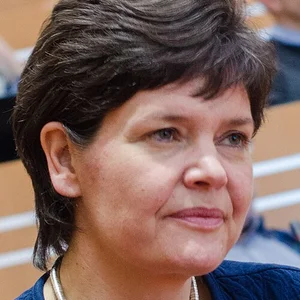

British economist born in 1970, she is known for having designed "Doughnut Economics," an economic model aiming to reconcile human needs with the ecological limits of the planet. Her major work renewed thinking about sustainable development.
Kate Raworth(1970 — ?)
Kate Raworth
Royaume-Uni
5 min read
Frequently asked questions
Key Facts
- Born in 1970 in the United Kingdom.
- In 2017, publishes her major work "Doughnut Economics," which formalizes her model.
- Designs the "doughnut" model articulating a social foundation and an ecological ceiling.
- Worked for many years for the NGO Oxfam before developing her theory.
- Teaches at the University of Oxford and the University of Amsterdam.
Works & Achievements
A working paper for Oxfam that introduced the doughnut model for the first time, linking social justice with ecological limits.
Her major book, which proposes rethinking the economy to meet everyone's needs without overshooting the planet's limits.
A widely shared talk in which she argues for economies designed to thrive rather than to grow endlessly.
An organization she co-founded to help cities, businesses, and communities put her model into practice.
An adaptation of her theory to the scale of a major city, which has become a case study around the world.
Anecdotes
Before imagining her famous diagram, Kate Raworth worked for the NGO Oxfam, where she wrote reports on global poverty. It was while trying to represent both human needs and the limits of the planet that she had the idea of drawing a ring shaped like an American doughnut.
The name of her theory comes from a simple image: a doughnut, that round cake with a hole punched through the center. The hole represents human shortfalls (hunger, lack of water, lack of schooling) and the outer edge represents ecological damage. The ideal space, sweet and balanced, lies between the two.
As a student, Kate Raworth spent time in the villages of Zanzibar studying how small businesses could help families. This field experience convinced her that the economy should serve people, and not just push numbers higher.
Her book “Doughnut Economics,” published in 2017, was such a success that it was translated into many languages. In 2020, the city of Amsterdam officially adopted her doughnut model to rethink its economy after the health crisis — something never before seen for an idea born on a sketch.
Kate Raworth likes to say that she would never have succeeded in a traditional economics class, because she found the conventional graphs disconnected from real life. She ended up inventing her own graph, which became known worldwide.
Primary Sources
Humanity in the 21st century faces an unprecedented challenge: to meet the needs of all people within the means of our living planet.
Between the social foundation and the environmental ceiling lies a ring-shaped space that is both an ecologically safe and a socially just space for humanity.
What if we designed economies that thrive, whether or not they grow?
Key Places
University town where Kate Raworth teaches and conducts her research at the University of Oxford. The heart of her intellectual activity.
Institution where she studied economics before turning to fieldwork and practice.
Archipelago in Tanzania where she carried out field research on small village businesses early in her career.
The first major city to adopt the doughnut model as a compass for its economic policy in 2020.
Anti-poverty NGO where she worked as a researcher and where the idea of the doughnut was born.
Typical Objects

A ring-shaped diagram representing the safe and just space for humanity, between social foundations and ecological limits. It is the central symbol of her thinking.

A 2017 work that lays out seven ways to think about economics in the 21st century. A best-seller translated into many languages.

The tools she uses to draw and redraw her diagrams during her lectures. The hand-drawn sketch is her trademark.

A working instrument for writing, analyzing data, and taking part in online conferences all over the world.

Traditional graphs measuring a country's wealth, which she criticizes for their inability to measure real well-being. A subject of debate in her work.
School Curriculum
Vocabulary & Tags
Key Vocabulary
Tags
Daily Life
Morning
Her morning often begins by reading the economic and environmental news, then by writing or preparing classes. She responds to the many requests that come in from all over the world.
Afternoon
The afternoon is devoted to research, to meetings with researchers or city officials, and to refining her famous diagrams. She also leads workshops and conferences.
Evening
In the evening, she talks by videoconference with partners on other continents because of the time differences, or takes the time to reconnect with her family in Oxford.
Food
Living in England in the 21st century, she has access to a varied, globalized diet. Mindful of environmental issues, she favors thoughtful and sustainable consumption.
Clothing
She wears contemporary clothes, plain and practical, suited to conferences and work meetings.
Housing
She lives in Oxford, a British university town, in a modern, connected home that allows her to work remotely with the whole world.
Historical Timeline
Period Vocabulary
Liens externes & ressources
Références
Œuvres
A Safe and Just Space for Humanity
2012
Doughnut Economics: Seven Ways to Think Like a 21st-Century Economist
2017
Conférence TED « A healthy economy should be designed to thrive, not grow »
2018
Doughnut Economics Action Lab (DEAL)
2019
Modèle du donut d'Amsterdam (City Doughnut)
2020