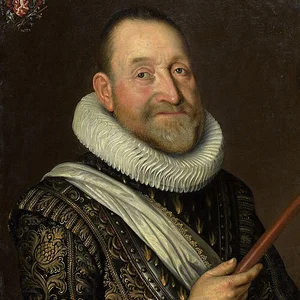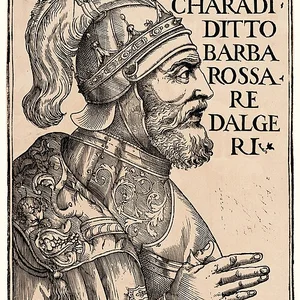

A corsair of Greek origin who became commander-in-chief of the Ottoman fleet under Suleiman the Magnificent. He dominated the western Mediterranean in the 16th century and turned the Regency of Algiers into an Ottoman stronghold.
Khayr ad-Dîn Barbarossa
Khayr ad-Dîn Barbarossa (Hayreddin Barbarossa)
6 min read
Frequently asked questions
Key Facts
- Born around 1466-1478 in Mytilene (island of Lesbos), died in 1546 in Constantinople
- Takes control of Algiers and places it under Ottoman sovereignty (1516-1518)
- Appointed kapudan pasha (grand admiral) of the Ottoman fleet by Suleiman the Magnificent in 1533
- Seizes Tunis in 1534, retaken by Charles V during the expedition of 1535
- Wins the naval battle of Preveza against the fleet of the Holy League (1538)
Works & Achievements
Transformation of Algiers into a corsair state placed under Ottoman protection, a lasting stronghold of Turkish power in North Africa.
Conquest of the Spanish fortress that controlled the harbour of Algiers, freeing the city once and for all from the Spanish coastal threat.
As Kapudan Pasha, he modernized and led the imperial arsenal and navy, making the Ottomans the foremost naval power in the Mediterranean.
Naval battle that secured Ottoman control of the eastern Mediterranean for a generation.
Joint operations with the France of Francis I against Charles V, illustrating the unprecedented diplomatic alliance between a Christian power and the Ottoman Empire.
An account of his conquests dictated to Seyyid Murâd, a major source on Barbary privateering and Ottoman naval expansion.
Anecdotes
Khayr ad-Dîn and his elder brother Arudj (Oruç) began their careers as corsairs in the Mediterranean. Arudj, who had lost an arm in battle, had a silver prosthesis made for himself, which earned him a terrifying reputation before his death in combat near Tlemcen in 1518.
In 1519, unable to hold Algiers alone against the Spanish, Khayr ad-Dîn made a decisive choice: he offered the city to the Ottoman sultan Selim I and received in exchange the title of governor and reinforcements of janissaries. Algiers thus became an Ottoman regency.
In 1533, Suleiman the Magnificent summoned him to Istanbul and appointed him Kapudan Pasha, that is, grand admiral of the entire Ottoman fleet. The corsair of Algiers became the supreme commander of the navy of the most powerful empire of the age.
In 1538, at the Battle of Preveza, Barbarossa crushed an immense Christian fleet commanded by the Genoese admiral Andrea Doria. This victory secured Ottoman dominance over the eastern Mediterranean for nearly thirty years.
In 1543-1544, allied with Francis I against Charles V, Barbarossa wintered with his fleet at Toulon. For his sailors, the city's cathedral was for a time turned into a mosque, and a slave market was held there, to the great embarrassment of Christendom.
Primary Sources
An account of his campaigns composed during his lifetime, relating the naval expeditions and the capture of Algiers under the sultan's authority.
A description of the Regency of Algiers, its fortifications and the Barbary corsairs, in which the figure of Barbarossa and his brother Aruj holds a central place.
The Italian humanist describes the naval power of the Ottoman admiral and the defeat of Andrea Doria at Preveza.
Key Places
Island in the Aegean Sea where Khayr ad-Din and his brother Aruj were born, into a family of modest origins. It had recently come under Ottoman rule at the time.
Port and regency that Barbarossa turned into an Ottoman stronghold and a base for Barbary corsair raids in the western Mediterranean.
Port on the Greek coast off which Barbarossa won his famous naval victory over Andrea Doria's Christian fleet in 1538.
City captured by Barbarossa in 1534 and then reconquered by Charles V in 1535, a focal point of the Ottoman-Spanish rivalry.
French port where Barbarossa's fleet wintered in 1543-1544 as part of the Franco-Ottoman alliance against Charles V.
Ottoman capital where Barbarossa was appointed grand admiral and where he died in 1546; his mausoleum stands on the Bosphorus, in Beşiktaş.
Typical Objects

A long, slender combat ship propelled by oars and sail, the backbone of 16th-century Mediterranean fleets. Barbarossa commanded dozens of them during his raids and battles.

A curved sabre with a keen cutting edge, the emblematic weapon of Ottoman fighters. It was used in close combat during boarding actions.

A piece of artillery mounted on galleys to bombard ships and coastal fortresses. Naval artillery was a major asset of the Ottoman fleets.

The garments of an Ottoman dignitary, worn by high-ranking officers. Having become Kapudan Pasha, Barbarossa displayed the insignia of his rank at the court of Suleiman.

A military banner, often adorned with the crescent or with verses, raised on the galleys and during campaigns. It symbolized the sultan's authority over the fleet.

Navigation instruments used to find one's bearings at sea by means of the stars and to map the coastlines. Indispensable to the corsairs roaming the Mediterranean.
School Curriculum
Vocabulary & Tags
Key Vocabulary
Daily Life
Morning
In Algiers or aboard his galley, the day of a corsair admiral began early: dawn prayer, inspection of the ships, and listening to the captains' reports. Expeditions were prepared, and supplies and men were counted.
Afternoon
The afternoon was spent governing the regency: dispensing justice, negotiating the ransom of captives, receiving envoys, or organizing raids. At sea, it was the time for maneuvers and watching the enemy coasts.
Evening
In the evening, the officers gathered around their commander to share meals and discuss strategy. At the court of Istanbul, having become Kapudan Pasha, he took part in the sultan's councils and receptions.
Food
Food aboard ship relied on sea biscuit, rice, dried legumes, olive oil, fish, and dried fruit. On land, Ottoman and North African cuisine offered meats, bread, dates, and non-alcoholic drinks in accordance with Islam.
Clothing
As a corsair, he wore loose clothing suited to the sea; as an Ottoman dignitary, he donned a turban, an embroidered caftan, and a belt bearing the saber, the insignia of his rank as admiral.
Housing
In Algiers, he lived in a fortified palace overlooking the harbor; in Istanbul, he had a residence befitting a high dignitary. His true home, however, remained the flagship galley, from which he commanded his fleet.
Historical Timeline
Period Vocabulary
Liens externes & ressources
Références
Œuvres
Établissement de la régence d'Alger
1516-1519
Reprise du Peñón d'Alger
1529
Réorganisation de la flotte ottomane
à partir de 1533
Victoire de Préveza
1538
Mémoires (Gazavât-ı Hayreddin Paşa)
vers 1545