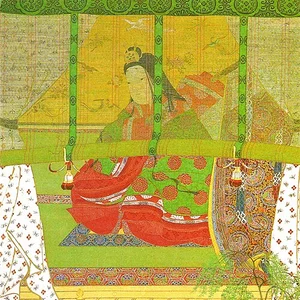

Empress of Japan who reigned twice (749–758 then 764–770), she is one of the very few women to have occupied the Japanese imperial throne. A devout Buddhist, she actively promoted the spread of Buddhism throughout the country and commissioned the construction of numerous temples.
Koken(718 — 770)
Kōken
Japon
8 min read
Frequently asked questions
Key Facts
- First reign 749–758 under the name Kōken, daughter of Emperor Shōmu
- Second reign 764–770 under the name Shōtoku after reclaiming power
- In 770, ordered the printing of one million Buddhist dharanis — among the earliest printed documents in the world
- Supported the monk Dōkyō, which caused significant political tensions at court
- Last reigning empress of Japan for over a millennium
Works & Achievements
The printing of one million Buddhist prayers placed inside one million miniature wooden pagodas. Carried out as an act of thanksgiving to the Buddha for victory over the rebellion of 764, this project stands as one of the oldest known examples of printing in the world and illustrates the political role of Buddhism in the Japanese state.
A series of royal decrees aimed at strengthening Buddhism as the state religion, ordering the copying of sutras, building temples, and regulating monastic life. These texts, preserved in the Shoku Nihongi, reveal a sovereign who governed as much through faith as through law.
The continuation and expansion of her father's program: the construction of a Buddhist temple in each of Japan's sixty-six provinces. This network was designed to spread Buddhism across the entire territory and to reinforce the authority of the central state.
Kōken presided over the grand consecration ceremony (kaigen) of the Daibutsu at Tōdai-ji in 752, a landmark event in Japanese religious history. She continued to allocate significant resources to the temple throughout both of her reigns.
Anecdotes
After crushing the rebellion of the powerful Fujiwara clan in 764, Empress Kōken had one million Buddhist prayers (darani) printed and placed inside one million small wooden pagodas. This colossal project, which kept hundreds of craftsmen busy for years, was intended to thank the Buddha for her victory and to protect Japan. These pagodas are considered one of the earliest examples of printing in the world.
Kōken abdicated once in 758 in favor of Emperor Junnin, but continued to wield considerable influence from her Buddhist retreat. When Junnin dared to publicly criticize her relationship with the monk Dōkyō, she seized power again in 764, exiled the emperor, and reigned once more under the name Shōtoku. She is thus one of the very few sovereigns in history to have reigned twice.
Her attachment to the Buddhist monk Dōkyō caused an enormous scandal at court. She elevated him to the rank of 'Hōō' (Dharma King), a nearly imperial title, and some courtiers feared she intended to pass the throne to him. An oracle at the great Usa Shrine was consulted and reportedly answered that no one outside the imperial family could ascend to the throne. Dōkyō was ultimately exiled upon the empress's death.
Kōken was the daughter of Emperor Shōmu, himself a devout Buddhist who had commissioned the great bronze Great Buddha of Tōdai-ji. In 752, she attended the grand consecration ceremony of this enormous statue (15 meters tall), which was attended by monks from China, India, and Korea. This event symbolized the central role that Buddhism played in the politics of the Japanese state at the time.
Primary Sources
In the tenth year of Tenpyō-hōji, the empress ascended the throne and proclaimed: 'We shall govern the realm by upholding both the Law of the Buddha and the law of men, so that all may live in peace.'
Let a seven-story pagoda be erected in each province, and let the sutras be copied to protect the country and ensure the prosperity of the people.
By the grace of the Buddha, we have been victorious. As a sign of gratitude and to purify the transgressions of all living beings, we order the production of one million miniature pagodas containing sacred prayers.
The poems composed at court banquets during the reign of Empress Kōken bear witness to the refined life of the Nara capital, where nature, beauty, and devotion intertwined.
Key Places
Capital of Japan from 710 to 784, built on the model of Chang'an. It was here that Kōken lived, reigned, and died; the imperial palace, in the northern part of the city, was the center of the country's political and religious power.
Buddhist temple built by Kōken's father, Emperor Shōmu, housing the Great Bronze Buddha. Kōken attended its consecration in 752 and continued to support it throughout her reign as a symbol of state Buddhism.
Major Shinto shrine in Kyushu consulted as an oracle when the question of succession to the throne arose. The oracle's response — that only a member of the imperial family could ascend the throne — put an end to the ambitions attributed to the monk Dōkyō.
Buddhist convent founded by Empress Kōmyō, Kōken's mother, and supported by Kōken herself. It served as the head temple for provincial nunneries, the female counterpart to the kokubunji network.
Temple founded by the Chinese monk Jianzhen (Ganjin), who arrived in Japan in 754 with the support of the imperial court. This temple illustrates the intense religious and cultural exchanges between Japan and Tang China during Kōken's era.
Typical Objects

These small 21 cm wooden pagodas, commissioned by Kōken, each contained a printed Buddhist prayer (dharani). Produced in one million copies, they represent one of the oldest and most ambitious printing projects in human history.

The official headdress worn by Japanese sovereigns and high dignitaries, inspired by Tang Chinese style. Kōken wore it during state ceremonies, asserting her imperial authority at a time when her legitimacy was sometimes called into question.

The copying of sutras (kyōsha) was a central religious and political practice during the Nara period. Kōken had numerous sacred texts copied and distributed throughout the country — most notably the Lotus Sutra — to ensure the protection of Japan.

One of the Three Sacred Treasures of Japan, a symbol of imperial legitimacy. Like all emperors, Kōken was entrusted with these divine regalia at her enthronement, affirming her descent from the gods.

This Buddhist object, associated with wandering monks, symbolizes the religious devotion that defined Kōken's inner circle — most notably the monk Dōkyō, whom she elevated to the highest rank in the religious hierarchy.

Small wooden slats used for administrative communications and record-keeping during the Nara period. Thousands of these tablets have been unearthed at Nara, offering a window into the workings of the ritsuryō state that Kōken governed.
School Curriculum
Vocabulary & Tags
Key Vocabulary
Daily Life
Morning
Kōken rose at dawn to perform her Buddhist devotions: sutra recitation, incense offerings, and meditation. These religious rituals structured her day as much as her political duties. She would then receive reports from her ministers on affairs of state.
Afternoon
Afternoons were devoted to official audiences in the great palace hall, administrative decisions, and reading documents written on wooden tablets (mokkan) or paper. She also oversaw matters of state Buddhism: the construction of temples, sutra copying, and the organization of religious ceremonies.
Evening
Court evenings included ritual banquets with gagaku music and poetry, following courtly customs modeled on the Tang dynasty. Poetry, scholarly exchanges, and evening Buddhist prayers brought the day to a close before rest.
Food
The diet of the imperial court at Nara was heavily influenced by Buddhism: white rice, vegetables, seaweed, tofu, fish, and seasonal fruits. Buddhist principles limited the consumption of meat. Official meals included sake and refined dishes prepared by court cooks.
Clothing
Kōken wore formal ceremonial attire inspired by Tang Chinese court dress: layered silk robes in colors coded by rank, with lacquered belts and elaborate headdresses. The color purple was reserved for members of the imperial family. Her Buddhist devotional garments were considerably plainer.
Housing
Kōken resided in the imperial palace of Heijō-kyō (Nara), a vast complex of red-and-white lacquered wooden buildings arranged in a symmetrical, Chinese-inspired layout. The rooms, divided by sliding screens (shoji), were furnished simply: tatami mats, low tables, and lacquered chests. Gardens, ponds, and pavilions completed the palatial setting.
Historical Timeline
Period Vocabulary
Visual Style
Le style visuel de l'époque de Nara s'inspire de la Chine Tang : architecture laquée rouge et blanche, robes impériales en soie superposées, iconographie bouddhiste dorée et compositions formelles et symétriques.
Sound Ambience
L'univers sonore de la cour de Nara mêle les chants bouddhistes des moines, les cloches des temples, la musique rituelle gagaku et le bruissement de la soie sur les planchers laqués du palais impérial.
Liens externes & ressources
Références
Œuvres
Projet des Hyakumantō Darani (百万塔陀羅尼)
764-770
Édits de gouvernement et de protection du Dharma
749-770
Soutien au réseau des Kokubunji (国分寺)
749-770
Patronage de Tōdai-ji et du Grand Bouddha
752