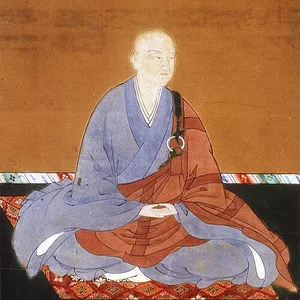

Kōmyō was emperor of Japan from the Northern Court (1336–1348), enthroned by shogun Ashikaga Takauji during the great imperial split of the Nanboku-chō period. After his abdication, he withdrew from political life and became a Buddhist monk, ending his days in prayer and contemplation.
Kōmyō(1322 — 1380)
Kōmyō
Japon
6 min read
Frequently asked questions
Key Facts
- Born in 1322 into the Jimyōin imperial line
- Enthroned as emperor of the Northern Court in 1336 by shogun Ashikaga Takauji
- Reigned during the split of the two rival courts (North and South) of the Nanboku-chō period
- Abdicated in 1348 in favor of his nephew Sukō
- Became a Buddhist monk after retiring, died in 1380
Works & Achievements
Ascending the throne at the call of Ashikaga Takauji, Kōmyō gave legitimate imperial authority to the new shogunate, founding the Northern lineage for over half a century.
Through his edicts and symbolic presence, he provided the imperial framework that allowed the Ashikaga to exercise real power over the country.
His transfer of the throne to his nephew ensured the continuity of the Northern Court amid the turmoil of dynastic war.
His survival of several years of detention by the Southern Court allowed the maintenance of the Jimyōin lineage's legitimacy after his release.
By taking Buddhist orders, he embodied the model of the emperor renouncing the world for the religious path, common in medieval Japan.
Anecdotes
When Shogun Ashikaga Takauji placed Kōmyō on the throne in 1336, there was a major problem: the Three Sacred Treasures (the mirror, the sword, and the jewel)—indispensable symbols of imperial legitimacy—remained in the hands of the rival emperor Go-Daigo, who had taken refuge in Yoshino. Kōmyō was thus enthroned without the regalia, casting a shadow over the validity of his reign throughout the Nanboku-chō period.
Kōmyō never truly ruled: real power belonged to the Ashikaga shogunate based in Kyoto, while the court's affairs were managed by his elder brother, the retired emperor Kōgon, according to the *insei* system (cloistered emperor government). Kōmyō primarily embodied the legitimacy that the Ashikaga needed.
In 1351–1352, during the Ashikaga fratricidal war known as the Kannō Disturbance, the Southern Court took advantage of the chaos to seize Kyoto. Kōmyō, his brother Kōgon, and other members of the Northern Court were captured and forcibly taken to the Southern mountains, where they were held for several years before being released.
After his abdication in 1348 in favor of his nephew, Emperor Sukō, Kōmyō gradually withdrew from public life. Marked by captivity and the instability of his era, he eventually took the Buddhist monastic habit and spent the rest of his life in religious retreat, dying in 1380.
Primary Sources
An epic account of the war between the Northern and Southern Courts, relating the fall of the Kenmu government and the rise of the Ashikaga, who placed an emperor of their choice on the throne of Kyoto.
A chronicle favorable to the Ashikaga house, describing how Takauji restored an emperor of the Jimyōin line against Go-Daigo and established his military authority.
The diary of a high-ranking Kyoto courtier recording day by day the life of the Northern Court, imperial rivalries, and the upheavals of the Kannō disturbance.
A historical prose narrative tracing the history of the imperial court and the rifts between the two rival dynastic lines.
Key Places
Seat of the Northern Court where Kōmyō was enthroned in 1336 and served as emperor under the tutelage of the Ashikaga shogunate.
Mountain refuge of the Southern Court, founded by Go-Daigo in 1336; heart of the rival dynasty that contested Kōmyō's legitimacy.
Power center of the Ashikaga shogunate, the true holder of authority while the emperor played a largely symbolic role.
Southern region where Kōmyō and other members of the Northern Court were held captive after their capture during the Kannō disturbances.
Major center of Tendai Buddhism dominating Kyoto, a key spiritual hub of the era whose influence permeated the court.
Typical Objects

The mirror, the sword, and the jewel, indispensable regalia of a legitimate emperor. Their absence — Go-Daigo had taken them to Yoshino — weighed heavily on the entire reign of Kōmyō.

The most formal court attire, worn by the emperor during official ceremonies such as the enthronement.

The ceremonial dais in the Kyoto Imperial Palace on which the emperor sat during major ceremonies, a symbol of dynastic continuity.

Documents issued by the court, through which the emperor of the Northern Court conferred formal legitimacy on the decisions of the Ashikaga shogunate.

A Buddhist monk's garment that Kōmyō donned after his retirement, marking his transition from imperial life to religious life.

Prayer beads used for recitation, a companion in the spiritual retreat of the emperor who became a monk.

Instruments of calligraphy and poetic composition, arts expected of a cultured emperor of the Kyoto court.
School Curriculum
Vocabulary & Tags
Key Vocabulary
Tags
Daily Life
Morning
The emperor awakens in the palace apartments and first performs the Shinto purification rites, greeting the protective deities of the dynasty. Ladies and courtiers help him don his heavy court robes before the first business of the day.
Afternoon
The afternoon is devoted to court ceremonies, receiving edicts transmitted by the Ashikaga shogunate, and exchanges with nobles (kuge). Since real power eludes him, his role is mostly ceremonial and symbolic.
Evening
The evening lends itself to the refined arts expected of a cultured sovereign: composing waka poems, calligraphy, and koto music. Sometimes this is mingled with reading Buddhist texts, in an atmosphere imbued with the melancholy of the era.
Food
Court cuisine is based on rice, seasonal vegetables, seaweed, fish, and clear soups, prepared with refinement. Buddhist influence promotes a sober diet, limiting meat.
Clothing
During ceremonies, the emperor wears the *sokutai*, a ceremonial robe with multiple superimposed layers of silk. After his conversion, he exchanges these sumptuous garments for the dark robe and *kesa* of a Buddhist monk.
Housing
He resides in the Kyoto Imperial Palace, a complex of wooden pavilions with elegant roofs, separated by paper partitions (shōji) and opening onto landscaped gardens, in the aristocratic architectural style inherited from the Heian period.
Historical Timeline
Period Vocabulary
Visual Style
Un style inspiré des rouleaux peints yamato-e : aplats de pigments minéraux, feuilles d'or et silhouettes de cour raffinées, baignés d'une mélancolie propre à l'âge des guerres médiévales.
Sound Ambience
Le calme feutré d'un palais de Kyoto — soieries, cloches de temple et fontaine de bambou — traversé par l'inquiétude d'une époque de guerre civile et de prières bouddhiques.
Liens externes & ressources
Références
Œuvres
Intronisation comme empereur de la Cour du Nord
1336
Légitimation de l'autorité Ashikaga
1336-1348
Abdication ordonnée en faveur de Sukō
1348
Endurance durant la captivité du Sud
1352-1357
Retrait dans la vie monastique
vers 1370