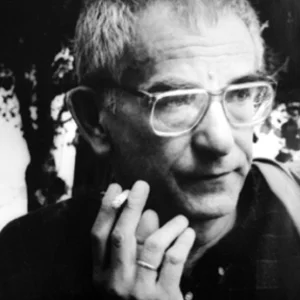

Krzysztof Kieślowski (1941-1996) was a Polish filmmaker and a major figure in European cinema of the late twentieth century. Initially a documentarian, he made his name with the television series *The Decalogue* and then the *Three Colours: Blue, White, Red* trilogy.
Krzysztof Kieślowski(1941 — 1996)
Krzysztof Kieślowski
Pologne
7 min read
Frequently asked questions
Key Facts
- Born on 27 June 1941 in Warsaw, in occupied Poland
- Directed the television series *The Decalogue* (1989), ten films inspired by the Ten Commandments
- Presented *The Double Life of Véronique* (1991), acclaimed at Cannes
- Directed the trilogy *Three Colours: Blue* (1993), *White* (1994) and *Red* (1994), on the values of the French motto
- Died on 13 March 1996 in Warsaw after announcing his retirement from filmmaking
Works & Achievements
The story of a factory worker who becomes passionate about amateur filmmaking and discovers the power, but also the dangers, of the camera. An emblematic film of the “cinema of moral anxiety.”
Three parallel destinies of a man depending on whether or not he catches a train. Censored until 1987, it foreshadows many branching narratives.
A drama set during martial law in Poland, revolving around the ghost of a lawyer. His first screenwriting collaboration with Krzysztof Piesiewicz.
A series of ten films for television, each inspired by one of the commandments, all set in the same Warsaw housing estate. Considered a pinnacle of his work.
A feature-length version of an episode of The Decalogue, an indictment of capital punishment. Jury Prize at Cannes and the first European Film Award.
A poetic tale about two identical women, one Polish, the other French, mysteriously linked. The filmmaker's first major Franco-Polish film.
The first installment of the trilogy, about freedom and grief, starring Juliette Binoche. Golden Lion at the Venice Film Festival.
Kieślowski's final film, about fraternity, shot in Geneva. Nominated for the Academy Awards for Best Director and Best Original Screenplay.
Anecdotes
Kieślowski first worked as a documentary filmmaker for nearly fifteen years. He gradually abandoned the genre after realizing that his camera could harm people: footage he had shot risked being used by the police to identify individuals. Filming real tears came to feel like an intolerable intrusion, and he turned to fiction.
His film *Blind Chance* (Przypadek, 1981) tells three possible fates of the same man depending on whether he catches or misses a train. Deemed too critical of the regime, the film was censored and put “on the shelf”: it was not released until 1987. This device of parallel destinies later inspired films such as *Run Lola Run* and *Sliding Doors*.
*The Decalogue* is a series of ten roughly hour-long films, each loosely inspired by one of the Ten Commandments, and all set in the same large Warsaw housing estate. Kieślowski entrusted the cinematography of nine of the ten episodes to nine different directors of photography, so that each story would have its own color.
For the *Three Colours* trilogy, Kieślowski drew inspiration from the three colors of the French flag and the republican motto: Blue for liberty, White for equality, Red for fraternity. After presenting *Red* at the Cannes Film Festival in 1994, he announced, at just 53, that he was retiring from cinema.
A heavy smoker all his life, Kieślowski died in March 1996 in Warsaw, at the age of 54, following open-heart surgery. He had only just retired, while producers and actors still hoped to convince him to make new films.
Primary Sources
I'm frightened of those real tears. In fact, I don't know whether I've got the right to photograph them. At such times I feel like somebody who's found himself in a realm which is, in fact, out of bounds. That's the main reason why I escaped from documentaries.
Liberty, Equality, Fraternity. We took these three words, just as the French inscribed them on their flag, and we asked ourselves how they work today, on the scale of a single person.
I have nothing more to say. I've decided to stop making films. I'm going to stay at home, read books and smoke cigarettes.
Key Places
Kieślowski's birthplace and the setting for many of his films, including the entire *Dekalog*, shot in a large housing estate. He died there in 1996.
The prestigious film school where Kieślowski trained as a director in the 1960s. It is the cradle of several great Polish filmmakers.
The filming and co-production location of his French films: *The Double Life of Véronique* and the *Three Colours* trilogy, notably *Blue*.
A key site of his international recognition. *A Short Film About Killing* won the Jury Prize there in 1988; it is also where he announced his retirement in 1994.
The main setting of *Red*, the final film of the trilogy and Kieślowski's last film, centred on a young model and a retired judge.
The historic Warsaw cemetery where Kieślowski is buried. A minimalist monument, depicting two hands framing an image, marks his grave.
Typical Objects

The filmmaker's central tool, first to capture reality in documentaries, then to stage fiction. Kieślowski said he dreaded what the camera could reveal about people.

Tinted gels and lighting used to bathe a scene in a dominant color. Blue, white and red structure his entire “Three Colours” trilogy.

A written text describing the story, dialogue and scenes. Kieślowski wrote it with the lawyer Krzysztof Piesiewicz, who brought him stories inspired by real cases.

A strip of photographic film on which the image is printed, to be edited and projected. Under the communist regime, films deemed troublesome were “shelved” so they would not be screened.

Music composed to accompany the film, written here by Zbigniew Preisner. Kieślowski even invented a fake composer, “Van den Budenmayer,” credited on several of his films.

An everyday object inseparable from Kieślowski, a heavy smoker all his life. His fragile health and his smoking contributed to the heart problems that took his life.
School Curriculum
Vocabulary & Tags
Key Vocabulary
Daily Life
Morning
A demanding filmmaker, Kieślowski often began his days reading and writing, reworking screenplays with his co-writer Krzysztof Piesiewicz. During shooting periods, his mornings were devoted to preparing shots with his cinematographer.
Afternoon
Afternoons were spent on set or in the editing room, directing actors, choosing camera angles and lighting. Meticulous, he could redo a scene many times to capture exactly the right emotion.
Evening
In the evening, he watched the day's rushes and discussed the film with his collaborators, notably the composer Zbigniew Preisner. These moments of reflection, cigarette in hand, were part of his work.
Food
Like many in communist Poland, he was familiar with long queues and shortages of basic goods. His diet remained simple, close to everyday Polish cooking: soups, potatoes, bread, and cured meats.
Clothing
On set, Kieślowski wore plain, practical clothes: sweaters, simple jackets, with no concern for elegance. His understated appearance contrasted with the glamorous image sometimes associated with famous filmmakers.
Housing
He lived in Warsaw, amid the urban landscape of the large apartment blocks typical of Eastern European cities — the very ones he filmed in “The Decalogue.” His international success also led him to stay regularly in France.
Historical Timeline
Period Vocabulary
Liens externes & ressources
Références
Œuvres
Le Hasard (Przypadek)
1981
Sans fin (Bez końca)
1985
Trois Couleurs : Bleu
1993