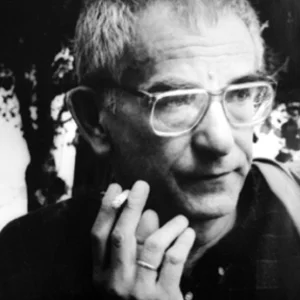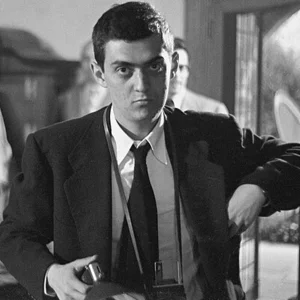

Stanley Kubrick (1928-1999) was an American director, screenwriter and producer. A former photographer, he became one of the most influential filmmakers of the 20th century, renowned for his perfectionism and the diversity of his genres, from war films to science fiction.
Stanley Kubrick(1928 — 1999)
Stanley Kubrick
États-Unis, Royaume-Uni
6 min read
Frequently asked questions
Key Facts
- Born on July 26, 1928 in New York, he started out as a photographer for Look magazine in the late 1940s
- 1964: directs Dr. Strangelove, a satire of the Cold War and nuclear deterrence
- 1968: 2001: A Space Odyssey revolutionizes science fiction and special effects in cinema
- 1971: A Clockwork Orange, whose violence sparks fierce controversy in the United Kingdom
- 1980: The Shining, a horror film adapted from Stephen King; he dies on March 7, 1999 shortly after completing Eyes Wide Shut
Works & Achievements
An indictment of the absurdity of war, set in the trenches of 1916. The film was long banned in France for its portrayal of the army.
A grand epic about the slave revolt in ancient Rome. Kubrick's first major box-office success, but also his least personal film.
A black comedy about the risk of nuclear war between East and West. An emblematic work capturing the anxieties of the Cold War.
A science-fiction film about the evolution of humanity and artificial intelligence (the computer HAL 9000). Its special effects left their mark on film history and earned Kubrick his only Oscar.
An adaptation of Anthony Burgess about youth violence and conditioning by the State. A cult and highly controversial film.
A sumptuous recreation of the 18th century, filmed by candlelight. A model of pictorial care and classical music.
A horror film set in an isolated hotel, based on Stephen King. Famous for its Steadicam tracking shots and its harrowing atmosphere.
A war film in two parts about Marine training and the Vietnam War. A study of the dehumanization of the soldier.
Anecdotes
At just 17, Stanley Kubrick sold his first photograph to Look magazine: the image shows a newsstand vendor devastated by the announcement of President Roosevelt's death in 1945. Hired as a staff photographer, he roamed New York for five years before ever touching a camera. This photographer's eye explains the extreme care he would later bring to every shot.
For the period film *Barry Lyndon* (1975), Kubrick wanted to film nighttime scenes lit by candlelight alone, with no electric lighting whatsoever. He had ultra-fast lenses adapted—originally designed by NASA to photograph the far side of the Moon. The result looks like 18th-century paintings coming to life.
Kubrick was famous for his perfectionism and sometimes demanded dozens of takes. On *The Shining* (1980), a staircase scene with actress Shelley Duvall was reportedly shot nearly 127 times, a long-cited record. The actors came away exhausted, but the director was searching for the most truthful emotion.
Passionate about chess since his teens, the young Kubrick played for money in New York's parks to make ends meet. He compared directing to a game of chess: anticipate, keep your cool, and never act on impulse.
Kubrick had a paralyzing fear of flying and refused to board a plane. Settled in England from the 1960s on, he shot nearly all his films there and drove his car at reduced speed, controlling everything in his world just as he did on his sets.
Primary Sources
The most terrifying fact about the universe is not that it is hostile, but that it is indifferent; yet if we can come to terms with this indifference, then our existence as a species can have genuine meaning.
I wanted to create a visual experience, one that bypasses verbalized understanding and penetrates directly into the subconscious with its emotional and philosophical content.
The director has to be a kind of idea-maker-in-chief: he decides everything, from the angle of a lamp to the tone of a line of dialogue, because it is the accumulation of these details that creates the meaning of the film.
Following threats and the conflation made between the film and real acts of violence, the director requested that the film no longer be shown in the United Kingdom.
Key Places
New York City borough where Stanley Kubrick was born in 1928. He grew up there and developed his passion for photography and chess.
Capital of American cinema where Kubrick directed *Spartacus*. He soon distanced himself from it to escape the control of the major studios.
Studios near London where Kubrick shot several of his major films, including *The Shining*. Working there spared him from having to fly.
Vast English manor where Kubrick lived and worked from the 1970s onward. He died there in 1999, shortly after completing *Eyes Wide Shut*.
Typical Objects

The director's central tool, recording images onto film. Kubrick personally controlled the framing and lens choice of every shot.

The camera Kubrick used as a teenage photographer for Look magazine. There he learned image composition before turning to cinema.

An ultra-fast lens originally made for space missions, adapted for “Barry Lyndon.” It made it possible to film scenes lit only by candlelight.

A game of chess that Kubrick played with passion, sometimes for money in New York City parks. He saw it as a school of strategy and patience.

A stabilizing harness that allows smooth tracking shots without rails. Kubrick made famous use of it in the hotel corridors of “The Shining.”

A film script covered with Kubrick's handwritten notes. On it he prepared every shot, line of dialogue, and movement with extreme precision.
School Curriculum
Vocabulary & Tags
Key Vocabulary
Tags
Daily Life
Morning
A bit of a night owl, Kubrick often began his day by reading scripts, books, or newspapers from all over the world. Settled in England, he ran his work from his manor house, making countless phone calls and notes.
Afternoon
On a shoot, he devoted the afternoon to getting every detail right: lighting, framing, the actors' movements. He could redo a single scene dozens of times until he got the effect he was after.
Evening
In the evening, he watched films, edited his own footage, or played chess. A tireless worker, he often carried on his activities late into the night.
Food
Kubrick led a sober life, with little taste for socializing. He ate simply, often at home with his family, preferring work to grand dinners.
Clothing
He dressed in a casual, practical way, far from Hollywood's glamorous image: loose jackets, comfortable shirts, and sometimes a thick beard. His unkempt appearance stood in sharp contrast to the extreme rigor of his work.
Housing
From the 1960s onward, he lived in England, eventually in the large manor house of Childwickbury surrounded by a vast estate. This home was at once his residence, his office, and his editing studio, which allowed him to control everything without traveling.
Historical Timeline
Period Vocabulary
Liens externes & ressources
Références
Œuvres
Docteur Folamour
1964