 flip
flipTaro Tunu i te Wai Niu — taro cooked in coconut milk
Taro Tunu i te Wai Niu — taro cooked in coconut milk
Why this dish? Taro was the staple tuber of Polynesian diet, cultivated in Hawaiki and among the first plants carried by navigators to new lands. For Kupe and his people, preparing taro in fresh coconut milk was the quintessential daily meal, shared on the ground, sitting in a circle after a day of labor or sailing.
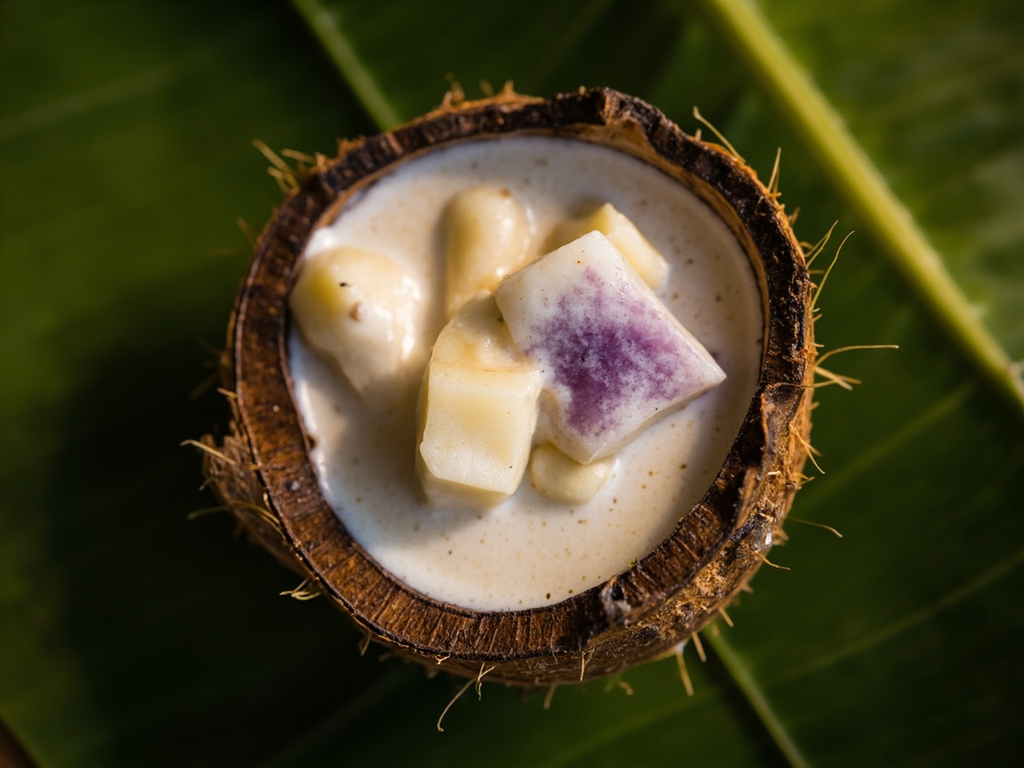
Pieces of taro with purplish, floury flesh, slowly cooked in hand-pressed coconut milk until tender and coated in a creamy, slightly sweet sauce. A dish of absolute simplicity, the heart of the Polynesian table.
Taro is the earth itself feeding you. In Hawaiki, my mother pressed the grated coconut flesh in her hands — the white milk flowed into the bowl like a river of moonlight. She dipped the taro pieces into it and let them simmer on the hot stones of the umu. When the milk thickened and coated each piece, we knew the kai was ready. This simple dish, I have eaten it a thousand times, and each time it reminded me that the land and the sea give everything to those who know how to listen.
- •Taro (peeled roots) — Several large roots (Staple tuber)
- •Grated mature coconut flesh — Two to three coconuts (To extract coconut milk)
- •Fresh water — A little (To thin the cooking)
Taro Tunu i te Wai Niu — taro cooked in coconut milk
Pieces of taro with purplish, floury flesh, slowly cooked in hand-pressed coconut milk until tender and coated in a creamy, slightly sweet sauce. A dish of absolute simplicity, the heart of the Polynesian table.
Why this dish? Taro was the staple tuber of Polynesian diet, cultivated in Hawaiki and among the first plants carried by navigators to new lands. For Kupe and his people, preparing taro in fresh coconut milk was the quintessential daily meal, shared on the ground, sitting in a circle after a day of labor or sailing.
Taro is the earth itself feeding you. In Hawaiki, my mother pressed the grated coconut flesh in her hands — the white milk flowed into the bowl like a river of moonlight. She dipped the taro pieces into it and let them simmer on the hot stones of the umu. When the milk thickened and coated each piece, we knew the kai was ready. This simple dish, I have eaten it a thousand times, and each time it reminded me that the land and the sea give everything to those who know how to listen.
Ingredients (period version)
- Taro (peeled roots) — Several large roots (Staple tuber)
- Grated mature coconut flesh — Two to three coconuts (To extract coconut milk)
- Fresh water — A little (To thin the cooking)
Ingredients
- Fresh taro — 600 g (Staple tuber)
- Coconut milk (preferably homemade) — 400 ml (Cooking sauce)
- Water — 200 ml (Adjust consistency)
- Salt — 1 pinch (Seasoning)
Method
- Peel the taro (wear gloves if the skin irritates) and cut into 3-4 cm cubes.
- Place cubes in a pot, cover with water and bring to a boil. Cook 10 minutes to remove the natural acridness of taro. Drain.
- Return taro to the pot, pour in coconut milk and water. Bring to a gentle simmer.
- Simmer over low heat for 20 to 25 minutes, stirring gently occasionally, until taro is tender and coconut milk has thickened into a creamy sauce.
- Lightly salt. Serve warm in a bowl, coated with the coconut sauce.
How it was made : Taro (*Colocasia esculenta*) is one of the oldest cultivated plants in Oceania, domesticated in Southeast Asia over 7,000 years ago and carried by Austronesians across the Pacific. Cooking in coconut milk in an *umu* (earth oven with hot stones) or on hot stones was the standard method. The milk was extracted by hand-pressing grated coconut pulp.
The contemporary twist : Lightly mash the cubes with a fork for a texture between purée and chunks, and serve in a half coconut shell as a natural bowl.
Sources : Lebot, Vincent. “Tropical Root and Tuber Crops”. CABI, 2009. · Hiroa, Te Rangi (Peter Buck). “The Coming of the Maori”. Whitcombe and Tombs, 1949.
Kupe · Charactorium