 flip
flipUmu Kai Moana — earth-oven seafood feast
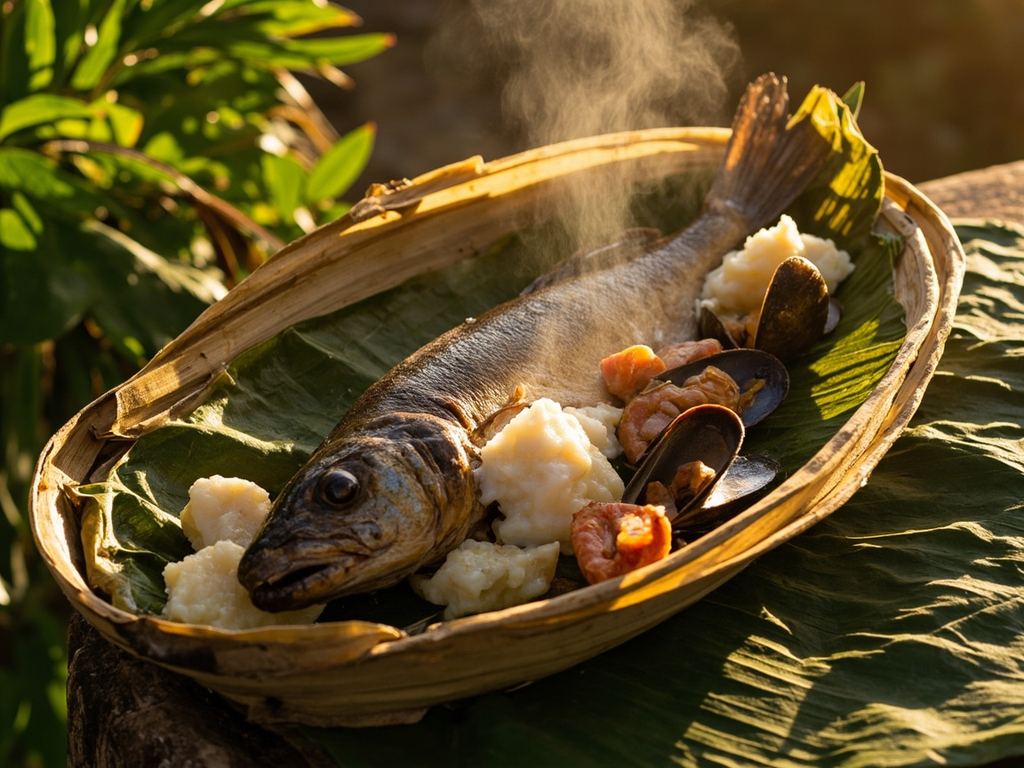
Umu Kai Moana — earth-oven seafood feast
Why this dish? Before the great departure into the unknown — or upon returning from a victorious crossing — Polynesians held a *hākari*, a communal feast. For Kupe, the feast marking the discovery of Aotearoa would have gathered the crew around an *umu* laden with treasures of the sea and land, as an offering of gratitude to the *atua* who had guided the *waka*.
An assortment of seafood (whole fish, shellfish, crustaceans) and tubers wrapped in leaves, steam-cooked in an oven dug into the ground on a bed of hot volcanic stones. The steam trapped by the earth gives the food a smoky flavor and extraordinary tenderness.
When we touched the land of Aotearoa, when our feet finally trod the black sand after so many days on the waves of Tangaroa, I said to my people: dig the umu, the greatest you have ever made. The stones reddened in the fire, then we laid upon them the fish wrapped in leaves, the shellfish gathered from the shore, the roots pulled from this new land. We covered it all with earth and waited for the heat to do its work. That evening, the kai tasted of victory and gratitude — we ate, thanking the atua for leading us here.
- •Whole fish (snapper or similar) — One or two fine fish (Centerpiece of the feast)
- •Shellfish (mussels, abalone, clams) — Large amount (Varied seafood)
- •Taro — Several roots (Accompaniment tuber)
- •Breadfruit (kuru) — One or two fruits (Starchy accompaniment)
- •Ti or banana leaves — Plentiful (Cooking wrap)
- •Thick coconut cream — Extracted from several nuts (Accompaniment sauce)
Umu Kai Moana — earth-oven seafood feast
An assortment of seafood (whole fish, shellfish, crustaceans) and tubers wrapped in leaves, steam-cooked in an oven dug into the ground on a bed of hot volcanic stones. The steam trapped by the earth gives the food a smoky flavor and extraordinary tenderness.
Why this dish? Before the great departure into the unknown — or upon returning from a victorious crossing — Polynesians held a *hākari*, a communal feast. For Kupe, the feast marking the discovery of Aotearoa would have gathered the crew around an *umu* laden with treasures of the sea and land, as an offering of gratitude to the *atua* who had guided the *waka*.
When we touched the land of Aotearoa, when our feet finally trod the black sand after so many days on the waves of Tangaroa, I said to my people: dig the umu, the greatest you have ever made. The stones reddened in the fire, then we laid upon them the fish wrapped in leaves, the shellfish gathered from the shore, the roots pulled from this new land. We covered it all with earth and waited for the heat to do its work. That evening, the kai tasted of victory and gratitude — we ate, thanking the atua for leading us here.
Ingredients (period version)
- Whole fish (snapper or similar) — One or two fine fish (Centerpiece of the feast)
- Shellfish (mussels, abalone, clams) — Large amount (Varied seafood)
- Taro — Several roots (Accompaniment tuber)
- Breadfruit (kuru) — One or two fruits (Starchy accompaniment)
- Ti or banana leaves — Plentiful (Cooking wrap)
- Thick coconut cream — Extracted from several nuts (Accompaniment sauce)
Ingredients
- Whole snapper or sea bream fillets — 800 g (Main fish)
- Fresh mussels — 500 g (Shellfish)
- Large prawns — 300 g (Crustaceans)
- Fresh taro — 400 g (peeled, in pieces) (Tuber)
- Breadfruit or yam (or sweet potato as substitute) — 300 g (Starch)
- Banana leaves (or aluminum foil) — 6 large leaves (Cooking wrap)
- Thick coconut cream — 200 ml (Sauce)
- Sea salt — 2 tsp (Seasoning)
Method
- Preheat oven to 200°C. Prepare banana leaves by passing them quickly over a flame to soften (or use aluminum foil).
- Peel taro and breadfruit, cut into large chunks. Precook in boiling water for 10 minutes, drain.
- On a large banana leaf, arrange a layer of taro and breadfruit chunks. Place the whole fish (or fillets) on top, surround with mussels and prawns.
- Pour over coconut cream and salt. Fold the leaves to form a tightly sealed parcel. Tie if necessary.
- Place the parcel on a baking sheet. Bake for 40 to 45 minutes.
- Open the parcel at the table, on a large platter. The mussels should be open, the fish tender, the tubers soft. Serve directly in the leaves, accompanied by the coconut cooking juices.
How it was made : The *umu* (called *hāngi* among the Māori) is the emblematic cooking technique of all Polynesia. A pit is dug, a fire is made to heat volcanic stones, food wrapped in leaves is placed on them, covered with mats and earth, and left to steam for several hours. The *hākari* (ceremonial feasts) marked major events: voyage departures, victories, births, funerals. Food had a sacred dimension, offered to the *atua* before being shared.
The contemporary twist : Serve the opened parcel directly on the table, surrounded by small bowls of lemony coconut cream for dipping — a banquet to share by hand, in the communal spirit of the *hākari*.
Sources : Hiroa, Te Rangi (Peter Buck). “The Coming of the Maori”. Whitcombe and Tombs, 1949. · Pollock, Nancy J. “These Roots Remain: Food Habits in Islands of the Central and Eastern Pacific since Western Contact”. University of Hawaii Press, 1992.
Kupe · Charactorium