 flip
flipBeshbarmak
Beshbarmak
Why this dish? Beshbarmak — literally "five fingers" because it is eaten by hand — was the dish of honor of the dastarkhan during *toïs* (festivals) where Kurmangazy played his *küis*. After a performance, the invited musician received the best pieces of meat: it was the supreme mark of respect in the steppe. Every dombra concert ended around this shared dish.
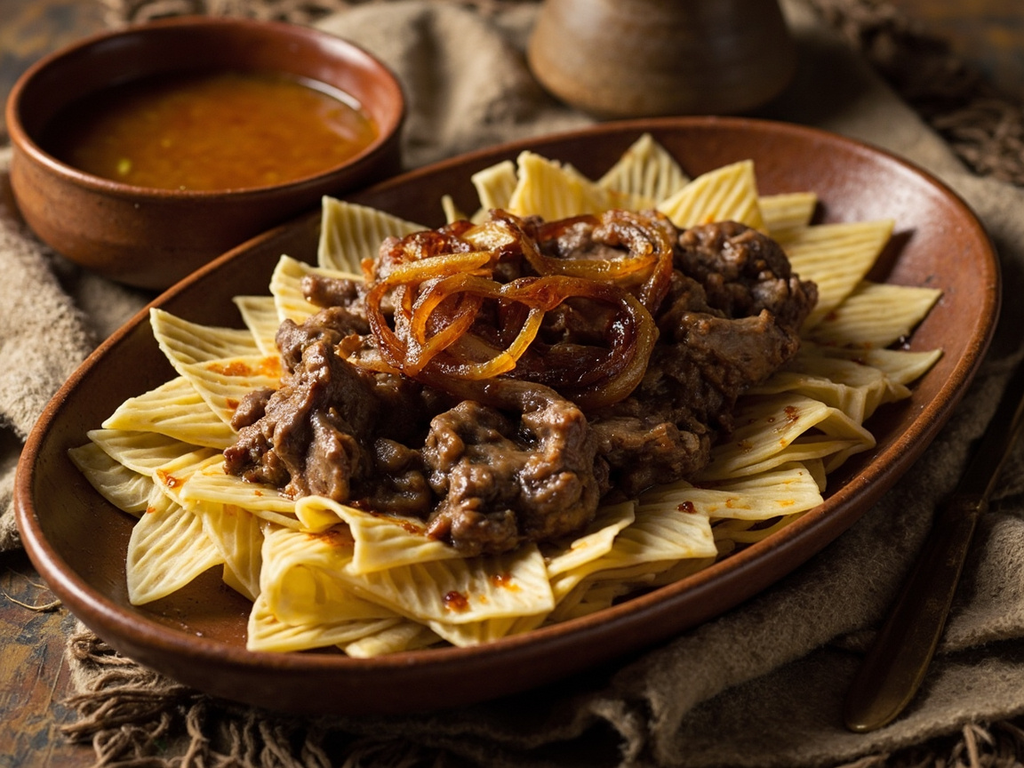
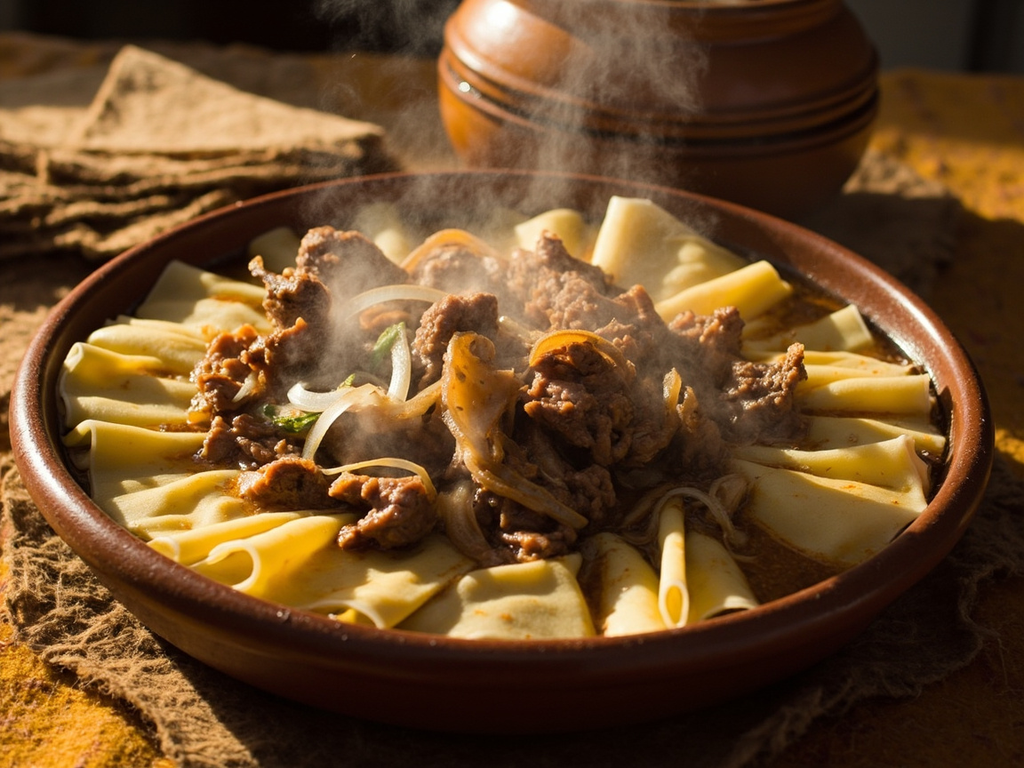
Long-boiled mutton, served on wide sheets of pasta cooked in the broth, with melting onions. The central dish of the Kazakh nomadic feast, eaten by hand in community.
Friend, when you enter my yurt after a long journey, I do not first ask your name — I seat you and order the sheep to be slaughtered. Beshbarmak is the voice of the steppe in your belly: the meat that melts, the dough that has drunk all the fat of the broth, the onions my wife cut while singing. For me, after playing a *küi* that makes men weep, I need only this and a bowl of burning hot *sorpa*. We eat with five fingers, and he who eats with a spoon has not understood the steppe.
- •Whole sheep (or half carcass) — a fat sheep, slaughtered the same day (main meat)
- •Wheat flour — several handfuls (dough)
- •Onions — three or four large (garnish)
- •Salt — to taste (seasoning)
- •Spring water — full *kazan* (broth)
Beshbarmak
Long-boiled mutton, served on wide sheets of pasta cooked in the broth, with melting onions. The central dish of the Kazakh nomadic feast, eaten by hand in community.
Why this dish? Beshbarmak — literally "five fingers" because it is eaten by hand — was the dish of honor of the dastarkhan during *toïs* (festivals) where Kurmangazy played his *küis*. After a performance, the invited musician received the best pieces of meat: it was the supreme mark of respect in the steppe. Every dombra concert ended around this shared dish.
Friend, when you enter my yurt after a long journey, I do not first ask your name — I seat you and order the sheep to be slaughtered. Beshbarmak is the voice of the steppe in your belly: the meat that melts, the dough that has drunk all the fat of the broth, the onions my wife cut while singing. For me, after playing a *küi* that makes men weep, I need only this and a bowl of burning hot *sorpa*. We eat with five fingers, and he who eats with a spoon has not understood the steppe.
Ingredients (period version)
- Whole sheep (or half carcass) — a fat sheep, slaughtered the same day (main meat)
- Wheat flour — several handfuls (dough)
- Onions — three or four large (garnish)
- Salt — to taste (seasoning)
- Spring water — full *kazan* (broth)
Ingredients
- Shoulder or leg of mutton (or lamb) — 1.2 kg with bone (main meat)
- Flour — 400 g (dough)
- Egg — 1 (dough)
- Warm water — 150 ml (dough) + 3 L (broth) (dough and cooking)
- Yellow onions — 3 large (garnish)
- Salt — to taste (seasoning)
- Black pepper — 1 tsp (seasoning)
- Fresh parsley or cilantro — 1 bunch (finishing)
Method
- Place the meat in a large pot, cover with cold water, bring to a boil. Skim carefully, salt, then lower the heat and simmer for 2.5 to 3 hours until the meat falls off the bone.
- Meanwhile, prepare the dough: mix flour, egg, salt, and warm water. Knead for 10 minutes until smooth. Let rest under a cloth for 30 minutes.
- Roll out the dough very thinly (2 mm) and cut into rectangles about 10 × 15 cm.
- Remove the meat from the broth and keep warm. Slice the onions and sweat them in a ladle of hot broth until soft and translucent.
- Cook the pasta sheets in the simmering broth for 3–4 minutes. Remove and arrange on a large serving platter.
- Shred the meat into generous pieces, place on the pasta sheets. Cover with melted onions. Ladle a few spoonfuls of hot broth over the top.
- Serve the broth (*sorpa*) separately in bowls as an accompaniment. Eat with your hands.
How it was made : In the 19th-century steppe, the sheep was slaughtered according to Muslim ritual and cooked whole in a *kazan* (large cast-iron cauldron) over a fire of dried dung. The dough, rolled directly on a clean carpet, was cut with a knife. The sheep's head was presented to the eldest or guest of honor, who carved it and distributed the symbolic pieces (ear to the youngest so they would listen, eye to the wisest). The invited musician, such as Kurmangazy, received the brisket — the most tender piece.
The contemporary twist : Serve the pasta sheets stacked like a mille-feuille, with shredded meat on top, and the broth in a small cup on the side — a "deconstructed" beshbarmak that keeps the soul of the dish.
Sources : Zhanibek Shaimerdenov, "Kazakh Traditional Cuisine and Hospitality Customs", in Central Asian Survey, 2006 · Sean R. Roberts, "The Art of Not Being Governed: Nomadic Food Culture in Kazakhstan", Anthropology of Food, 2010
Kourmangazy · Charactorium