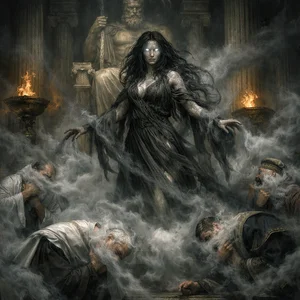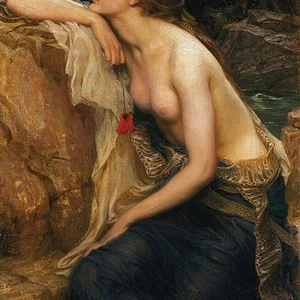

Lamia is a figure from Greek mythology, a queen of Libya loved by Zeus. Struck by Hera's jealousy, who stole her children from her, she became a devastating monster who devoured the children of others.
Lamia
Lamia
7 min read
Frequently asked questions
Key Facts
- Lamia was originally a beautiful queen of Libya, beloved by Zeus
- Hera, consumed by jealousy, is said to have stolen or killed her children
- Cursed, Lamia transformed into a monster that devoured the children of mortals
- She is described as half-woman, half-serpent in later sources
- Aristophanes mentions her in his comedies (5th century BCE) as a figure of popular terror
Works & Achievements
Comedy in which Lamia is mentioned as a figure of ugliness and moral looseness, attesting to her widespread notoriety in classical Athens.
Horace cites Lamia to illustrate the limits of plausibility in literary fiction: even poetry must not stretch the bounds of the believable too far.
The primary source for the myth of Lamia as queen of Libya, providing a full account of her love affair with Zeus, Hera's jealousy, and her transformation into a child-devouring monster.
The account of the Lamia of Corinth unmasked by the philosopher — a foundational text that would inspire the entire subsequent Western literary tradition on vampires and succubi.
A Romantic English poem that draws directly on the Philostratus episode and rehabilitates the lamia as a tragic figure — as much victim as predator.
Anecdotes
Lamia was originally a beautiful queen of Libya, so captivating that Zeus himself fell in love with her. Their passionate affair drew the fury of Hera, whose jealousy knew no bounds. The goddess killed the children born of this union, condemning Lamia to endless grief.
In some versions of the myth, Hera, after destroying Lamia's children, granted her a strange consolation: the ability to remove her own eyes from their sockets and replace them at will. This sinister gift symbolized both her suffering and her now monstrous nature.
Mad with grief and rage, Lamia began devouring infants and young children whenever she could seize them, as though trying to fill the void left by the loss of her own. Her name became a threat that Greek mothers used to frighten disobedient children: 'Lamia will come for you!'
The neo-Pythagorean philosopher Apollonius of Tyana reportedly unmasked a lamia in Corinth in the 1st century AD, according to Philostratus. She had disguised herself as a beautiful woman to seduce a young man named Menippus, intending to devour him. Apollonius revealed her true nature during the wedding banquet, and the feast vanished like an illusion.
Lamia gave rise to an entire family of creatures: the 'Lamiai,' shape-shifting female demons who lured men with their beauty before consuming them. This mythological lineage illustrates how a tragic figure can be transformed, in the collective imagination, into an archetype of danger and temptation.
Primary Sources
Lamia ruled over Libya and was renowned for her beauty. Zeus fell in love with her and lay with her; but Hera, consumed by jealousy, caused the children she had borne to perish. Lamia, mad with grief, began killing the children of others.
Apollonius cried out: 'You are nursing a lamia.' And when he had exposed her, the golden vessels, the food, and the servants all vanished; the lamia wept and begged Apollonius not to torment her, but he forced her to confess what she was: she had been fattening Menippus in order to devour him.
Nec pransae Lamiae vivum puerum extrahat alvo. (Nor should he drag a living child from the belly of a well-fed Lamia.)
You are just like the Lamia, who lets her guts loose when she is caught.
Key Places
Mythical kingdom of which Lamia was queen before being cursed by Hera. In ancient Greek geography, Libya referred to the entire known African continent.
Home of the Greek gods, where Zeus reigned and where Hera decided the fate of Lamia. It was from Olympus that Hera enacted her vengeance against the Libyan queen.
The city where Philostratus set the episode of the lamia disguised as a beautiful woman, unmasked by Apollonius of Tyana. This real location anchors the myth in actual Greek geography.
The realm of the dead to which Lamia is symbolically linked since the loss of her children. Her nocturnal wandering associates her with a creature of the underworld.
Typical Objects

Hera is said to have granted Lamia the ability to remove and replace her eyes at will. This attribute symbolizes her supernatural nature and perpetual suffering, oscillating between clarity and blindness.

As queen of Libya, Lamia is associated with North African ceramics used to store oil, wine, and grain. These vessels represent her royal status before her transformation.

In several ancient depictions, Lamia is portrayed with a body that is half woman, half serpent. The scaly skin is her most recurring iconographic attribute.

The lamiai used nets and traps to capture their victims. This hunting tool illustrates their predatory nature and cunning.

Lamia often wanders at night by torchlight, weeping for her lost children. The torch symbolizes her eternal mourning and her wandering between the world of the living and that of the dead.

Before her curse, Lamia wore a golden crown as ruler of Libya. This royal insignia stands in stark contrast to her later downfall into a feared monster.
School Curriculum
Vocabulary & Tags
Key Vocabulary
Daily Life
Morning
Before her curse, Lamia would rise in her Libyan palace to the sound of handmaidens bringing perfumed water and olive oil for her morning toilet. She received dignitaries of her kingdom and dispensed justice according to Libyan custom. Now a monster, she dozes at sunrise, exhausted from her nocturnal wanderings.
Afternoon
As queen, Lamia once oversaw her kingdom's grain stores and trade. After her transformation, her afternoons are haunted by visions of her dead children; some myths describe her sunk in a restless sleep — the only time she escapes the pain.
Evening
It is at dusk that Lamia stirs back to life and emerges from her lair. She roams the back alleys of Greek cities or the Libyan desert in search of children to devour. Her wail of grief mingles with her predatory roar, the terror of nurses and young mothers.
Food
Before her curse, Lamia feasted like an eastern queen: roasted meats, dates, figs, and wine diluted with water in the Greek fashion. After her transformation, she feeds on fresh flesh — children above all — unconsciously trying to fill the void left by her own children, devoured or slain by Hera.
Clothing
Queen Lamia wore fine linen robes dyed in Tyrian purple, fastened with golden fibulae, and crowned with a royal diadem. As a monster, her clothes are in tatters, her hair matted, and her half-human, half-reptilian body requires no adornment — her monstrous nakedness is itself a costume of terror.
Housing
Her Libyan palace, before the curse, was adorned with marble columns and frescoes depicting the gods. After her transformation, Lamia dwells in caves, ruins, and desolate places at the boundary between the civilized world and the wild — a threshold that mirrors her own nature, caught between humanity and bestiality.
Historical Timeline
Period Vocabulary
Visual Style
Style céramique grec antique, entre beauté royale et monstruosité, avec des teintes ocre et terracotta évoquant les nuits libyennes et la tragédie divine.
Sound Ambience
Une nuit méditerranéenne antique, entre les lamentations d'une mère éplorée et les bruits inquiétants d'une créature nocturne chassant dans l'obscurité.
Liens externes & ressources
Références
Œuvres
La Paix — Aristophane
421 av. J.-C.
Art poétique — Horace
vers 19 av. J.-C.
Bibliothèque historique — Diodore de Sicile
Ier s. av. J.-C.
Vie d'Apollonios de Tyane — Philostrate
IIIe s. apr. J.-C.
Lamia — John Keats
1820