 flip
flipSuman sa Gata
Suman sa Gata
Why this dish? Lapu-Lapu's warriors sailed between islands on their *balangay*. *Suman* — sticky rice cooked in coconut milk and wrapped in palm leaves — was the ideal travel ration: compact, nourishing, keeping for several days without fire. It was also taken as offerings to the *anito* before battles.
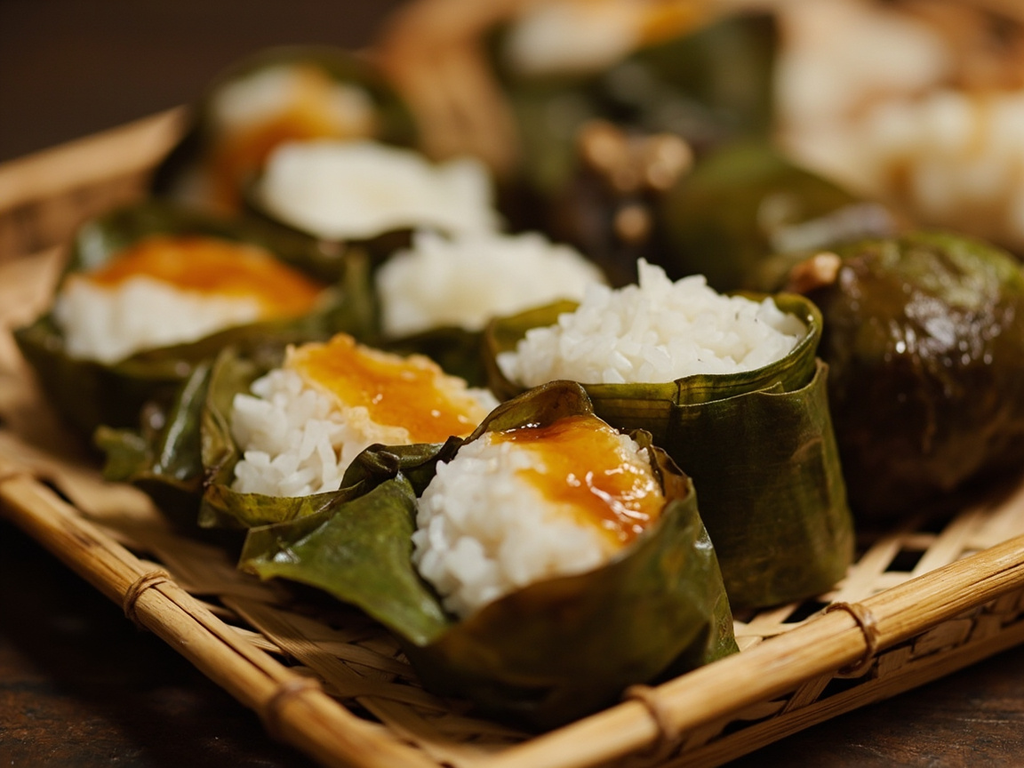
Sticky rice slowly cooked in coconut milk with a little salt, wrapped into tight cylinders in coconut or palm leaves, then steamed. Compact and naturally sweet from the coconut, it is the travel ration of Visayan sailors and warriors.
Before boarding the *balangay*, each warrior tucks *suman* into his cloth belt. This is the food of the sea — it does not spoil, it does not scatter, and the *gata* of the *niyog* gives you strength to paddle a whole day. My women soak the *malagkit* all night, then cook it in the thick milk until it sticks and shines. They roll it in palm leaves, tight as a warrior's wrist. We also place some before the *anito* of the sea so that they guide our prows.
- •Malagkit (glutinous rice) — Several handfuls, soaked overnight (Base)
- •Gata (coconut milk, thick first press) — The milk of several coconuts (Richness, cooking)
- •Sea salt — A small pinch (Enhancer)
- •Coconut or nipa palm leaves — Several long leaves (Wrap)
Suman sa Gata
Sticky rice slowly cooked in coconut milk with a little salt, wrapped into tight cylinders in coconut or palm leaves, then steamed. Compact and naturally sweet from the coconut, it is the travel ration of Visayan sailors and warriors.
Why this dish? Lapu-Lapu's warriors sailed between islands on their *balangay*. *Suman* — sticky rice cooked in coconut milk and wrapped in palm leaves — was the ideal travel ration: compact, nourishing, keeping for several days without fire. It was also taken as offerings to the *anito* before battles.
Before boarding the *balangay*, each warrior tucks *suman* into his cloth belt. This is the food of the sea — it does not spoil, it does not scatter, and the *gata* of the *niyog* gives you strength to paddle a whole day. My women soak the *malagkit* all night, then cook it in the thick milk until it sticks and shines. They roll it in palm leaves, tight as a warrior's wrist. We also place some before the *anito* of the sea so that they guide our prows.
Ingredients (period version)
- Malagkit (glutinous rice) — Several handfuls, soaked overnight (Base)
- Gata (coconut milk, thick first press) — The milk of several coconuts (Richness, cooking)
- Sea salt — A small pinch (Enhancer)
- Coconut or nipa palm leaves — Several long leaves (Wrap)
Ingredients
- Glutinous rice — 400 g (Base)
- Coconut milk (thick, canned or fresh) — 400 ml (Richness, cooking)
- Coconut sugar or brown sugar — 60 g (Sweetness (compensates for lower natural sugar in commercial coconut milk))
- Salt — ½ tsp (Enhancer)
- Banana leaves (easier to find) — 8 to 10 pieces, 20 x 15 cm (Wrap)
Method
- Soak the glutinous rice in cold water for at least 4 hours (ideally overnight). Drain.
- In a saucepan, combine the drained glutinous rice, coconut milk, sugar and salt. Cook over medium heat, stirring constantly, for 15 to 20 minutes, until the rice has absorbed the liquid and becomes sticky and translucent.
- Soften the banana leaves by briefly passing them over a flame or microwaving (30 seconds).
- Place 2 to 3 tablespoons of the coconut rice in the center of each leaf. Roll into a tight cylinder and fold in the ends. Tie if necessary.
- Steam for 30 minutes in a steamer basket or couscoussier.
- Let cool slightly before unrolling. *Suman* keeps for 2 to 3 days at room temperature.
How it was made : *Suman* is attested in pre-colonial Philippines as travel food and ritual offering. The Visayans prepared several varieties of *kakanin* (rice cakes) for animist rituals (*pagdiwata*) and maritime expeditions. Glutinous rice (*malagkit*) was cultivated specifically for these preparations, distinct from everyday rice.
The contemporary twist : Serve the *suman* sliced into rounds on a plate, drizzled with *latik* (caramelized coconut cream) and a pinch of flaky sea salt — a reminder of the maritime origin of this warrior ration.
Sources : William Henry Scott, Barangay: Sixteenth-Century Philippine Culture and Society (1994) — Visayan food and rituals · Doreen Fernandez, Tikim: Essays on Philippine Food and Culture (1994) — kakanin and glutinous rice
Lapu-Lapu · Charactorium