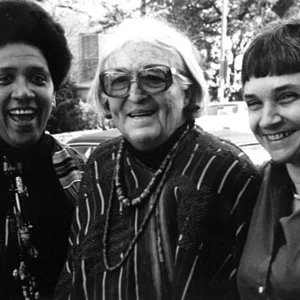

An American writer, playwright, and activist, Larry Kramer was a major figure in the fight against AIDS. He co-founded the organizations Gay Men's Health Crisis (1982) and then ACT UP (1987), pioneers in mobilizing against the epidemic and advocating for the rights of the sick.
Larry Kramer(1935 — 2020)
Larry Kramer
États-Unis
6 min read
Frequently asked questions
Key Facts
- Born in 1935 in Bridgeport (Connecticut), died in 2020 in New York.
- Nominated in 1970 for his film adaptation of the novel “Women in Love” by D. H. Lawrence.
- Co-founded the Gay Men's Health Crisis in 1982, the first major organization helping people with AIDS.
- Founded ACT UP in 1987, an activist movement using direct action against the inaction of public authorities in the face of AIDS.
- Author of the autobiographical play “The Normal Heart” (1985), denouncing the passivity shown toward the epidemic.
Works & Achievements
Adaptation of D. H. Lawrence's novel, which earned Kramer a nomination for the Academy Award for Best Adapted Screenplay, revealing his talent as a writer.
A controversial satire of gay life in New York, which made Kramer a critical and unsettling voice within his own community.
The first major organization helping AIDS patients in the United States, a model of community solidarity.
A manifesto-style article denouncing the inaction in the face of the epidemic, which became a founding text of the movement.
A largely autobiographical drama about the early days of the epidemic, one of the major theatrical works about AIDS.
A direct-action movement that transformed the fight against AIDS and gave patients a voice in health policy.
A sequel to “The Normal Heart,” a finalist for the Pulitzer Prize, exploring the memory and illness of the author's stand-in character.
A vast two-volume novelistic fresco on homosexuality throughout American history, the work of a lifetime.
Anecdotes
In 1978, Larry Kramer published a novel titled *Faggots*, a biting satire of gay life in New York. The book caused a scandal even within the gay community itself: it was even pulled from the shelves of New York's main gay bookstore. Kramer found himself isolated, but he never gave up saying what he thought.
On March 11, 1983, Kramer published a long article in a gay newspaper with a shocking title: “1,112 and Counting.” In it he listed those who had died of AIDS and accused the authorities of letting the sick die. This cry of alarm became a founding text of the mobilization against the epidemic.
In 1987, furious at the government's inaction, Kramer founded ACT UP. The movement's slogan, “Silence = Death,” paired with a pink triangle, became world-famous. The activists organized spectacular demonstrations, such as the occupation of the headquarters of the U.S. Food and Drug Administration (FDA) in 1988.
Kramer was himself HIV-positive and lived with hepatitis B, which destroyed his liver. In 2001, he received a liver transplant, something some considered impossible for a patient with HIV at the time. He survived nearly twenty more years, continuing to write and to campaign.
His uncompromising stance earned him many enemies, even among his allies: he was pushed out of Gay Men's Health Crisis, the very organization he had co-founded in 1982, which he judged too moderate for his taste. For Kramer, anger was a legitimate political weapon in the face of an emergency.
Primary Sources
If this article doesn't scare the shit out of you, we're in real trouble. If this article doesn't rouse you to anger, fury, rage, and action, gay men may have no future on this earth.
I belong to a culture that includes Proust, Henry James, Tchaikovsky, Cole Porter, Plato, Socrates, Aristotle... I am not concerned that all of these gay men provided so much... I am proud of it.
A satirical novel depicting gay male life in New York and on Fire Island in the late 1970s, denouncing reckless escapism and the absence of lasting love.
Kramer asks his audience how many of them will still be alive in five years, then calls on them to take direct action against governmental inaction.
Key Places
Larry Kramer's hometown, where he was born in 1935 into a middle-class Jewish family.
The heart of New York gay life and of the AIDS epidemic, where Kramer lived, wrote, and waged his activist battles.
The institution where Kramer studied; ill at ease with himself, he attempted suicide there, before later funding a center for gay and lesbian studies on its campus.
A summer resort for the gay community, the setting of his novel “Faggots” and a symbol of a carefree era swept away by the epidemic.
The U.S. drug agency, occupied by ACT UP activists in 1988 to demand faster access to treatments.
A community center in Greenwich Village where Kramer delivered the 1987 speech that gave birth to ACT UP.
Typical Objects

The tool of the writer and pamphleteer, on which Kramer wrote his novels, plays, and militant essays. Writing was his main weapon.

A poster with a pink triangle on a black background, the graphic emblem of ACT UP. It denounced the deadly silence of the authorities in the face of the epidemic.

A loop of red ribbon worn as a sign of solidarity with people living with AIDS, which became an international symbol of the fight against the disease.

A board held up during ACT UP's headline-grabbing actions, bearing slogans and the names of the sick. A central tool of nonviolent civil disobedience.

The first antiretroviral approved against AIDS in 1987, at first scarce and very costly. Access to it was at the heart of the battles waged by ACT UP.

A stage text, such as that of “The Normal Heart,” blending intimate emotion and political struggle to reach the general public.
School Curriculum
Vocabulary & Tags
Key Vocabulary
Tags
Daily Life
Morning
Kramer often began his days by reading the press, hunting for news of the epidemic and the death tolls. A disciplined writer, he devoted his mornings to writing, seated at his typewriter and later his computer.
Afternoon
His afternoons were paced by activist meetings, phone calls, and the planning of actions. He drafted open letters and blistering opinion pieces aimed at newspapers and political leaders.
Evening
In the evening, he frequented New York theaters and literary circles, or met up with his partner David Webster. Evenings could also turn into fiery activist gatherings.
Food
Living in the urban New York of the late twentieth century, Kramer shared the diet of an American intellectual of his time. His liver transplant in 2001 then forced him to closely monitor his diet and his health.
Clothing
Far from the activist in fatigues, Kramer dressed soberly, like a Manhattan city-dweller: shirts, jackets, and classic outfits. At demonstrations, he might sport slogan T-shirts and the pink triangle of ACT UP.
Housing
He spent most of his life in Manhattan apartments, notably near Greenwich Village, the iconic neighborhood of New York's gay and artistic life.
Historical Timeline
Period Vocabulary
Liens externes & ressources
Références
Œuvres
Women in Love (scénario)
1969
Faggots (roman)
1978
Cofondation de Gay Men's Health Crisis
1982
1,112 and Counting (essai)
1983
The Normal Heart (pièce)
1985
Fondation d'ACT UP
1987
The Destiny of Me (pièce)
1992