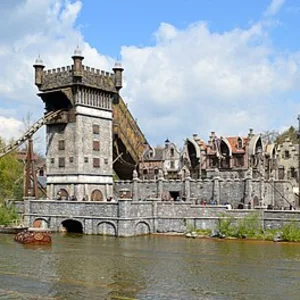

The Flying Dutchman is a legendary ghost ship doomed to wander the seas forever, never able to make port. Born from the maritime folklore of the great European voyages of exploration, it has become a universal symbol of curse and damnation. The legend has inspired operas, novels, and films.
The Flying Dutchman
De Vliegende Hollander
7 min read
Frequently asked questions
Key Facts
- The legend was born from the folklore of European sailors during the era of the great shipping companies (17th–18th centuries)
- The first known written mention dates to the late 18th century, in British travel accounts (around 1790)
- The ship is said to be doomed to round the Cape of Good Hope forever without ever reaching it
- Sighting the ghost ship was believed to be an ill omen foretelling a shipwreck
- Richard Wagner drew from it the opera Der fliegende Holländer (The Flying Dutchman) in 1843
Works & Achievements
Narrative poem that evokes the ghost ship and helps spread the legend through British literature.
Story that invents what became the central theme: the captain's redemption through the faithful love of a woman.
Maritime adventure novel centered on Philip Vanderdecken, son of the cursed captain, which anchors the family name in the legend.
Romantic opera that established the legend on the international stage and made it a major artistic myth.
British film that adapts the legend to the screen and revives its popularity in the 20th century.
Blockbuster film that reinvents the Flying Dutchman as a monstrous ship commanded by Captain Davy Jones.
Anecdotes
The future King George V of England, then a young naval cadet, recorded the sighting of the Flying Dutchman in the log of HMS Bacchante on 11 July 1881, off the coast of Australia: “At 4 a.m. the Flying Dutchman crossed our bows.” Thirteen people are said to have seen it, and the sailor who had reported it from the crow's nest died shortly afterward, falling from a mast.
The earliest known printed mention of the legend appears at the end of the 18th century in British travel accounts, notably that of George Barrington in 1795, who reports sailors' belief in a ghostly vessel haunting the Cape of Good Hope and heralding the coming storm.
A very real captain of the Dutch East India Company, Bernard Fokke, was so renowned for the speed of his crossings to Java that his contemporaries suspected him of having made a pact with the devil. His sulfurous reputation fed into the figure of the cursed captain of the Flying Dutchman.
In 1843, the composer Richard Wagner turned the legend into an opera: his cursed captain can only be delivered by the faithful love of a woman. Wagner borrowed this theme of redemption from the German writer Heinrich Heine, who had imagined it about a decade earlier.
The legend was born on one of the most feared sea routes in the world: the Cape of Good Hope, first named the “Cape of Storms” by the Portuguese. Sailors of the age of sail faced storms there so violent that many ships returning from the Indies vanished with all hands.
Primary Sources
The weather was so dreadful that the sailors claimed to catch sight of the Flying Dutchman. Common belief holds that this ship went down in the storm off the Cape and that it is doomed to tack to and fro forever.
It is said that a Dutch warship was lost off the Cape of Good Hope, perishing with all hands; its spectre sometimes appears to sailors, and its apparition is held to foretell the storm.
The captain is doomed to wander the sea until Judgment Day, unless a woman stays faithful to him until death; every seven years he may come ashore to seek this deliverance.
At 4 a.m. the Flying Dutchman crossed our bows. A strange red light, like that of a phantom ship all aglow, in the midst of which the masts, spars, and sails of a brig two hundred yards distant stood out in sharp relief.
Key Places
Southern tip of Africa, nicknamed the “Cape of Storms,” an unavoidable passage for VOC ships heading to the Indies. It is the legendary setting for the eternal wandering of the Flying Dutchman.
Home port of the VOC and the heart of Dutch maritime power in the 17th century, the departure point for the great expeditions to the East Indies from which the ships of the legend set sail.
A waystation founded by the VOC in 1652 at the foot of Table Mountain. Ships would put in here to resupply before or after the dreaded crossing of the southern seas.
Saxon city where Richard Wagner premiered his opera Der fliegende Holländer in 1843, transforming a sailors' superstition into a great European Romantic myth.
Off the coast of Australia, between Melbourne and Sydney, the site of the spectre's sighting recorded in 1881 in the logbook of HMS Bacchante.
Typical Objects

The spectral vessel itself, doomed to roam the seas without ever making landfall. It is said to appear in the storm, sails billowing and beating into the wind against all logic.

A strange red light said to envelop the cursed ship and let witnesses recognize it from afar, as recorded in the log of HMS Bacchante. Sighting it is taken as an omen of misfortune.

A lantern fixed to the stern or the masts to light the deck and mark the ship at night. On the cursed vessel, its pallid glow becomes a supernatural sign.

A bell that marks the watches and the rhythm of the crew's life aboard. In the legend, it is heard ringing on its own in the fog, announcing the passing of the specter.

According to legend, the cursed crew hails passing ships to entrust them with letters addressed to loved ones long since dead. Accepting them is said to bring misfortune upon the ship.

A compass pointing north, an instrument indispensable for rounding the Cape of Good Hope. On the damned ship, it is said to spin wildly, never letting the vessel reach a port.
School Curriculum
Vocabulary & Tags
Key Vocabulary
Daily Life
Morning
On the Flying Dutchman, there is no true morning: the cursed ship wanders endlessly through fog and storm, never seeing the sun rise over a harbor. On the real VOC vessels that inspired the legend, the dawn watch began with scouring the deck with holystone and checking the rigging.
Afternoon
The ghostly crew forever works sails that lead it nowhere, struggling against a wind that is always against them. On the real East India ships, the afternoon was spent pumping out the bilge water, repairing ropes and canvas, and fixing the ship's position with compass and astrolabe.
Evening
In the evening, legend has it that the bell rings of its own accord and the red glow of the specter appears to terrified sailors. Aboard the ships of the period, when night fell the lanterns were lit, the watches were changed, and the crew listened to tales of ghosts that haunted the southern seas.
Food
According to legend, the damned crew no longer eats, condemned to eternal hunger and thirst. On the real ships of the 17th century, the everyday fare consisted of ship's biscuit, salted meat and fish, dried peas, and beer, often spoiled after a few weeks at sea.
Clothing
The cursed captain is often depicted in the dark garb of a sailor of the Grand Siècle, a broad-brimmed hat and a long coat lashed by the spray. The VOC sailors wore short jackets of coarse canvas, baggy trousers, and caps, clothing that stood up to salt and wind.
Housing
The captain's dwelling is his very ship, a floating prison he can never leave. On the East India vessels, the crew slept crammed into hammocks on the lower decks, while the captain occupied a narrow cabin at the stern.
Historical Timeline
Period Vocabulary
Liens externes & ressources
Références
Œuvres
Rokeby (Walter Scott)
1813
Mémoires de M. de Schnabelewopski (Heinrich Heine)
1834
The Phantom Ship (Frederick Marryat)
1839