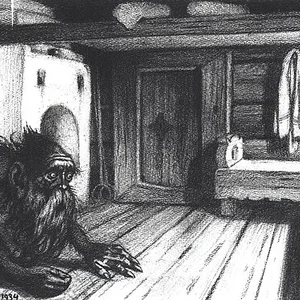

A legendary creature of Aztec mythology, the Ahuizotl is an aquatic monster resembling a small dog, with smooth black fur and a grasping hand at the tip of its tail. Lurking in lakes and ponds, it lures and drowns its victims to devour their eyes, teeth, and nails.
Ahuizotl(1450 — 1502)
Ahuitzotl
6 min read
Frequently asked questions
Key Facts
- Described in detail in the Florentine Codex of Bernardino de Sahagún (c. 1540-1585), a major source on Aztec beliefs
- Its name in Nahuatl (āhuitzotl) means “water dog” or “spiny water creature”
- Depicted as a small black-furred animal with a hand at the tip of its tail, living in the waters of the Basin of Mexico
- According to belief, its drowned victims were honored by the rain god Tlaloc and joined his paradise, the Tlalocan
- The 8th tlatoani of Tenochtitlan, Ahuitzotl (reigned 1486-1502), bears the name of this legendary creature
Works & Achievements
The most complete and most frequently cited description of the ahuitzotl, gathered by Sahagún from Nahua informants. The reference source for the entire mythology of the creature.
Monument commemorating the enlargement of the great temple under Tizoc and Ahuitzotl. It bears the emperor's name-glyph, that is, the image of the creature.
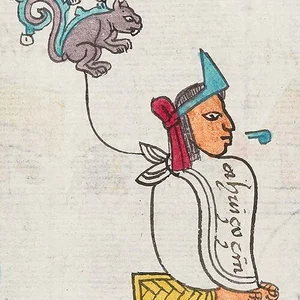
Post-conquest pictographic manuscript in which the glyph of Ahuitzotl depicts the little aquatic beast with the hand-tipped tail, fixing its iconography.
The first major Nahuatl-Spanish dictionary, which records "auitzotl" and attests to the spread of the word and the creature within the language.
Illustrated colonial manuscript recounting the lineage of the rulers, including Ahuitzotl, and reproducing his glyph inspired by the monster.
Anecdotes
The creature's name was given to the eighth emperor of Tenochtitlan, Ahuitzotl, who reigned from 1486 to 1502. Said to be as ferocious as the monster whose name he bore, he had the Templo Mayor enlarged. In the codices, the glyph that records his name depicts that very small aquatic beast.
According to the Franciscan friar Bernardino de Sahagún, who gathered Nahua accounts in the 16th century, the Ahuizotl drowned its prey and then devoured only their eyes, teeth, and nails. The bodies floated back to the surface intact but stripped of these three parts: that was the signature of the attack.
To lure fishermen, the Ahuizotl made fish and frogs rise to the surface, like easy prey. It was also said to imitate a child's crying from among the reeds; the curious soul who came closer was seized by the hand at the tip of its tail and dragged to the bottom.
Far from being cursed, drowning victims were thought to have been chosen by Tlaloc, the god of rain. They were not cremated like other dead: they were buried with the body adorned, for it was believed they reached Tlalocan, the god's green and watery paradise.
Because death by water was sacred, only the priests had the right to recover the body of an Ahuizotl's victim. The family received honors instead of mourning a mere drowning, a sign that the deceased had been called by the gods of the waters.
Primary Sources
There is in this land an animal that lives in the water, never seen anywhere else, which is called ahuitzotl. It is the size of a small dog, with short, smooth fur, small pointed ears, a black and very glossy body, and at the end of its tail it bears a hand like that of a person.
From those it has drowned, it eats the eyes, the teeth, and the nails; the body bears no other wound and floats back to the surface.
Auitzotl: a certain water animal.
The ruler's anthroponymic glyph depicts the small aquatic creature whose tail ends in a hand, read “Ahuitzotl”.
Key Places
Large brackish lake in the Valley of Mexico that surrounded Tenochtitlan. Its waters and whirlpools were the supposed domain of the Ahuizotl.
Aztec capital built on islands in the lake and crisscrossed by canals. The constant proximity of water fed the fear of the creature.
Great double pyramid of Tenochtitlan, one of whose shrines was dedicated to Tlaloc. It was ceremonially enlarged under Emperor Ahuitzotl in 1487.
The lush, watery paradise of the god Tlaloc, where the drowned and victims of water were believed to go. A place of abundance, flowers, and eternal waters, sometimes associated with Mount Tlaloc.
An area of chinampas (floating gardens) and canals in the south of the Valley of Mexico, still visible today. Its still waters embody the kind of setting where legend placed the Ahuizotl.
Typical Objects

At the tip of its tail, the Ahuizotl bears a hand of human appearance. It uses this hand to grab its victims and drag them to the bottom of the water.

A dugout or reed canoe used to travel across the lakes and canals of the Valley of Mexico. Fishermen who strayed too far from shore were thought to fall prey to the Ahuizotl.

Fishing implements woven from plant fibers, found everywhere along the shores of Lake Texcoco. Legend held that the Ahuizotl made the fish rise to the surface to better lure those who handled them.

Jars, copal incense, and green stones laid out for the god of rain and waters. Those who died by drowning were linked to him, considered to belong to Tlaloc.

Those who died in the water were buried with a dry staff in their hands. It was believed that in Tlalocan the staff would turn green again and grow leaves, a sign of the deceased's new life.

A pictographic sign depicting the aquatic creature whose tail ends in a hand. It was used to write the emperor's name in the codices and on monuments.
School Curriculum
Vocabulary & Tags
Key Vocabulary
Tags
Daily Life
Morning
Lurking at the bottom of springs and canals at dawn, the Ahuizotl watches for the slightest ripple. Invisible beneath the surface, it observes the fishermen pushing their canoes across the still-misty lake.
Afternoon
When the sun warms the shores, it draws fish and frogs up to the surface to lure the careless. Its tail-hand then bursts from the water to seize an ankle and drag the victim down to the depths.
Evening
At dusk, it is said to mimic the cries of a child from among the reeds. The passerby who approaches to rescue the child is snatched underwater and never resurfaces.
Food
It feeds only on the eyes, teeth, and nails of its drowned victims. The rest of the body, without any visible wound, is abandoned and floats back up to the surface.
Clothing
The creature wears no clothing: its body is covered in short, glossy black fur, as if oiled. Its small pointed ears and its tail tipped with a human hand make it instantly recognizable.
Housing
It dwells in the depths of the lakes, springs, and submerged caves of the Valley of Mexico. Tradition gives it a fondness for the darkest waters and the whirlpools.
Historical Timeline
Period Vocabulary
Liens externes & ressources
Références
Œuvres
Codex de Florence, Livre XI (Historia general de las cosas de Nueva España)
vers 1577
Pierre de dédicace du Templo Mayor
1487
Codex Mendoza
vers 1542
Vocabulario en lengua castellana y mexicana, Alonso de Molina
1571
Codex Telleriano-Remensis
vers 1563