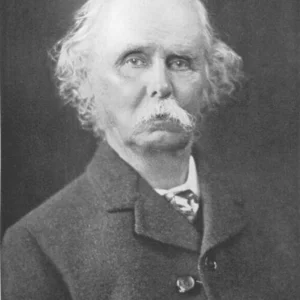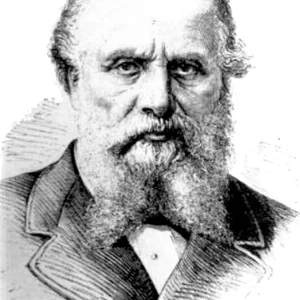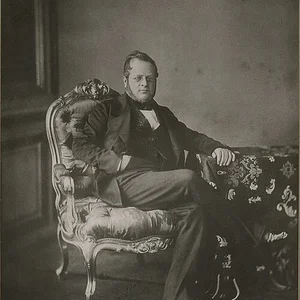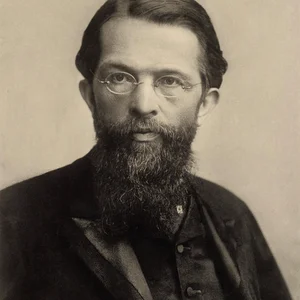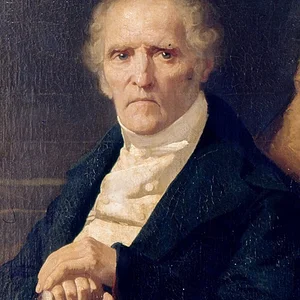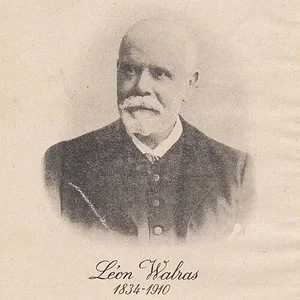

Léon Walras (1834-1910) was a French economist and founder of the Lausanne School. He is one of the fathers of the neoclassical approach and developed the theory of general equilibrium, described using mathematical tools.
Léon Walras(1834 — 1910)
Léon Walras
France
5 min read
Frequently asked questions
Key Facts
- Born in 1834 in Évreux and died in 1910 in Clarens (Switzerland).
- Appointed professor of political economy at the Academy of Lausanne in 1870.
- Published the 'Elements of Pure Political Economy' starting in 1874, setting out the theory of general equilibrium.
- Developed, independently of Jevons and Menger, the theory of marginal utility (the marginalist revolution of the 1870s).
- Founder of the Lausanne School, continued by Vilfredo Pareto.
Works & Achievements
A major work by Walras, setting out the theory of general equilibrium and the application of mathematics to economics. It is regarded as one of the founding texts of neoclassical economics.
A model describing how, across all interdependent markets, supply and demand reach equilibrium simultaneously. It is Walras's most famous contribution.
The mechanism by which prices adjust gradually until equilibrium is reached, illustrated by the image of the auctioneer. A central concept in his analysis of markets.
A collection devoted to the distribution of wealth and to questions of social justice, including the nationalization of land. It reveals the reformist dimension of Walras's thought.
A set of texts applying his theories to money, credit, and production. It complements the “pure” dimension of his work.
A school of economic thought born from his teaching and carried on by Vilfredo Pareto. It left a lasting mark on mathematical economics.
Anecdotes
Léon Walras initially failed the entrance exam for the École Polytechnique twice because of his weaknesses in mathematics, even though he would later become one of the pioneers of mathematical economics. He then taught himself the mathematical tools that would make him famous.
Before becoming an economist, Walras tried several careers: he was a journalist, a railway clerk, and even a novelist, publishing a novel that went unnoticed. It was his father, an economist himself, who finally steered him toward political economy.
In 1870, Walras obtained a chair in political economy at the University of Lausanne, in Switzerland, because no French university wanted his ideas, which were considered too mathematical and unorthodox. There he founded what is now known as the “Lausanne School.”
Walras came up with the image of the “auctioneer” (the market that adjusts prices through successive trial and error) to explain how supply and demand eventually reach a balance. This metaphor is still taught today in economics courses.
Disappointed never to receive the Nobel Prize (which did not yet exist for economics during his lifetime), Walras considered himself misunderstood. Yet the economist Joseph Schumpeter would later call him “the greatest of all economists.”
Primary Sources
Exchange value is thus a magnitude; and we can already see that mathematics applies to that part of political economy which deals with exchange value.
In matters of the production of useful things, free competition is a principle, or a rule of application, whose limits are easy to determine.
Everyone knows from experience that the price of a commodity rises when demand for it increases and falls when supply grows.
Key Places
Town in Normandy where Léon Walras was born in 1834. His father was the headmaster of a local secondary school there.
Walras attempted his studies here, failed the entrance exam to the École Polytechnique, and held various jobs before turning to economics. The French capital remained hostile to his mathematical ideas.
Walras obtained his chair of political economy here in 1870 and developed his entire body of work at the university. It was here that he founded the Lausanne School.
Swiss town on the shore of Lake Geneva where Walras spent his final years and died in 1910.
Typical Objects

Walras wrote his treatises and his abundant correspondence with a quill, like all scholars of the 19th century. His correspondence with other economists was an essential part of his work.

Walras translated market equilibrium into systems of simultaneous equations, the first major application of mathematics to economics. These equations described the balancing of supply and demand.

The Elements of Pure Political Economy is the founding work of general equilibrium theory. Walras reworked it through several successive editions.

The chair of political economy in Lausanne gave Walras the platform that France denied him. It was from there that he spread his ideas and trained his successors.

An indispensable tool for the professor, the blackboard allowed Walras to draw his supply and demand curves in front of his Lausanne students. On it he illustrated the mechanism of price tâtonnement.
School Curriculum
Vocabulary & Tags
Key Vocabulary
Daily Life
Morning
A methodical professor, Walras devoted his mornings to preparing his lectures and writing his treatises. He worked rigorously on his mathematical demonstrations, tirelessly reworking his equations.
Afternoon
The afternoon was often reserved for teaching at the University of Lausanne, where he presented his theories to his students. There he passionately defended the use of mathematics in economics.
Evening
In the evening, Walras maintained a considerable correspondence with economists from all over the world, from Italy to the United States. This correspondence was his main means of making his ideas known and discussed.
Food
Walras led the sober life of an academic in the second half of the 19th century. His diet reflected that of the Swiss and French bourgeoisie of the time, without excess.
Clothing
Like the professors of his time, he wore the dark suit, frock coat, and stiff collar that were de rigueur in the academic world of the 19th century. A formal attire befitting his role as a teacher.
Housing
Walras spent much of his adult life in Switzerland, near Lake Geneva, in the Lausanne region and later in Clarens. There he had the modest but comfortable lodgings of a university professor.
Historical Timeline
Period Vocabulary
Liens externes & ressources
Références
Œuvres
Éléments d'économie politique pure
1874-1877
Théorie de l'équilibre général
1874
Théorie du tâtonnement
1874
Études d'économie sociale
1896
Études d'économie politique appliquée
1898
Fondation de l'école de Lausanne
1870-1892