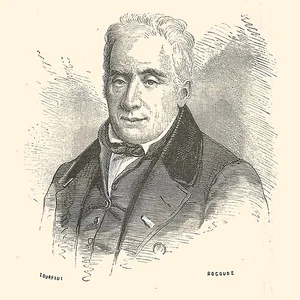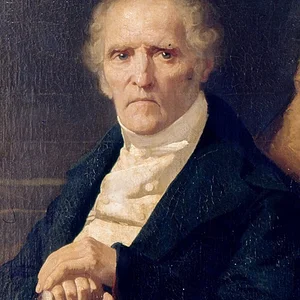

Charles Fourier was a French philosopher and social theorist, one of the leading representatives of utopian socialism. He envisioned a harmonious society organized into self-sufficient communities called phalansteries.
Charles Fourier(1772 — 1837)
Charles Fourier
France
5 min read
Frequently asked questions
Famous Quotes
« Attractions are proportional to destinies.»
Key Facts
- Born in 1772 in Besançon, died in 1837 in Paris.
- Published in 1808 the Theory of the Four Movements and of the General Destinies.
- Conceived the phalanstery, an ideal community bringing together about 1,600 people.
- Coined the term and founded the doctrine of Fourierism, a form of utopian socialism.
- Inspired communal experiments such as the Familistère of Guise (Jean-Baptiste Godin).
Works & Achievements
Fourier's first work, setting out his theory of passionate attraction and his critique of civilization. The cornerstone of his societal thought.
Also known as the Theory of Universal Unity, in it he details the concrete organization of the phalanstery and of attractive labor.
A clearer, more accessible version of his doctrine, intended to convince a broad public to found phalansteries.
A model of a self-sufficient community of 1,600 people living in harmonious association. A central idea that inspired many social experiments in the 19th century.
His last major work, extending his critique of the economic system of “civilization” and his project for social harmony.
Anecdotes
Charles Fourier worked as a mere commercial clerk, a job he deeply detested. It was by observing an apple sold in Paris for far more than in the provinces that he reportedly began to denounce the waste and absurdity of commerce, prompting him to imagine a better-organized society.
Fourier imagined a future world where the seas would turn into lemonade and where “anti-whales” would tow ships. These fanciful prophecies, mixed with serious social ideas, made Fourier seem like a gentle dreamer in the eyes of his contemporaries.
For years, Fourier published a notice claiming that every day at noon he waited at home for a wealthy patron ready to fund his first phalanstery. The benefactor never came, but Fourier kept the appointment faithfully until his death.
That Fourier coined the word “feminism” in its modern sense is not established, but he was one of the first to write that the degree of women's emancipation measured the progress of a society. This idea, daring for 1808, had a lasting influence on social movements.
At his death in 1837, Fourier was found by his landlady, kneeling at the foot of his bed as if in prayer, surrounded by the flower pots he tended with passion in his modest Parisian apartment.
Primary Sources
Social progress and changes from one period to the next come about in proportion to the advance of women toward liberty, and social decadence comes about in proportion to the decrease in the liberty of women.
Passionate attraction is the impulse given by nature prior to any reflection, and persistent despite the opposition of reason, of duty, and of prejudice.
Attractive labor will replace, in the societary order, the forced labor that prevails in civilization, the source of all our miseries.
Key Places
Birthplace of Charles Fourier, where he was born in 1772 into a well-off family of cloth merchants.
Large trading city where Fourier worked as a clerk; he lost his property here during the siege of 1793 under the Reign of Terror.
Capital where Fourier spent his final years, publishing and waiting in vain for a patron to fund his phalansteries; he died here in 1837.
Town near Rambouillet where his disciples attempted in 1833 to found a first experimental phalanstery, which failed for lack of funds.
Typical Objects

Fourier tirelessly filled notebooks with his teeming theories, blending calculations, tables and cosmic visions. Much of it remained unpublished during his lifetime.

Architectural drawing of a vast communal palace meant to house around 1,600 people living in association. This plan gave concrete form to Fourier's social utopia.

A working tool of Fourier the clerk, in which prices and transactions were recorded. It was by handling them that he forged his critique of commercial waste.

Fourier passionately cultivated flowers in his modest Parisian lodging, seeing in them a reflection of the natural harmony he sought for society.

Published anonymously in 1808, this first work set out Fourier's system for the first time. Little read at the time, it became a key reference of utopian socialism.
School Curriculum
Vocabulary & Tags
Key Vocabulary
Daily Life
Morning
A trade clerk for much of his life, Fourier rose early to take his place behind counters and in warehouses. Once free of commerce, he devoted his mornings to the methodical writing of his theories.
Afternoon
In the afternoon he carried on with his painstaking calculations and the drafting of his tables of the human passions. In **Paris**, he waited every day at noon for the wealthy patron supposed to fund his phalanstery.
Evening
In the evening, Fourier led a solitary and frugal life, reading and watering his flowers. A methodical and somewhat fussy man, he loved order and regularity.
Food
Fourier lived simply and modestly, keeping the table of a man of small means. Though hungry for theories, he nonetheless imagined for the future a “gastrosophy,” a science of good eating that would reconcile pleasure and health.
Clothing
He wore the plain, middle-class dress of clerks and minor employees of the early **19th century**: a frock coat, waistcoat and cotton shirt, with no concern for elegance.
Housing
A bachelor all his life, Fourier lodged in modest furnished apartments, notably in **Paris**, which he brightened with carefully tended flowerpots.
Historical Timeline
Period Vocabulary
Liens externes & ressources
Références
Œuvres
Théorie des quatre mouvements et des destinées générales
1808
Traité de l'association domestique-agricole
1822
Le Nouveau Monde industriel et sociétaire
1829
Concept du phalanstère
1822
La fausse industrie
1835