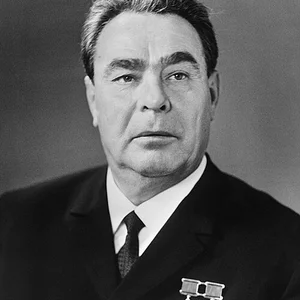

Soviet statesman, General Secretary of the Communist Party of the Soviet Union from 1964 to 1982. His long rule, which followed Khrushchev's, is associated with the “stagnation” of the USSR and with the détente and subsequent renewed tensions of the Cold War.
Leonid Brezhnev(1906 — 1982)
Leonid Brezhnev
Union soviétique
6 min read
Frequently asked questions
Key Facts
- 1964: comes to power as General Secretary of the CPSU after the ousting of Khrushchev
- 1968: sends Warsaw Pact troops to crush the Prague Spring (Brezhnev Doctrine of limited sovereignty)
- 1972-1979: policy of détente with the United States (SALT I and SALT II agreements)
- 1979: orders the Soviet military intervention in Afghanistan
- 1982: dies in office, leaving a USSR in economic stagnation
Works & Achievements
Principle asserting the USSR's right to intervene in socialist countries that threatened to leave the bloc. It justified the crushing of the Prague Spring.
The first major strategic arms limitation agreements with the United States. They marked the height of the policy of Détente.
Final Act recognizing post-war European borders and committing the signatories to human rights. A provision that would turn against the USSR.
New fundamental law of the USSR, known as the “Brezhnev Constitution,” enshrining the leading role of the Communist Party.
Second arms limitation agreement signed with Carter. It was never ratified by the U.S. Senate following the invasion of Afghanistan.
Official memoirs glorifying Brezhnev's role, widely distributed and awarded prizes. A central tool of his cult of personality.
Anecdotes
Brezhnev loved Western luxury cars and owned an impressive collection: a Rolls-Royce, a Mercedes, a Cadillac, and a Maserati, often gifts from foreign leaders. It is said that he sometimes drove himself at high speed through the streets of Moscow, much to the dismay of his bodyguards.
Over the years, Brezhnev had himself decorated with a considerable number of medals. He was awarded the title of Hero of the Soviet Union four times and, in 1978, granted himself the Order of Victory, the highest military distinction — which prompted quiet mockery, given how modest his actual military achievements had been.
Brezhnev's “fraternal kiss” was dreaded by Communist leaders: he kissed his counterparts on the mouth as a sign of socialist friendship. His kiss with East German leader Erich Honecker in 1979 became an iconic image, later reproduced as a mural on a surviving section of the Berlin Wall.
In the final years of his life, Brezhnev's declining health was visible on television: slurred speech, slow gestures, dependence on sedatives. Soviet citizens privately mocked him through countless jokes — a sign that the official cult of the leader no longer convinced anyone.
In 1968, Brezhnev justified the crushing of the Prague Spring with a doctrine that bore his name: the “limited sovereignty” of socialist countries. According to him, the USSR had the right to intervene militarily whenever a Bloc country threatened to leave the Communist camp.
Primary Sources
When forces hostile to socialism try to turn the development of a socialist country toward capitalism, this becomes not only a problem of the country concerned, but a common problem for all socialist countries.
The participating States respect human rights and fundamental freedoms, including the freedom of thought, conscience, religion or belief, for all without distinction.
The Parties undertake to limit launchers of intercontinental ballistic missiles, launchers of submarine-launched ballistic missiles, and heavy bombers.
The Small Land has remained forever in my heart. There, on that strip of land soaked in blood, we forged our victory.
Key Places
Industrial city where Brezhnev was born in 1906 into a working-class family. It was renamed Dniprodzerzhynsk during the Soviet era.
Seat of Soviet power where Brezhnev carried out his duties as General Secretary. This is where the great decisions of the Politburo were made.
Site of the great military parades that Brezhnev reviewed from Lenin's Mausoleum. A showcase of Soviet might.
Capital where, in 1975, Brezhnev signed the Final Act of the Conference on Security and Cooperation in Europe, a summit of Détente.
Burial place of Brezhnev after his death in 1982, among the most honored Soviet leaders, behind Lenin's Mausoleum.
Typical Objects

Brezhnev amassed dozens of decorations, including four titles of Hero of the Soviet Union and the Order of Victory. His chest covered in medals became the symbol of his cult of personality.

Document attesting membership in the CPSU, the single party that ruled the USSR. Holding this card was a precondition for any career in the administration and the army.

Brezhnev was passionate about foreign automobiles (Rolls-Royce, Mercedes, Cadillac), often gifts from foreign leaders. They contrasted with the official egalitarian rhetoric.

Nuclear weapons capable of striking the other continent, at the heart of the arms race and the SALT negotiations. The balance of terror rested on these rockets.

From the top of Lenin's Mausoleum, Brezhnev reviewed the military parades of May Day and the 7th of November. This tribune embodied the hierarchy of Soviet power.

Document setting the economic objectives of the USSR over five years, managed by Gosplan. Under Brezhnev, these plans increasingly struggled to meet their targets, a sign of the “stagnation.”
School Curriculum
Vocabulary & Tags
Key Vocabulary
Daily Life
Morning
Brezhnev started his day late and at an increasingly slow pace as he aged and grew ill. He was driven to the Kremlin in an official limousine, surrounded by guards and doctors. The Politburo meetings, over which he presided, took up most of the morning.
Afternoon
The afternoon was devoted to audiences with Party officials, foreign policy files, and receptions for foreign leaders. Brezhnev delegated a great deal, especially in his final years, when his concentration was fading. He also liked to slip away to hunt in the reserves set aside for dignitaries.
Evening
In the evening, Brezhnev enjoyed films, hunting parties and games of dominoes, or long conversations with his close circle. He spent more and more time at his dachas, vast state residences. His use of sedatives and sleeping pills marked his evenings in his final years.
Food
The food of the Soviet leaders was plentiful and refined, in stark contrast to the shortages of everyday Soviet life. It included caviar, game, vodka and Armenian cognac, of which Brezhnev was fond. His doctors tried in vain to curb his excesses of food and tobacco.
Clothing
In public, Brezhnev wore dark Western-cut suits, covered with medals during ceremonies. In winter, he sported the large fur hat (*ushanka*) and a thick overcoat during the parades on Red Square. His well-kept wardrobe displayed the status of the nomenklatura.
Housing
Brezhnev had an official apartment in Moscow and several luxurious dachas reserved for the top leaders. These state residences, staffed and equipped with private hunting grounds and every comfort, were out of reach for the ordinary citizen. They symbolized the privileges of the nomenklatura.
Historical Timeline
Period Vocabulary
Liens externes & ressources
Références
Œuvres
Doctrine Brejnev (souveraineté limitée)
1968
Accords SALT I et traité ABM
1972
Accords d'Helsinki
1975
Constitution soviétique de 1977
1977
Traité SALT II
1979
Trilogie de mémoires (La Petite Terre, La Renaissance, Les Terres vierges)
1978