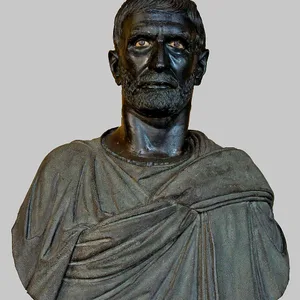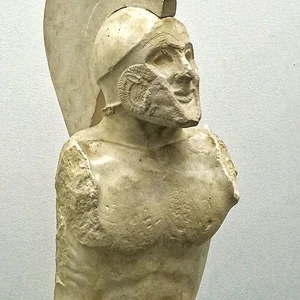

Leonidas I was king of Sparta in the 5th century BC. A member of the Agiad dynasty, he commanded the Greek coalition at the Battle of Thermopylae against the Persian army of Xerxes I in 480 BC. His heroic resistance and death in battle made him a lasting symbol of patriotic sacrifice.
Leonidas
Leonidas I of Sparta
Sparte
6 min read
Frequently asked questions
Famous Quotes
« Come and take them (Molon labe)»
Key Facts
- Becomes king of Sparta around 490 BC as a member of the Agiad dynasty
- Commands the Greek coalition at the Battle of Thermopylae in 480 BC
- Holds out with about 300 Spartans and their allies against the immense army of Xerxes I
- Dies in battle at Thermopylae in 480 BC, outflanked through the treachery of Ephialtes
- Becomes an emblematic symbol of courage and sacrifice for one's homeland
Works & Achievements
For three days, Leonidas and a handful of men held back the immense army of Xerxes, inflicting heavy losses on the Persians and delaying their advance.
As king of Sparta, Leonidas was given command of the Greek forces tasked with defending northern Greece against the Persian invasion.
After the mountain path was betrayed, he sent away most of the allies and stayed to fight to the death to cover their retreat, turning a defeat into a symbol.
Through his obedience to the laws of Sparta even unto sacrifice, Leonidas embodied the values of *agōgē* (military upbringing) and discipline that defined his city.
His fight was immortalized by the poet Simonides of Ceos, whose verses carved at Thermopylae fixed the legend for the centuries to come.
Anecdotes
According to Herodotus, when the Persians demanded that the Greeks surrender their weapons, Leonidas is said to have replied with two words that became legendary: “Molon labe” — “Come and take them.” This defiant phrase remains a symbol of resistance even today.
Before the battle, a Spartan worried that the Persian arrows were so numerous they would blot out the sun. The warrior Dienekes is said to have laughed and retorted: “So much the better, we shall fight in the shade.” Herodotus reports this reply as the finest of the entire war.
Leonidas led only 300 Spartans to Thermopylae, carefully chosen from among men who already had a living son, so that no bloodline would die out. In all, several thousand allied Greeks fought at his side.
When the treachery of Ephialtes allowed the Persians to outflank the pass by a mountain path, Leonidas sent most of the Greek contingents away to save them, but stayed with his Spartans, his Thespians, and his Thebans to cover the retreat and keep his word.
After the battle, Xerxes had Leonidas's body beheaded and his head displayed on a stake — a treatment the Persians rarely inflicted, a sign of the fury the Greek resistance had provoked. Forty years later, the Spartans repatriated his bones and raised a tomb in his honor.
Primary Sources
The Lacedaemonians fought in a memorable fashion... they showed that they were men who knew how to fight against people who did not.
Go tell the Spartans, stranger passing by, that here, obedient to their laws, we lie.
Leonidas, having gathered his companions, urged them to prove themselves worthy of Sparta and to take their morning meal like men who would dine that night in Hades.
When someone told him that the enemy were near, Leonidas replied: “And we too are near them.”
Key Places
City-state of the Peloponnese, of which **Leonidas** was one of two kings. A militarized society where every citizen was trained for combat from childhood.
A narrow coastal passage between mountain and sea in central Greece, whose name means “Hot Gates” because of its thermal springs. It was here that **Leonidas** fought his final battle.
The great sanctuary of Apollo where the Greeks consulted the oracle. Before the battle, the Pythia is said to have predicted that **Sparta** would be saved by the death of one of its kings.
A funerary monument erected in **Sparta** to honor **Leonidas**, where his bones were repatriated about forty years after his death.
A city both rival and ally of **Sparta** within the Hellenic League. Its fleet and that of the coalition fought at Artemisium while **Leonidas** held **Thermopylae**.
Typical Objects

Large circular shield made of wood covered in bronze, carried on the left arm. In phalanx formation, each hoplite protected his neighbor, forming a defensive wall.

Ash-wood spear about two to three meters long, the hoplite's main weapon. Its iron tip was used to attack, its bronze butt-spike to finish off an enemy or to plant it in the ground.

Straight double-edged iron sword, used when the spear was broken or the fighting too tight. The Spartans preferred theirs especially short.

Cast bronze helmet covering the entire face, with slits for the eyes and a nose guard. Often adorned with a horsehair crest marking the warrior's rank.

Bronze armor (or reinforced linen) protecting the torso, completed by molded shin guards called greaves. The whole load weighed around twenty kilos.

Wool cape dyed red, the distinctive garment of Spartan soldiers. The color, it is said, concealed the blood of wounds and symbolized belonging to the military elite.
School Curriculum
Vocabulary & Tags
Key Vocabulary
Daily Life
Morning
A king but a soldier above all, Leonidas began his day like every Spartan with physical exercise and weapons training. The morning was structured around military drills and overseeing the *agōgē*, the education of the young boys.
Afternoon
The afternoon might be devoted to royal duties: presiding over certain religious rites, dispensing justice, or directing military affairs alongside the other king and the ephors. Sparta indeed had two kings who shared power.
Evening
In the evening, Leonidas took his meal at the *syssitia*, the common mess where all the citizen-soldiers ate together, with no privilege for the king. These communal meals reinforced equality and solidarity among the warriors.
Food
The Spartan diet was deliberately frugal and austere. The emblematic dish was the “black broth,” a soup of pork, blood, vinegar, and salt, so notoriously unappetizing that foreigners found it inedible.
Clothing
In times of peace, Leonidas wore the simple woolen cloak (*himation*), without ostentatious luxury, a sign of Spartan austerity. In battle, he donned the full armor of the hoplite and the distinctive red cape of the soldiers of Sparta.
Housing
Even as king, he lived in a modest dwelling, for Sparta forbade the display of wealth. Houses had to be built with rudimentary tools, and the city, lacking great ramparts, boasted that its walls were its warriors.
Historical Timeline
Period Vocabulary
Liens externes & ressources
Références
Œuvres
Défense du défilé des Thermopyles
480 av. J.-C.
Direction de la coalition hellénique terrestre
481-480 av. J.-C.
Sacrifice volontaire et arrière-garde
480 av. J.-C.
Modèle de l'idéal spartiate
Ve siècle av. J.-C.
Mémoire commémorée par l'épitaphe de Simonide
Ve siècle av. J.-C.