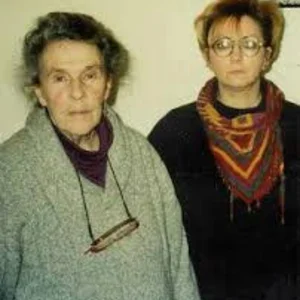

British painter, sculptor and writer who became a naturalized Mexican citizen, and a major figure of Surrealism. Once linked to Max Ernst, she developed a dreamlike universe peopled with fantastical creatures and esoteric symbols, and was one of the last living representatives of the Surrealist movement.
Frequently asked questions
Key Facts
- Born in 1917 in England into a bourgeois family whose conventions she rejected
- Met Max Ernst in 1937 and joined the Surrealist circle in Paris
- Fled Europe during the Second World War and settled in Mexico in 1942
- Published the memoir 'Down Below' (1943), an account of her psychiatric internment
- Died in 2011 in Mexico City, the last great surviving figure of historical Surrealism
Works & Achievements
An iconic painting in which she depicts herself between a hyena and a rocking horse, beneath a white horse leaping through the window. A declaration of freedom and artistic identity.
A collection of Surrealist tales with a preface by Max Ernst, revealing her talent as a writer with a singular fantastical imagination.
A harrowing autobiographical account of her psychiatric confinement, a rare document on madness experienced from the inside.
A large mural created for the National Museum of Anthropology in Mexico City, blending Maya mythology with Surrealist imagery.
A cult novel featuring an old woman in a fantastical retirement home, which became a classic of feminist and Surrealist literature.
A canvas representative of her dreamlike world, peopled with hybrid figures and child-creatures bathed in an unreal light.
A series of monumental bronze sculptures installed along Mexico City's grand avenue, cementing her stature as a national figure.
Anecdotes
Born into a wealthy Lancashire family, Leonora Carrington was expelled from several Catholic boarding schools for her rebellious nature. Her father, a textile industrialist, fiercely opposed her artistic calling, but her mother gave her a book about Surrealism that changed her life.
In 1937, at just 20 years old, she met the German painter **Max Ernst**, 26 years her senior, and went to live with him in France. Their romance was shattered by the Second World War: Ernst, regarded as an “enemy alien,” was interned several times.
After Ernst's arrest in **1940**, Leonora plunged into a severe mental breakdown and was committed to an asylum in Santander, Spain, where she endured brutal treatment. She would recount this traumatic experience in her memoir *Down Below*.
To escape war-torn Europe, she entered into a marriage of convenience with the Mexican diplomat **Renato Leduc**, which allowed her to reach Mexico in **1942**. She would remain there for nearly all her life and become a central figure in Mexican art.
In Mexico, she formed a deep friendship with the Spanish painter **Remedios Varo**. The two women shared a passion for alchemy, magic, and esotericism, which they infused into their canvases peopled with hybrid creatures and mysterious rituals.
Primary Sources
I must relive this experience, because, by doing so, I believe I can be useful to others, as much as to myself.
When Carmella gave me the hearing trumpet, she perhaps did not suspect the consequences this object would have.
Self-portrait: stories where horses and hyenas move through a world half dream, half nightmare.
Key Places
Industrial region of northern England where Leonora Carrington was born in 1917 into a wealthy textile family. Her childhood unfolded in a grand manor steeped in Celtic legends told by her mother and her Irish nanny.
Village in southern France where she lived with Max Ernst in the late 1930s. There they decorated their house with sculptures and frescoes, in a creative happiness shattered by the war.
City in northern Spain where Carrington was committed to a psychiatric clinic in 1940 after her breakdown. This traumatic ordeal would later fuel her memoir “Down Below.”
Capital of Mexico where she settled in 1942 and spent nearly all of her life. There she became a major figure of Mexican art and created her most important works.
Capital of Surrealism where she frequented the circle of André Breton, Picasso, Miró and Dalí in the late 1930s. It was there that she came into her own as a young artist of the movement.
Typical Objects

The fundamental tools of her work as a painter, with which she composed her tempera and oil canvases peopled with fantastical creatures. Her meticulous technique recalls the Flemish Primitives.

An old object used as a hearing aid, which became the title and central element of her most famous novel. For Carrington, it symbolizes listening to a hidden and wondrous world.

The white horse runs through her entire body of work as a double of herself and a symbol of freedom and metamorphosis. It appears as early as her famous youthful self-portrait.

Carrington drew on alchemy, the Kabbalah, and Celtic traditions to enrich her paintings with esoteric symbols. These references turn her canvases into riddles to be deciphered.

In her final decades, she created bronze sculptures depicting hybrid creatures and fantastical figures. Several now adorn the Paseo de la Reforma in Mexico City.

Cooking and its utensils appear often in her world, associated with domestic magic and feminine alchemy. For her, cooking became an almost ritual act of transformation.
School Curriculum
Vocabulary & Tags
Key Vocabulary
Tags
Daily Life
Morning
Leonora often began her days early in her house on Chihuahua Street in Mexico City, surrounded by cats and unusual objects. She would make tea and write down the dreams she'd had during the night, the primary source of her inspiration.
Afternoon
Afternoons were devoted to painting in her cluttered studio, where she worked with painstaking patience in tempera. She sometimes welcomed her fellow exiled artists, such as Remedios Varo, to discuss art and esotericism.
Evening
In the evening, she read works on alchemy, Celtic mythology, or the Kabbalah, or wrote tales and novels. Cooking also held a ritual place in her domestic life.
Food
Carrington enjoyed preparing dishes that were sometimes strange, seeing cooking as a form of alchemy. Tea, inherited from her English childhood, remained a ritual drink, blended with the flavors of the Mexican cuisine that surrounded her.
Clothing
She adopted a bohemian and understated look, far from the conventions of the high society she came from. Loose, practical clothing suited her work as a painter and sculptor in the studio.
Housing
She lived for decades in a modest house in the Roma district of Mexico City, transformed into a magical world peopled with canvases, sculptures, and cats. This home is today a museum dedicated to her work.
Historical Timeline
Period Vocabulary
Liens externes & ressources
Références
Œuvres
The House of Fear (La Maison de la peur)
1938
Down Below (En bas)
1943
The Hearing Trumpet (Le Cornet acoustique)
1974
And Then We Saw the Daughter of the Minotaur
1953